Galvanized steel pipe price quotes vary by up to 22% — but is it just raw material costs, or are factors like galvanized steel coil quality, coating thickness, ASTM/EN compliance, and corrosion-resistant pipes certification driving the gap? As a leading structural steel manufacturer & exporter from China, Hongteng Fengda helps procurement professionals, project managers, and technical evaluators cut through pricing noise. Whether you’re sourcing galvanized steel pipe for roofing, A36 steel plate for framing, or 316 Stainless steel pipe for harsh environments, our transparent quoting reflects real-world variables — not markup guesswork. Discover what truly impacts your total cost of ownership.
Why Do Galvanized Pipe Quotes Differ by 22% — And What’s Really Behind It?
A 22% variance in galvanized steel pipe quotations isn’t random — it’s rooted in measurable technical and operational variables. While base steel prices fluctuate daily (±5–8% month-on-month), the remaining 14–17% spread stems from specification-driven decisions made during procurement. These include zinc coating weight (e.g., 275 g/m² vs. 600 g/m²), substrate grade (Q235 vs. Q355), dimensional tolerance class (EN 10219 Class C vs. Class B), and post-galvanizing treatments like passivation or chromating.
Hongteng Fengda’s quoting process isolates these variables transparently: every quote includes a breakdown of raw material cost, galvanizing process type (hot-dip vs. pre-galvanized coil), coating verification method (gravimetric test per ASTM A123), and third-party inspection scope (SGS/BV/CCIC). This eliminates ambiguity — especially critical for buyers managing multi-site infrastructure projects across North America and the Middle East where corrosion resistance standards differ significantly.
For example, a 6-inch SCH40 galvanized pipe quoted at $1,280/ton vs. $1,560/ton may reflect differences in minimum coating thickness (45 µm vs. 85 µm), batch traceability (lot-level EN 10240 certification), or weld seam testing (100% ultrasonic vs. spot radiography). Without this clarity, procurement teams risk over-specifying — or worse, under-specifying — with long-term lifecycle cost implications.
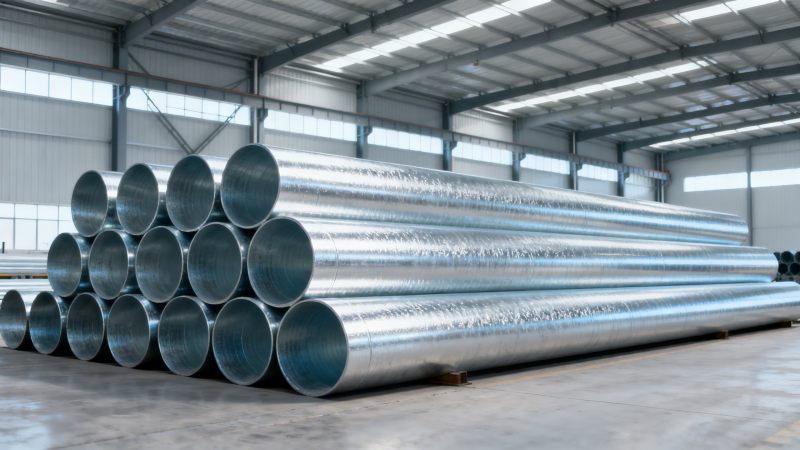
How Coating Thickness & Substrate Quality Drive Real Cost Differences
Zinc coating thickness directly correlates with service life in aggressive environments. Per ASTM A123, standard hot-dip galvanizing requires ≥85 µm on steel >6 mm thick — yet many budget suppliers quote based on minimum 45 µm coatings that fail accelerated salt-spray tests after 300 hours (vs. 1,000+ hours for compliant layers). That discrepancy translates into premature replacement cycles: field data shows 2–4x higher maintenance frequency for substandard coatings in coastal or industrial zones.
Substrate steel quality matters equally. Low-cost coils often use recycled content with inconsistent phosphorus/sulfur ratios, increasing brittleness and reducing weld integrity. At Hongteng Fengda, all galvanized pipe substrates meet GB/T 700 Q235B or Q355B with full mill test reports (MTRs), and coating adhesion is verified via cross-cut and bend tests per ISO 2047. We also offer dual-certified pipe — e.g., ASTM A53 + EN 10255 — for global EPC contractors needing parallel compliance.
This table illustrates how layered specifications compound cost — but also deliver verifiable value. The “Premium Option” adds ~12% to base price yet extends field service life by 3–5 years in chemical plant applications, reducing total cost of ownership (TCO) by 18–22% over a 15-year asset lifecycle.
When Does 316 Stainless Steel Pipe Make Economic Sense?
While galvanized carbon steel dominates general construction, environments demanding superior corrosion resistance shift the economic calculus. In petroleum refineries, food processing lines, or nuclear support systems, chloride-induced pitting and stress corrosion cracking render even high-grade galvanized pipe unsuitable beyond 3–5 years. Here, 316 Stainless steel pipe becomes a TCO-optimized choice — not a premium luxury.
With molybdenum content (2–3%), 316 stainless delivers significant improvements in corrosion resistance, high-temperature stability, and mechanical properties compared to the base 304 stainless steel tubing. Its performance in saline, acidic, or high-temperature steam environments (up to 870°C intermittent) avoids costly shutdowns — a key consideration for plant managers evaluating downtime ROI. Typical delivery lead time for custom 316 pipe orders is 4–6 weeks, including ASTM A312/A213 certification and hydrostatic testing.
Applications span petroleum, foodstuff, chemical industry, electric power, nuclear, energy, machinery, biotechnology, paper making, shipbuilding, and boiler fields. Wall thickness ranges from 1mm–150mm (SCH10–XXS), outer diameter from 6mm–2500mm (3/8″–100″), and lengths up to 12,000mm — all customizable per project requirements and certified to ASTM, EN, JIS, DIN, GOST, BS, and GB standards.
What Should Procurement & Technical Teams Verify Before Finalizing a Quote?
Before approving any galvanized or stainless pipe quotation, cross-check these five non-negotiable items:
- Coating thickness verification method — gravimetric (ASTM A123) or magnetic (ISO 2178)? Reports must show min/max values per pipe length, not batch averages.
- Substrate mill test report (MTR) grade — confirm it matches your design spec (e.g., Q355B for seismic zones, not just “Q235”).
- Dimensional tolerance class — EN 10219 Class C allows ±1.5% OD tolerance; Class B restricts to ±0.75%, critical for precision flange alignment.
- Corrosion test documentation — salt-spray (ASTM B117) results ≥1,000 hours for coastal projects; intergranular corrosion (ASTM A262 Practice E) for welded 316 installations.
- Lead time transparency — distinguish between production time (7–15 days), galvanizing cycle (3–5 days), and logistics (10–30 days depending on destination port).
At Hongteng Fengda, every quote includes these five checkpoints as standard — with optional add-ons like laser marking per ASME B31.3, third-party witness testing, or container-load coordination for multi-country deliveries.
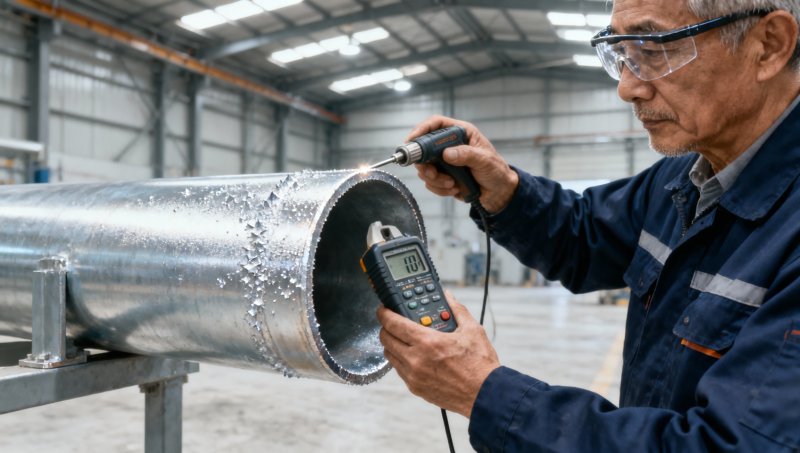
Why Global Buyers Choose Hongteng Fengda for Structural Steel Sourcing
We’re not just a supplier — we’re your structural steel partner across the entire project lifecycle. With ISO 9001-certified facilities, 120,000+ tons annual capacity, and dedicated engineering support, we help you:
- Reduce sourcing risk: Fixed-price contracts locked for 90 days, backed by 100% L/C acceptance and 24-hour response SLA.
- Control costs: Free dimensional optimization review — e.g., substituting cold-formed RHS for hot-rolled beams where load paths allow, saving 12–18% material cost.
- Ensure compliance: Pre-shipment audits against ASTM, EN, JIS, and GB standards — no last-minute certification delays.
- Accelerate timelines: 7-day sample turnaround, 3-week prototyping for custom profiles, and FOB Shanghai/ Qingdao with weekly consolidated container departures.
Whether you need angle steel for warehouse racking, channel steel for solar mounting structures, or customized cold-formed components for modular housing — contact us today with your drawings, specs, or application details. Let’s align on parameters, certifications, and delivery windows — before your next RFQ goes out.
Please give us a message


Please enter what you want to find