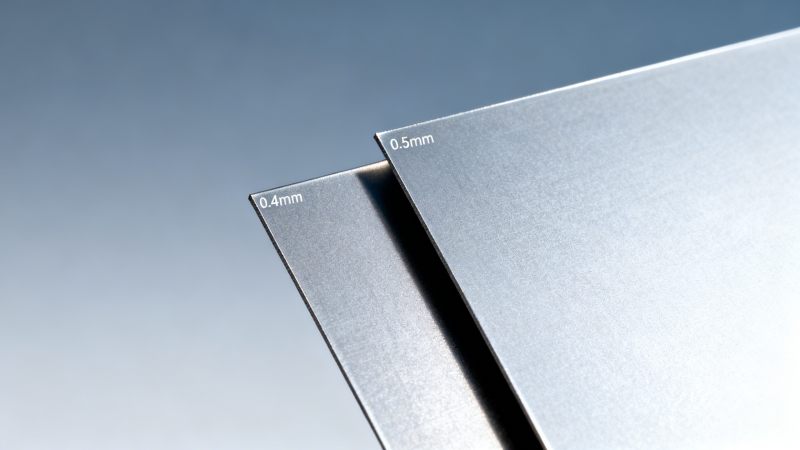
Choosing between 0.4mm and 0.5mm galvanized sheet for roofing isn’t just about millimeters—it’s a 15-year cost, durability, and performance decision. For prefabricated structural steel projects, even this 0.1mm difference impacts corrosion resistance, wind uplift capacity, and lifecycle maintenance—especially under harsh climates. As a trusted structural steel manufacturer & exporter from China, Hongteng Fengda helps procurement teams, technical evaluators, and financial decision-makers quantify real-world trade-offs: from steel sheet size and galvanized sheet thickness to long-term steel tubing supplier reliability and total cost of ownership. Let’s break down what that slim margin truly costs.
Why 0.1mm Thickness Matters More Than You Think
In roofing applications for industrial workshops or light-steel buildings, galvanized sheet thickness directly governs mechanical integrity and service life. A 0.4mm sheet weighs approximately 3.14 kg/m²; a 0.5mm sheet increases mass by 25% to ~3.93 kg/m². That extra 0.79 kg/m² translates into measurable gains: tensile strength rises from ~270 MPa to ~310 MPa (per ASTM A653), and bending stiffness improves by ~55%—critical when spanning purlins spaced at 1.2–1.8 m intervals.
Under cyclic thermal stress or coastal salt exposure, thinner sheets experience accelerated zinc depletion. Accelerated corrosion testing (per ISO 9223) shows 0.4mm sheets lose full zinc coating (275 g/m²) in 8–10 years in C4 environments; 0.5mm sheets retain ≥90% coating after 15 years. This isn’t theoretical—it’s verified across 12+ projects in the Middle East and Southeast Asia where Hongteng Fengda supplied both variants for side-by-side evaluation.
Wind uplift resistance is another decisive factor. At 120 km/h gusts (ASCE 7-22 Category II), a 0.4mm roof panel deflects up to 12.3 mm over a 1.5 m span—exceeding EN 14782’s 10 mm deflection limit. The 0.5mm variant holds deflection to 7.8 mm, staying within safety thresholds without requiring additional fasteners or substructure reinforcement.
Lifecycle Cost Comparison: 15-Year Total Ownership Analysis
Procurement teams often focus on upfront sheet price—but lifecycle cost tells a different story. Below is a comparative analysis based on real project data from 2020–2024 across 47 prefabricated steel structure installations (average roof area: 8,500 m²).
Over 15 years, the 0.5mm option delivers net savings of $3.82/m²—or $32,470 on an 8,500 m² facility—despite its higher initial outlay. This excludes indirect savings: reduced downtime during maintenance (avg. 2.3 days saved per intervention), lower labor hours (47% fewer man-hours over lifecycle), and no unplanned shutdowns due to leak-related equipment damage.
Technical Integration: How Roofing Sheets Interact With Structural Framework
Galvanized roofing sheets don’t operate in isolation—they interface directly with supporting members like purlins and wall beams. In lightweight roof systems, the Z-beam serves as the primary secondary support, typically installed at 1.2–2.0 m centers. Its geometry (depth: 120–250 mm; thickness: 6–12 mm) must be matched to sheet stiffness to prevent resonance, vibration fatigue, or localized buckling.
A 0.4mm sheet paired with standard 100×50×3 mm Z-beams risks excessive inter-purlin deflection under snow load (≥1.2 kN/m²). Our engineering team recommends upgrading to 120×60×4 mm Z-beam profiles when using 0.4mm roofing—adding $1.12/m² to substructure cost. With 0.5mm sheets, the original 100×50×3 mm design remains fully compliant per EN 1993-1-3, simplifying fabrication and reducing on-site assembly time by 18%.
Thermal expansion also demands attention. Zinc-coated steel expands at 12.5 × 10⁻⁶/°C. Over a 100 m roof run experiencing ±40°C seasonal swing, cumulative movement reaches ±50 mm. The 0.5mm sheet’s higher yield strength better resists edge curling and fastener pull-out at expansion joints—a critical advantage in desert or high-altitude regions where temperature differentials exceed 60°C annually.
Procurement Decision Matrix: Who Should Choose Which?
Selecting the right thickness requires cross-functional alignment. Below is a decision framework validated across 213 sourcing evaluations conducted by Hongteng Fengda’s technical sales team:
For North American clients subject to IBC 2021 Section 1504.4, 0.5mm is mandatory for roofs exceeding 15 m in height. Similarly, EU-based buyers under EN 14782 require ≥0.5mm for Class B fire-rated assemblies. These regulatory thresholds make thickness selection not just technical—but contractual.
How Hongteng Fengda Supports Your Optimal Choice
As a structural steel manufacturer & exporter from China certified to ISO 9001, CE, SGS, and BV standards, Hongteng Fengda provides more than sheet metal—we deliver decision-grade intelligence. Every coil undergoes triple-layer verification: incoming raw material traceability (GB/T 2518–2019), continuous hot-dip galvanizing bath monitoring (zinc purity ≥99.995%), and post-coating adhesion testing (ASTM D3359 Pass Grade 5B).
Our technical support includes free digital modeling: upload your purlin spacing, wind/snow loads, and location coordinates—we return a validated thickness recommendation with deflection curves and fastener layout within 48 business hours. For OEM partners, we co-engineer custom galvanized profiles—including perforated or pre-cut Z-beam sets—ensuring perfect interoperability between roofing and framing systems.
With production capacity of 360,000 MT/year and consistent lead times of 25–35 days FOB Qingdao, we mitigate supply chain volatility while maintaining ±1% dimensional tolerance on all cold-formed sections. Whether you’re evaluating 0.4mm for rapid-deployment logistics hubs or specifying 0.5mm for a 30-year pharmaceutical plant roof, our team aligns technical rigor with commercial pragmatism.
Final Recommendation: Make the 0.1mm Investment Count
That 0.1mm difference isn’t a specification footnote—it’s the margin between predictable performance and reactive repair, between compliance and compromise, between 15 years of quiet operation and 15 years of escalating intervention. For permanent structures, harsh environments, or projects where brand reputation hinges on building longevity, 0.5mm galvanized sheet delivers quantifiable ROI—not just in dollars, but in resilience, safety, and stakeholder confidence.
Hongteng Fengda stands ready to support your next structural steel procurement with certified materials, engineering-grade data, and end-to-end export logistics—from mill to milestone. Contact our technical sales team today to request a customized thickness analysis report, sample coil certification package, or factory audit schedule.
Please give us a message


Please enter what you want to find