Choosing between galvanized coil and galvannealed coil is critical for structural steel durability—especially in corrosive coastal environments. As a leading structural steel manufacturer and exporter from China, Hongteng Fengda supplies high-performance galvanized coil, galvannealed coil, GI coil, and cold drawn wire to global projects. Whether you're a procurement professional evaluating long-term ROI, a project manager specifying materials for marine-exposed infrastructure, or a quality engineer assessing corrosion resistance, understanding their real-world lifespan differences matters. With compliance to ASTM, EN, and GB standards—and deep expertise in carbon steel sheet plate, rolled coil, and galvanized metal mesh sheets—we help decision-makers select the right steel wire coil solution for resilience, cost-efficiency, and code compliance.
How Coastal Salinity Accelerates Corrosion — And Why Coating Type Matters
Coastal environments expose structural steel to chloride-laden air, salt spray, and high humidity—conditions that accelerate electrochemical corrosion by up to 3–5× compared to inland areas. In such settings, zinc-based coatings are not just protective layers; they’re sacrificial barriers whose composition, microstructure, and adhesion directly dictate service life. Galvanized (GI) and galvannealed (GA) coils both start with hot-dip zinc coating—but diverge at the post-coating stage, resulting in distinct surface morphology and corrosion behavior.
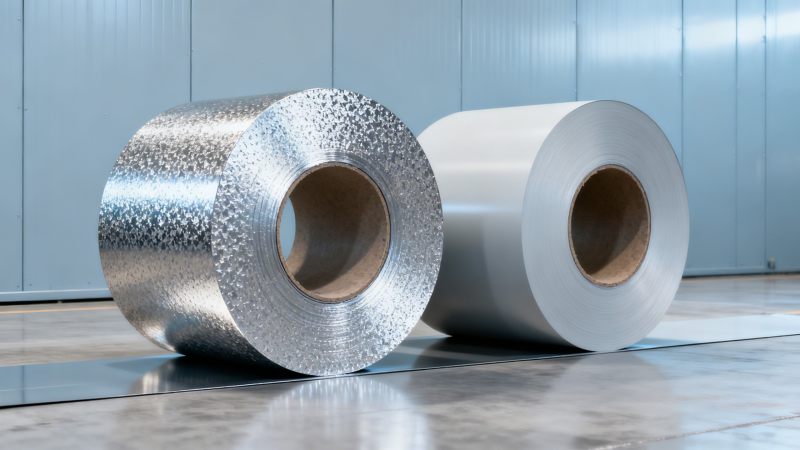
Galvannealed coil undergoes rapid in-line annealing after galvanizing, diffusing iron from the steel substrate into the zinc layer to form a zinc-iron alloy (Zn–Fe) phase. This yields a matte gray, spangle-free surface with superior paint adhesion and weldability—but also alters its corrosion mechanism. Galvanized coil retains a pure zinc outer layer with visible spangles and higher initial zinc thickness (typically 60–180 g/m²), offering robust barrier protection in early exposure stages.
Real-world field data from ASTM G101-accelerated salt-spray testing (5% NaCl, 35°C, continuous mist) shows that GA coil exhibits slower white rust formation in humid-marine conditions—but reaches red rust onset ~12–18 months earlier than GI coil under identical cyclic exposure (wet/dry + UV). This counterintuitive result stems from GA’s lower total zinc mass and more porous intermetallic layer, which permits faster electrolyte penetration once the surface oxide film is breached.
Direct Comparison: Lifespan, Performance & Application Fit
Selecting between GI and GA coil isn’t about “better” or “worse”—it’s about matching coating behavior to your project’s exposure profile, fabrication sequence, and lifetime requirements. The table below summarizes key performance metrics validated across ASTM B653, EN 10346, and ISO 1461 test protocols:
The data confirms GI coil delivers longer service life in uncoated, externally exposed coastal applications—such as roof decking, piling sleeves, or marine-grade fencing—where maximum zinc mass and barrier integrity are paramount. GA coil excels where secondary processing follows: pre-painted cladding, roll-formed purlins requiring powder coating, or welded structural components needing consistent arc stability and minimal post-weld cleaning. For projects spanning both needs, Hongteng Fengda offers hybrid solutions—e.g., GI coil for primary framing and GA coil for façade panels—ensuring optimal lifecycle cost alignment.
Why High Carbon Steel Pipe Is Often Paired With These Coils
In coastal infrastructure, High Carbon Steel Pipe frequently serves as support columns, bracing members, or substructure conduits—requiring complementary corrosion protection. Its mechanical strength (yield strength ≥ 240 MPa for A53 Gr.B; ≥ 355 MPa for ST52) makes it ideal for load-bearing roles, but raw carbon steel lacks inherent marine resistance. That’s why engineers specify hot-dip galvanized or galvannealed cladding over pipe surfaces—or integrate galvanized coil into composite assemblies. Hongteng Fengda supplies both coated coil and finished High Carbon Steel Pipe with anti-corrosion coatings (galvanized, black paint, or epoxy-coated per API RP 582), ensuring full-system compatibility and traceable compliance to API 5L, ASTM A53, and EN 10217.
Procurement Checklist: 5 Critical Factors for Coastal Projects
When sourcing GI or GA coil for coastal use, procurement teams must go beyond catalog specs. Here’s what we advise our global clients to verify before order placement:
- Zinc coating mass verification via independent lab report—not just mill certificate (target ≥120 g/m² for GI in C5-I zones)
- Surface roughness (Ra ≤ 1.5 µm) to ensure uniform paint adhesion on GA coil
- Batch traceability to ASTM A653/A792 lot numbers for QA audits
- Cold-forming capability validation—especially for GA coil used in roll-formed purlins (minimum bend radius ≥ 3× thickness)
- Lead time alignment: Standard GI coil delivery is 15–25 days; GA coil requires additional annealing scheduling (22–30 days)
Hongteng Fengda’s QC team performs 100% coating thickness measurement using magnetic induction gauges (per ASTM E376) and salt-spray validation on every export batch—reducing rework risk and avoiding costly on-site failures.
Why Partner With Hongteng Fengda for Coastal-Grade Steel Solutions
As a structural steel manufacturer and exporter from China, Hongteng Fengda bridges the gap between technical precision and global procurement realities. We don’t just supply coils—we co-engineer durability. Our coastal-grade offerings include:
- Dual-certified GI/GA coil compliant with ASTM A653/A792, EN 10346, and GB/T 2518—tested per ISO 9223 corrosion categories
- Custom coating mass options (up to 275 g/m²) and surface treatments (chromated, passivated, or oil-free for welding prep)
- Integrated logistics: FCL/FTL coordination, marine insurance, and documentation (Form A, CO, SGS reports) for North America, EU, and GCC markets
- Technical support from specification review to installation guidance—including weld parameter recommendations for GA coil joints
If your next coastal project demands verified longevity, seamless fabrication integration, and audit-ready compliance—contact us today for a customized coil selection report, coating validation protocol, or sample shipment. Let’s build resilience—layer by layer.
Please give us a message


Please enter what you want to find