Galvanized Steel Channel vs Stainless Steel Channel: Total Cost of Ownership Analysis for Wastewater Treatment Infrastructure
When selecting structural materials for wastewater treatment infrastructure, the choice between galvanized steel channel and stainless steel channel is rarely about material preference—it’s a capital allocation decision with measurable financial consequences over 20 to 30 years. Upfront price differences—often 2.5× to 4× higher for stainless—mask deeper cost drivers: corrosion degradation rates in chloride-laden atmospheres, maintenance labor frequency, unplanned downtime during repairs, and replacement cycle timing. For procurement leaders overseeing multi-million-dollar infrastructure projects, total cost of ownership (TCO) isn’t theoretical. It’s the difference between budget certainty and recurring CAPEX surprises.
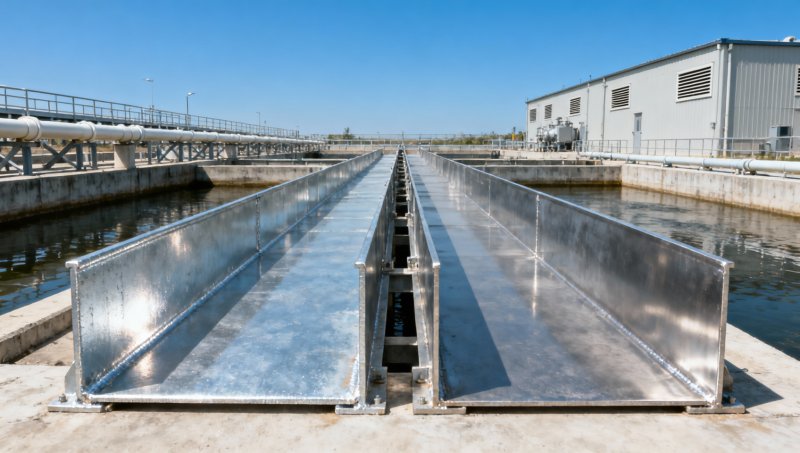
Galvanized steel channel, when properly specified and applied, delivers predictable performance in most above-grade wastewater infrastructure applications—including clarifier support frames, grit chamber enclosures, pipe rack structures, and pump station platforms. Its protection relies on a metallurgically bonded zinc layer that sacrificially corrodes ahead of the base steel. In typical inland or moderately coastal environments—where chloride deposition ranges from 50 to 200 mg/m²/day—the service life of hot-dip galvanized (HDG) channel steel meeting ASTM A123/A153 or EN ISO 1461 standards exceeds 25 years without recoating. Field data from municipal plants in North America and Europe confirms median time-to-first-maintenance at 22–27 years for HDG sections exposed to splash zones and humid, chemically aggressive air.
Stainless steel channel—typically grades 304 or 316—offers superior resistance to pitting and crevice corrosion, but only under specific conditions. Grade 304 begins showing localized attack in environments exceeding 100 ppm chlorides, especially where stagnant moisture accumulates (e.g., bolted connections, welded seams, or shielded under-deck areas). Grade 316 improves resistance due to molybdenum content, yet real-world performance hinges less on alloy composition and more on surface condition, fabrication quality, and post-weld passivation. Unpassivated weld zones in 316 stainless can corrode faster than HDG steel in identical exposure. Moreover, stainless steel’s mechanical strength per unit weight is lower than structural carbon steel: a 200×80×8 mm stainless channel weighs ~22.5 kg/m but delivers only ~210 MPa yield strength, whereas an equivalent galvanized carbon steel channel (same dimensions, Q345 grade) yields ~345 MPa at ~20.1 kg/m—offering better load-bearing efficiency and lower dead load on foundations.
The TCO divergence emerges most sharply in three operational phases: installation, service life, and end-of-life management.
**Installation**: Galvanized channels arrive ready for erection—no field passivation, no surface rework, no risk of weld contamination compromising corrosion resistance. Stainless requires strict handling protocols: plastic film removal only after installation, dedicated stainless tooling, and post-weld acid pickling or electropolishing to restore chromium oxide layer integrity. These steps add 12–18% to installed labor cost and introduce schedule risk if subcontractors lack certified stainless fabrication experience.
**Service life**: Maintenance cost isn’t just about “how often”—it’s about *what* maintenance entails. HDG steel allows visual inspection and targeted repair: localized zinc loss can be restored via zinc-rich paint or thermal spray without system shutdown. Stainless corrosion, once initiated, is rarely localized; it propagates along grain boundaries or under deposits, requiring section replacement. A 2022 audit of 14 U.S. municipal wastewater facilities found that stainless-supported pump stations incurred 3.2× more unscheduled structural interventions over 15 years than comparable HDG installations—primarily due to undetected subsurface pitting beneath insulation or debris accumulation.
**End-of-life**: At decommissioning, galvanized steel retains full recyclability with no separation requirement—the zinc layer volatilizes cleanly in EAF furnaces. Stainless requires sorting by grade and removal of carbon steel attachments; mis-sorted batches depress scrap value by 30–40%. More critically, stainless components often remain in service longer *in name only*: hidden corrosion compromises structural integrity well before visible failure, increasing liability risk during asset transfer or regulatory review.
Critical specification variables—not material category—determine long-term outcome. For galvanized channel, coating thickness (minimum 85 µm for severe environments), base steel grade (Q345 or S355JR preferred over Q235 for higher tensile reserve), and edge coverage (ASTM A123 mandates ≥90% coverage on all edges) are non-negotiable. For stainless, grade selection must match actual chloride exposure—not worst-case assumptions. Grade 316 is over-engineered—and unnecessarily costly—for inland plants with <50 ppm airborne chlorides; duplex 2205 offers marginal benefit only in high-velocity seawater splash zones, not general infrastructure framing.
Hongteng Fengda produces galvanized steel channel to ASTM A123 and EN ISO 1461 specifications using controlled immersion baths and verified coating thickness measurement. Our standard offerings include Q235, Q345, and S355JR base steels with consistent 85–100 µm zinc coatings, validated per ISO 1460. This ensures compliance with U.S. EPA CWA infrastructure guidelines and EU EN 1993-1-1 durability requirements for corrosive environments. For hybrid structural systems requiring both high strength and corrosion resilience, I Shaped Beams in Q345 or S355JR—hot-rolled, galvanized post-fabrication—provide optimized section modulus with predictable corrosion margins.
The decision isn’t “galvanized vs stainless.” It’s whether the application demands stainless-grade corrosion resistance—or whether engineered galvanizing delivers equivalent lifecycle reliability at demonstrably lower TCO. For clarified water tanks, secondary clarifiers, blower enclosures, and most above-grade process structures, galvanized steel channel remains the fiscally responsible standard—not a compromise. Where stainless is justified (e.g., submerged aerator supports, marine-intake grating frames), its value lies in eliminating maintenance access entirely—not in reducing initial procurement cost. Procurement leaders who treat material selection as a line-item price comparison miss the leverage point: durability is a function of specification rigor, not alloy mystique.

Previous page: Already the first one
Next page: Already the last one
Please give us a message


Please enter what you want to find