Galvanized Steel Beam: How to Judge Corrosion Value
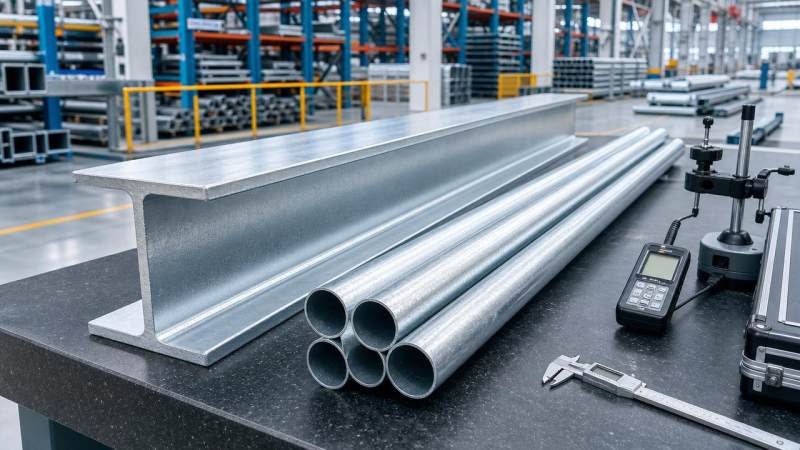
When evaluating a galvanized steel beam for sourcing or project approval, corrosion value is a key cost signal.
It affects service life, maintenance budgets, warranty exposure, and long-term asset reliability.
A lower purchase price can quickly lose value if coating performance is weak.
That is why corrosion assessment should go beyond visual appearance and basic quotations.
In practical procurement, the real question is simple.
How much anti-corrosion value does the galvanized steel beam deliver per dollar spent?
The answer depends on zinc coating weight, base steel quality, process stability, and service conditions.
It also depends on whether the supplier can prove compliance with ASTM, EN, JIS, or GB requirements.
For global projects, this evidence matters as much as the beam itself.
Why Corrosion Value Matters in Purchase Decisions
A galvanized steel beam is often selected to reduce rust risk in exposed structures.
But not every galvanized product creates the same economic return.
Corrosion value means the balance between coating cost and the protection delivered over time.
This becomes more important in coastal zones, industrial plants, transport hubs, and humid storage facilities.
In these environments, early corrosion can lead to repainting, reinforcement, or replacement.
Those hidden costs usually exceed the initial material savings.
From a business standpoint, corrosion value supports three decisions.
- Whether the galvanized steel beam fits the project environment.
- Whether the supplier quote reflects real coating performance.
- Whether long-term ownership cost stays within forecast.
This is also where supplier capability becomes part of product value.
Hongteng Fengda, a structural steel manufacturer and exporter from China, supports global buyers with stable production, customized supply, and standard-based quality control.
That helps reduce sourcing risk when comparing galvanized steel beam options across markets.
Start with the Zinc Coating, Not the Catalog
The first step is checking actual zinc coating data.
A galvanized steel beam gets corrosion resistance mainly from its zinc layer.
If the layer is thin, uneven, or poorly bonded, rust can appear much earlier than expected.
Request measurable values instead of general claims like “good anti-corrosion performance.”
Key coating points to verify
- Average zinc coating weight or thickness.
- Minimum local coating value on critical areas.
- Coating adhesion after forming, handling, or welding exposure.
- Surface consistency at edges, corners, and cut ends.
- Third-party test reports or mill inspection certificates.
Hot-dip galvanizing usually provides stronger long-term protection than lighter coating methods.
Still, performance depends on process control.
Bath chemistry, surface preparation, and cooling conditions all influence corrosion value.
Match the Galvanized Steel Beam to the Service Environment
A galvanized steel beam should never be judged in isolation.
The same coating can perform very differently in different environments.
That is why corrosion value must be tied to use conditions.
Ask these environment questions
- Will the beam face coastal salt exposure?
- Is it near chemical fumes or industrial emissions?
- Will water stay on the surface because of poor drainage?
- Will the beam be enclosed, ventilated, or fully exposed?
- Are there planned cuts, welds, or site modifications?
More aggressive sites need stronger coating specifications and clearer maintenance plans.
This is where many buyers underestimate risk.
They compare galvanized steel beam prices without comparing actual exposure severity.
A slightly higher coating cost can be justified if the structure avoids early repair shutdowns.
Check Standards, Traceability, and Supplier Discipline
Corrosion value is not only a material issue.
It is also a documentation issue.
A qualified galvanized steel beam supplier should provide clear test and traceability records.
Without that, the corrosion claim is difficult to defend internally.
Documents worth requesting
- Mill test certificate for chemical and mechanical properties.
- Coating inspection record with thickness results.
- Standards reference such as ASTM, EN, JIS, or GB.
- Batch traceability for each shipped lot.
- Quality control process for pretreatment and galvanizing.
Reliable exporters usually make this easy.
Hongteng Fengda supplies structural steel products under internationally recognized standards and supports OEM and specification-based orders.
That matters when procurement teams need apples-to-apples comparison across multiple suppliers.
Look Beyond Beams: Cross-Check Related Galvanized Products
A smart sourcing review often looks at related galvanized products too.
Why does that help?
Because a supplier with consistent anti-corrosion capability usually performs well across product categories.
For example, Hot diped-Galvanized Pipe is used in construction, low-pressure fluid transport, petroleum support systems, and industrial frames.
Its anti-corrosion value comes from a hot-dipped or electro galvanized surface layer designed to extend service life.
Available standards include AISI, ASTM, DIN, JIS, GB, SUS, and EN.
Typical supply ranges cover lengths from 1 to 12 meters and thickness from 0.1mm to 300mm.
That type of range suggests process flexibility, which is often useful in beam projects too.
Use a Simple Cost Model to Judge Real Corrosion Value
A galvanized steel beam should be judged on life-cycle cost, not just purchase cost.
This helps turn technical coating data into a decision-ready business comparison.
A practical review model
- Initial material price per ton or per piece.
- Expected coating life under site conditions.
- Inspection and maintenance frequency.
- Probability of repair, downtime, or replacement.
- Internal cost of procurement failure or project delay.
This model often changes the ranking of supplier quotations.
The cheapest galvanized steel beam is not always the most economical option.
A more stable coating system usually creates better total project value.
Common Warning Signs During Supplier Comparison
Several warning signs usually point to weak corrosion value.
- The galvanized steel beam quote is low, but coating details are missing.
- The supplier cannot explain pretreatment or galvanizing controls.
- Test records show average values only, with no minimum points.
- Delivery promises are aggressive, but quality paperwork is incomplete.
- The product is promoted for every environment without qualification.
These are not always deal breakers.
But they should trigger deeper review before approval.
A Better Way to Approve the Right Galvanized Steel Beam
The best purchasing decision combines technical proof with commercial logic.
A galvanized steel beam has strong corrosion value when it meets four conditions.
- The coating is measurable and consistent.
- The beam matches the actual service environment.
- The supplier provides standards-based traceability.
- The total cost outlook is better than low-price alternatives.
In real sourcing work, this approach makes approvals more defensible and outcomes more predictable.
If the goal is reliable long-term value, do not judge a galvanized steel beam by price alone.
Judge it by corrosion performance, evidence quality, and lifetime cost impact.
That is the safer way to reduce procurement risk and select a steel partner with lasting value.
Please give us a message


Please enter what you want to find