When sourcing galvanized steel angle iron, procurement teams need to balance upfront cost with long-term service life. The right choice can reduce maintenance, improve project durability, and lower total ownership costs. For buyers in construction and industrial sectors, understanding how material quality, galvanizing standards, and supplier reliability affect performance is essential to making cost-effective purchasing decisions.
For purchasing managers, the lowest unit price rarely delivers the lowest project cost. A cheaper angle may require earlier replacement, more frequent inspection, or additional surface treatment within 3 to 8 years, especially in coastal, humid, or industrial environments.
By contrast, properly specified galvanized steel angle iron can extend service life to 15, 20, or even 30+ years depending on zinc coating thickness, base steel quality, fabrication accuracy, and site exposure. That difference directly affects maintenance budgets, shutdown risk, and supplier evaluation criteria.
Why Cost vs Service Life Matters in Galvanized Steel Angle Iron Procurement
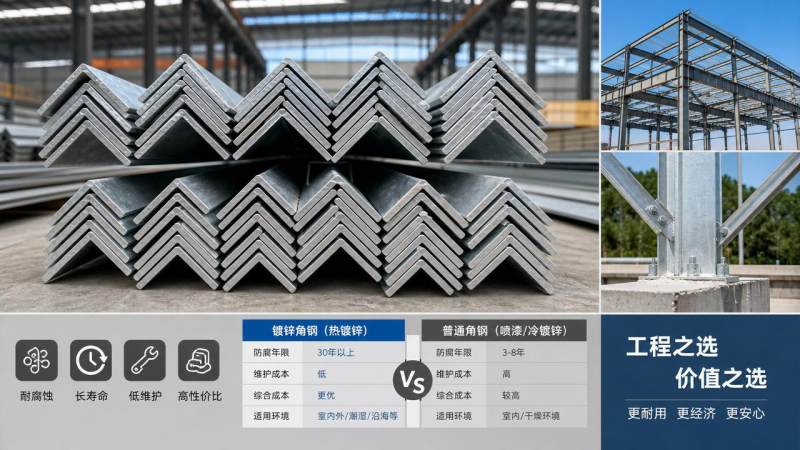
In steel purchasing, cost should be measured across the full use cycle rather than at the quotation stage alone. For galvanized steel angle iron, total ownership cost usually includes 4 core elements: purchase price, fabrication compatibility, transportation efficiency, and maintenance or replacement frequency.
Angle sections are widely used in frames, supports, towers, brackets, rail infrastructure, warehouse structures, fencing systems, and equipment bases. In these applications, corrosion resistance is not a cosmetic feature. It affects load reliability, appearance retention, and the pace of structural degradation over time.
The Main Drivers Behind Long-Term Value
Procurement teams usually compare dimensions, weight, and price per ton first. However, long-term performance often depends on 5 practical factors: steel grade consistency, zinc coating method, coating thickness range, dimensional tolerance, and the supplier’s process control.
- Base steel quality affects forming stability, weldability, and mechanical reliability.
- Hot-dip galvanizing generally provides stronger corrosion resistance than thinner electro-galvanized finishes in outdoor use.
- Uniform coating coverage on corners and edges is critical because angle iron exposes sharp profiles.
- Stable dimensional tolerance reduces fit-up problems during assembly and site installation.
- Reliable batch traceability helps buyers control risk across repeat orders.
Typical Cost Mistakes Buyers Try to Avoid
A common error is selecting a lighter zinc coating for a medium-to-severe corrosion environment to save 3% to 8% on initial cost. That short-term saving can disappear quickly if the installed component needs repainting, repair, or replacement within the first 5 to 10 years.
Another mistake is buying from suppliers that can quote quickly but cannot maintain coating consistency across multiple shipments. For projects with phased delivery over 2 to 6 months, inconsistent quality creates installation delays, reinspection costs, and disputes over compliance.
A Practical Procurement View
For many buyers, the right question is not “Which galvanized steel angle iron is cheapest?” but “Which specification minimizes lifecycle cost under the actual service environment?” That shift in thinking often improves purchasing outcomes more than negotiating a small discount.
The table below shows how procurement decisions often change when buyers move from unit-price comparison to service-life evaluation.
The key takeaway is simple: galvanized steel angle iron should be specified according to environment and service expectations, not only weight and price. Buyers who treat galvanizing as a performance variable usually make more durable purchasing decisions.
How Material, Coating, and Standards Influence Service Life
Service life starts with the combination of substrate quality and protective coating. Even when two suppliers offer the same nominal size, such as 50 x 50 x 5 mm or 75 x 75 x 6 mm, corrosion behavior can differ significantly if the coating process or steel chemistry is inconsistent.
Base Steel Consistency and Fabrication Quality
A stable structural steel substrate helps ensure uniform galvanizing adhesion and reliable section performance. Procurement teams should check dimensional tolerance, straightness, leg equality, edge condition, and surface cleanliness before galvanizing or before shipment if material is supplied finished.
For structural and industrial applications, buyers often request compliance with ASTM, EN, JIS, or GB standards. This matters because standard alignment improves compatibility across drawings, inspections, and downstream fabrication in multinational projects.
Hot-Dip vs Lighter Coating Approaches
In many outdoor projects, hot-dip galvanized steel angle iron offers a better durability profile than lighter electro-galvanized alternatives. The thicker zinc layer acts as a sacrificial barrier and typically performs better under rain exposure, temperature swings, and moderate airborne contaminants.
Buyers should match coating selection to service conditions. A warehouse interior may tolerate a lighter protection level, while marine-adjacent structures, agricultural installations, and chemical plant supports generally require a more robust zinc coating strategy.
Reading Coating Thickness as a Cost Indicator
A thicker zinc layer often increases initial purchase cost, but it may reduce maintenance intervals from every 3 to 5 years to every 8 to 15 years in moderate exposure conditions. That is why coating data should be reviewed together with expected installation life, not separately.
The comparison below helps procurement teams connect specification choices with expected field performance and budgeting logic.
This is why experienced buyers ask for more than a quotation sheet. They request coating details, tolerance information, applicable standards, and inspection records before comparing suppliers side by side.
How Procurement Teams Should Evaluate Suppliers
Supplier evaluation has a direct effect on both cost control and service life. A qualified structural steel manufacturer should offer stable production capacity, documented QC procedures, and the ability to supply standard sections or customized components with repeatable quality across multiple orders.
For global sourcing, buyers usually assess at least 6 areas: manufacturing capability, standards compliance, galvanizing process control, packaging method, delivery lead time, and communication speed on technical issues. Missing just 1 or 2 of these can increase project risk.
Key Questions to Ask Before Ordering
- Which standards can the supplier produce to: ASTM, EN, JIS, GB, or project-specific drawings?
- What are the usual lead times for standard sizes and for customized steel components: 2 to 4 weeks, or longer?
- How is coating thickness checked and recorded across batches?
- What packaging method is used to reduce transport damage and moisture exposure?
- Can the supplier support OEM production and mixed container loading?
Why Manufacturer Support Matters
Hongteng Fengda, as a structural steel manufacturer and exporter from China, focuses on angle steel, channel steel, steel beams, cold formed steel profiles, and customized structural steel components. For buyers managing international projects, this matters because coordinated sourcing can reduce supplier fragmentation and simplify quality follow-up.
With modern manufacturing facilities and strict quality control, suppliers in this category can support procurement teams that require stable output, standard compliance, and dependable lead times for North America, Europe, the Middle East, and Southeast Asia. That consistency helps reduce sourcing uncertainty during phased construction schedules.
A Broader View of Corrosion-Protected Steel Products
Many procurement teams sourcing galvanized steel angle iron also buy related corrosion-resistant steel products for lifting, support, or industrial systems. For example, applications involving cranes, mining, marine work, drilling, or electric line infrastructure may require galvanized rope systems alongside structural sections.
In such cases, buyers may also review Galvanized Steel Wire Rope 1470Mpa to 1960Mpa for projects requiring tensile strength from 1470Mpa to 1960Mpa, diameters from 1.0 mm to 22 mm, and coating options including plain, electro galvanized, and hot dipped galvanized.
That product range covers models such as 6X7+FC, 6X19+IWR, and 8x19S+FC, with applications in elevators, cranes, mining, agriculture, cableways, and marine industries. For procurement teams, the same lifecycle logic applies: match zinc coating thickness and operating condition rather than purchasing only by initial price.
Practical Buying Strategy for Construction and Industrial Projects
A practical sourcing plan for galvanized steel angle iron usually starts with environment classification. Buyers can divide projects into 3 broad categories: dry indoor, general outdoor, and severe corrosion exposure. This simple framework helps narrow coating requirements before RFQs are issued.
Recommended 5-Step Procurement Workflow
- Confirm section size, thickness, length, quantity, and load-related use.
- Define service environment and expected life target, such as 10, 15, or 25 years.
- Request standards, coating details, tolerance limits, and inspection documents.
- Compare quotations using delivered cost plus maintenance implications.
- Approve sample, trial order, or pre-shipment verification before bulk release.
Common Misunderstandings in Price Comparison
Some buyers compare only FOB or EXW price and ignore packing density, bundle weight, or loading efficiency. Yet freight cost per ton can shift depending on section length, destination, and container utilization. In multi-item orders, optimized loading may offset part of a higher product price.
Another misunderstanding is assuming all galvanized steel angle iron performs the same if the dimensions match. In practice, edge coverage, zinc adhesion, and process consistency influence field performance just as much as nominal size does.
What Smart Buyers Prioritize
- Documented compliance with target standards
- Clear coating specification tied to service environment
- Predictable lead times, often 15 to 30 days for standard production windows
- Responsive engineering communication for customized sections or OEM supply
- Quality consistency across repeat shipments and project phases
Final Considerations Before You Place an Order
The best galvanized steel angle iron purchase is rarely the one with the lowest headline quote. It is the one that fits the service environment, meets required standards, arrives on schedule, and performs with fewer maintenance events over the intended operating life.
For procurement teams in construction, industrial manufacturing, infrastructure, and OEM projects, lifecycle thinking leads to better steel decisions. It reduces hidden costs, limits replacement risk, and supports more stable project execution from fabrication through installation.
If you are evaluating galvanized steel angle iron for your next project, Hongteng Fengda can support standard specifications, customized structural steel solutions, and export-oriented supply with dependable quality control. Contact us today to discuss your drawings, target standards, coating requirements, and delivery schedule, or request a tailored quotation for your application.
Please give us a message


Please enter what you want to find