Galvanized sheet or cold rolled steel sheet for outdoor work?
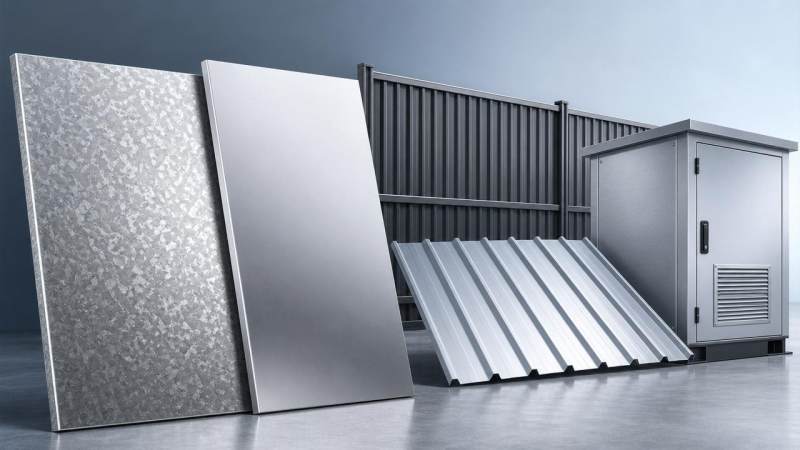
Outdoor fabrication looks simple at first glance, but material choice changes everything.
Between galvanized sheet and cold rolled steel sheet, the better option depends on exposure, finish expectations, forming steps, and total service life.
That is why this question appears so often in steel sourcing and project planning.
In practical outdoor use, corrosion resistance matters just as much as strength or dimensional accuracy.
A bright surface may look ideal at delivery, yet fail early in rain, salt air, or polluted industrial settings.
By contrast, a galvanized sheet may look less refined, but often lasts much longer outside.
The real decision is not which steel is better in general.
It is which one fits the fabrication route and the outdoor environment without creating hidden maintenance cost.
What is the real difference between galvanized sheet and cold rolled steel sheet?
The difference starts with the surface and ends with performance in service.
Cold rolled steel sheet is processed for tighter tolerances, smoother finish, and better surface consistency.
It is often chosen where appearance, precise bending, or painting quality are important.
Galvanized sheet is steel coated with zinc.
That zinc layer protects the base metal from moisture and oxygen, slowing rust formation.
This protection is especially valuable in outdoor fabrication.
Even when the surface gets scratched lightly, zinc can still offer sacrificial protection.
Cold rolled steel sheet does not have that built-in barrier unless it is painted, powder coated, or otherwise treated.
So if the question is purely about outdoor survival, galvanized sheet usually starts with an advantage.
A quick comparison helps clarify the choice
Does galvanized sheet always win in outdoor fabrication?
Not always, but it wins more often than many expect.
For fencing, enclosures, roofing parts, support covers, cabinets, and exposed brackets, galvanized sheet is often the safer starting point.
The reason is simple.
Outdoor components face condensation, rainwater retention, dust, and damaged paint edges.
These are exactly the conditions where unprotected cold rolled steel starts losing value.
Still, there are cases where cold rolled steel sheet remains useful.
If the part will be fully sealed, coated to a controlled standard, and installed in a mild environment, it can perform well.
That is common for housings, decorative outdoor elements, or parts requiring excellent surface flatness before finishing.
So the better question is not whether galvanized sheet is superior in theory.
It is whether the part will remain protected after cutting, welding, drilling, transport, and installation.
What should be checked before making a final material decision?
A useful decision usually comes from four checks, not one.
- Exposure level: inland dry climate, coastal air, chemical splash, or constant humidity.
- Fabrication process: bending radius, stamping depth, welding points, and edge treatment.
- Appearance requirement: visible architectural surface or hidden structural component.
- Maintenance reality: easy repainting schedule or difficult field access.
When these checks are reviewed together, galvanized sheet becomes easier to judge objectively.
For example, a shaped outdoor panel may need a smooth finish, but still benefit from corrosion protection.
In such cases, processing sequence matters as much as material selection.
For heavier fabricated parts, another route may also be considered.
Projects involving machinery structures, construction components, or engineering supports sometimes move beyond thin sheet choices.
A practical reference is Carbon Steel Sheet Plate, available in Q345A(16Mn).
It suits manufacturing plants, construction, cranes, excavators, loaders, and other demanding applications.
With sizes from 3000-11880mm in length, 1500-4000mm in width, and 6-700mm in thickness, it supports broader structural design needs.
Materials aligned with GB, JIS, DIN, ASTM, and EN standards are often easier to integrate into international projects.
Where do people make mistakes when comparing galvanized sheet with cold rolled steel?
One common mistake is comparing only purchase price.
Cold rolled steel sheet may look cheaper at first, but outdoor finishing, repainting, and corrosion repair can quickly change the total cost.
Another mistake is assuming any zinc coating means long life.
Coating thickness, forming damage, storage conditions, and edge exposure all affect service performance.
Welding is another area that gets underestimated.
If galvanized sheet is welded, burned coating zones need suitable post-treatment.
Without that step, local corrosion may begin earlier than expected.
There is also a design mistake that appears often in outdoor steelwork.
Water traps, sharp folds, unsealed lap joints, and rough cut edges can defeat a good material choice.
So galvanized sheet should not be treated as a shortcut around design discipline.
It performs best when material, fabrication, and drainage details are considered together.
A short judgment table for real projects
How do standards, supply consistency, and processing support affect the choice?
This part is often overlooked until production starts.
A material that looks correct on paper may still create issues if thickness tolerance, coating consistency, or lead time is unstable.
For outdoor fabrication, repeatability matters.
That includes coil or sheet quality, documentation, and compatibility with ASTM, EN, JIS, or GB requirements.
Hongteng Fengda works as a structural steel manufacturer and exporter from China with this broader project view in mind.
Beyond angle steel, channels, beams, and cold formed profiles, reliable supply control helps reduce sourcing uncertainty across different steel categories.
That matters when a project mixes exposed sheet parts with customized structural components.
Stable production, quality control, and standard compliance can save more time than a small raw material price difference.
In outdoor fabrication, rework and schedule delays are usually more expensive than expected.
So which one fits outdoor fabrication better in the end?
For most exposed outdoor applications, galvanized sheet is the more dependable choice.
It offers practical corrosion resistance, lower maintenance pressure, and better lifecycle value.
Cold rolled steel sheet still has a place, especially where surface quality and controlled finishing are central.
But it should not be selected for outdoor fabrication without a clear coating and maintenance strategy.
If the environment is aggressive, the design has water traps, or field access is limited, galvanized sheet usually makes the safer decision easier.
A good next step is to list exposure level, appearance target, fabrication steps, and expected maintenance interval side by side.
Then compare galvanized sheet and cold rolled steel sheet against those points, not against price alone.
That approach leads to a material choice that works in production, survives outdoors, and stays cost-effective over time.
Please give us a message


Please enter what you want to find