When choosing electrical raceways for industrial and construction projects, understanding the differences between galvanized conduit pipe and EMT is essential for procurement decisions.
While both are widely used for cable protection, they vary in strength, corrosion resistance, installation method, and cost.
This guide helps buyers compare their key features and select the right option for project performance, compliance, and long-term value.
Which Option Is Better for Procurement: Galvanized Conduit Pipe or EMT?
For procurement teams, the short answer is simple: neither option is universally better.
The right choice depends on project environment, mechanical protection needs, code requirements, labor conditions, and total installed cost rather than material price alone.
In general, galvanized conduit pipe is preferred for heavier-duty applications where strength, threaded connections, and impact resistance matter most.
EMT, or Electrical Metallic Tubing, is usually selected for indoor commercial work where speed of installation, lower weight, and lower upfront cost are priorities.
Buyers searching for galvanized conduit pipe often want a practical comparison they can use for RFQs, technical review, and supplier discussions.
That means the key question is not only what each product is, but where each one creates value and where it creates risk.
Understanding the Basic Difference Between the Two
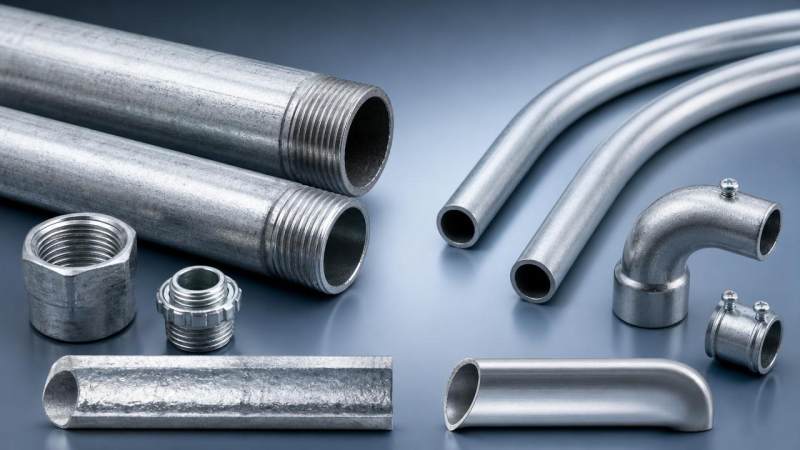
Galvanized conduit pipe usually refers to rigid steel conduit with a zinc-coated surface designed for electrical cable protection in demanding conditions.
It has thicker walls, higher mechanical strength, and often uses threaded ends with couplings for secure and durable installation.
EMT is a thinner-wall steel tubing also used as a metal raceway, but it is not the same as rigid conduit.
It is lighter, easier to bend, and commonly connected with set-screw or compression fittings instead of threaded joints.
Both products can be galvanized for corrosion resistance, which is why they are sometimes confused during sourcing discussions.
However, coating alone does not make them equivalent, because wall thickness, connection method, and load performance differ significantly.
What Procurement Buyers Usually Care About First
Procurement professionals are rarely comparing conduit materials just for technical curiosity.
They are usually balancing compliance, installation efficiency, durability, delivery reliability, and cost control across a project schedule.
The first concern is often whether the raceway meets the applicable standard, specification, and authority requirements in the destination market.
The second concern is total cost, including fittings, threading, labor time, handling, scrap risk, and future maintenance exposure.
The third concern is supplier consistency, because even a technically acceptable product can create project delays if dimensions or coating quality are unstable.
For this reason, a good buying decision compares performance in real project conditions rather than comparing catalog descriptions only.
Strength and Mechanical Protection: Where Galvanized Conduit Pipe Leads
If a project involves exposed runs, industrial facilities, outdoor infrastructure, or areas subject to impact, rigid galvanized conduit usually has a clear advantage.
Its thicker wall provides stronger protection against crushing, accidental contact, and physical abuse during operation or maintenance activities.
This matters in factories, transport terminals, warehouses, utility areas, and heavy commercial installations where raceways are not fully protected by walls or ceilings.
Threaded joints also support more secure connections in demanding environments, reducing the chance of loosening under vibration or repeated servicing.
For buyers, this means galvanized conduit pipe often supports lower long-term risk even if the purchase price is higher than EMT.
In applications where downtime, repair access, or safety exposure is expensive, the stronger product can deliver better lifecycle value.
Installation Speed and Labor Cost: Where EMT Often Wins
EMT is popular because it is easier to transport, cut, and bend on site.
Its lighter weight reduces handling effort, especially in high-volume commercial installations with long interior conduit runs.
Installers can often complete EMT work faster than rigid conduit work, which directly affects labor cost and project schedule performance.
Because EMT does not typically require threading, field installation can be simpler and more efficient when the site environment allows it.
This is one reason many office buildings, schools, retail spaces, and indoor service areas use EMT instead of heavier rigid systems.
For procurement teams, lower material cost plus lower installation labor can make EMT the more economical choice in suitable indoor environments.
Corrosion Resistance: The Comparison Buyers Should Make Carefully
Many buyers assume the corrosion question is easy because both products may be galvanized, but real performance depends on more than surface appearance.
The environment, coating process, installation exposure, cut edges, and maintenance conditions all influence service life.
Galvanized conduit pipe often performs better in harsher settings because its heavier wall gives more tolerance against long-term degradation and abuse.
EMT can perform well in dry indoor conditions, but it may be less suitable in highly corrosive, wet, or mechanically aggressive environments.
Procurement review should therefore consider whether the project includes chemical exposure, coastal air, condensation, washdown procedures, or outdoor service.
A lower-priced raceway can become a costly choice if early corrosion leads to replacement, inspection issues, or compliance concerns.
Standards, Compliance, and Regional Market Expectations
For international buyers, one of the most important distinctions is not just technical performance but code acceptance in the project location.
Different markets and project owners may specify rigid galvanized conduit, EMT, or equivalent products under local or international standards.
North American projects often follow detailed conduit classification rules, while other markets may use local standards or engineer-defined specifications.
Procurement teams should confirm material grade, wall thickness, zinc coating, dimensions, and fitting compatibility before issuing purchase orders.
It is also essential to verify whether the specification requires threaded conduit, impact resistance, or a particular corrosion protection level.
Buying the wrong raceway type can create approval delays, rework, and cost overruns that are far greater than the original price difference.
Total Cost of Ownership Matters More Than Unit Price
Many sourcing decisions start with unit price, but experienced buyers know the better metric is total installed and operating cost.
Galvanized conduit pipe may cost more per ton or per length, yet it can reduce damage risk, maintenance frequency, and replacement needs over time.
EMT may reduce both purchase cost and installation hours, which can be very attractive for large-volume indoor projects with tight schedules.
The correct comparison should include accessories, fittings, labor skill requirements, transport efficiency, site waste, and expected service conditions.
It is also wise to compare lead times, because project savings disappear quickly when delayed deliveries interrupt electrical installation sequencing.
From a procurement perspective, the lowest quote is not always the lowest project cost after execution and service life are considered.
How to Decide Based on Application Scenario
If the project is an indoor commercial building with concealed or protected conduit runs, EMT is often the practical and economical choice.
If the installation is exposed, industrial, outdoor, or subject to impact, rigid galvanized conduit is usually the safer specification.
Where code compliance is strict or the owner has a standard specification, buyers should follow the approved raceway class without substitution risk.
Where lifecycle reliability is more valuable than first cost, the stronger option often provides better procurement value.
Where installation speed and labor availability are major constraints, EMT can offer meaningful savings if the environment is suitable.
The most effective purchasing decisions come from matching product characteristics to site conditions instead of defaulting to one option for every project.
What to Ask Suppliers Before Placing an Order
To avoid sourcing mistakes, buyers should request more than a price list.
They should confirm standard compliance, wall thickness, coating quality, dimensional tolerances, and fitting compatibility for the target market.
It is also important to ask about production capacity, packaging method, export experience, and inspection documentation.
For large or repeat projects, sample approval and third-party verification can reduce risk before mass production begins.
Buyers should also clarify whether the supplier can support custom lengths, bundled accessories, or mixed product shipments for project efficiency.
Reliable manufacturers add value not only through product quality, but through consistency, communication, and delivery control.
Related Material Considerations in Corrosion-Sensitive Projects
In some procurement discussions, buyers comparing conduit systems also review surrounding steel materials used in enclosures, supports, panels, or fabricated components.
When corrosion resistance and forming performance are important, coated steel selection can affect overall system durability and fabrication efficiency.
For example, DX52D Galvalume Steel Coil is a low-carbon steel product designed for cold forming and plastic deformation without fracturing.
Its yield strength does not exceed 260 MPa, tensile strength ranges from 300 to 360 MPa, and elongation after fracture is no less than 28%.
Available sizes include widths from 500 to 1500 mm, thicknesses from 0.12 to 4 mm, and lengths from 100 mm to 12000 mm.
Certified to ISO 9001, SGS, and BV, it offers long-term corrosion resistance that can outperform galvanized coating by two to six times in suitable applications.
For buyers evaluating auxiliary steel components near electrical systems, this kind of material option can support longer service life and efficient fabrication planning.
Common Buying Mistakes When Comparing EMT and Galvanized Conduit Pipe
One common mistake is treating EMT and rigid galvanized conduit as interchangeable because both are steel and both may have zinc protection.
Another is comparing only base material cost without considering fittings, installation method, and long-term operating exposure.
Some buyers also overlook regional compliance rules, assuming a product accepted in one market can be used the same way in another.
Others fail to review packaging and logistics details, which can increase damage, shortages, or loading inefficiency during export shipment.
Technical misunderstandings during RFQ stages often lead to inaccurate quotes and difficult supplier disputes later in the project.
A precise specification and application-based comparison are the best ways to avoid preventable procurement risk.
Final Recommendation for Buyers
When comparing galvanized conduit pipe and EMT, buyers should think in terms of application fit, compliance, and total project value.
Choose galvanized conduit pipe when the project requires stronger mechanical protection, threaded security, and better suitability for demanding conditions.
Choose EMT when the project is primarily indoor, labor efficiency matters, and the environment does not require heavier-duty raceway performance.
The best procurement outcome comes from aligning the raceway type with actual service demands rather than selecting by habit or lowest initial quote.
For global sourcing, work with suppliers that can provide stable quality, clear documentation, and products aligned with ASTM, EN, JIS, or GB requirements.
That approach helps reduce sourcing risk, control total cost, and support reliable project delivery from specification to installation.
Please give us a message


Please enter what you want to find