Galvalume Steel vs Galvanized Steel: Which Performs Better for Roofing Projects?
For roofing projects, the material choice is rarely just about the sheet itself. It affects service life, maintenance planning, heat performance, and how much risk you carry after handover. In most project settings, galvalume steel gives better long-term roofing performance than galvanized steel, but that does not make it the automatic answer for every job. The right choice depends on corrosion environment, budget, roof design, and how much future maintenance you can tolerate.
If you are comparing galvalume steel vs galvanized steel for a roofing package, the practical question is simple: which one lowers lifecycle risk for your specific site? That is where the difference matters.
## Galvalume Steel vs Galvanized Steel: What Actually Changes on Site
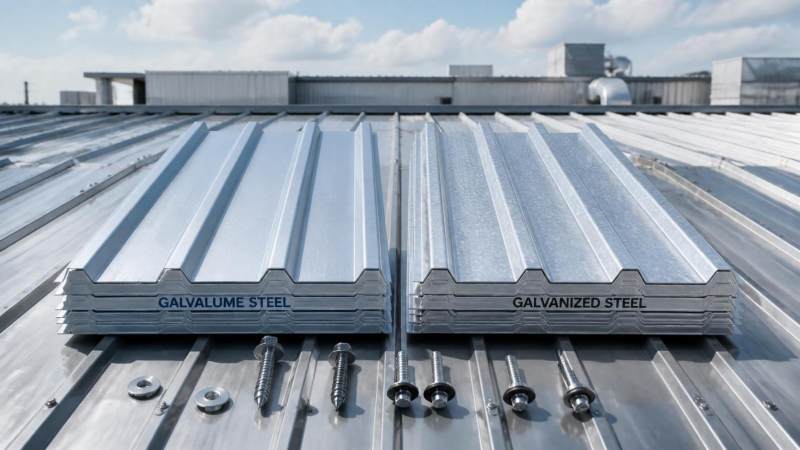
Both materials start with a steel base and a protective coating, but the coating behaves differently.
Galvanized steel uses zinc as the main protective layer. It is familiar, widely available, and usually easier to source in standard specs. For many ordinary roofing jobs, it is still acceptable.
Galvalume steel uses an aluminum-zinc coating, and that is why it often performs better on roofs. The aluminum helps with barrier protection, while zinc supports sacrificial protection at exposed edges and small damaged spots. In roofing terms, that usually means better resistance to weathering, slower red rust formation, and better long-term stability when the roof is exposed to sun, rain, and repeated thermal movement.
 The key point is not that one is “good” and the other is “bad.” It is that the failure modes are different. Galvanized steel can be fine when the environment is mild and the project horizon is short. Galvalume steel is usually the more disciplined choice when the roof is expected to stay in service for years with limited intervention.
## Why galvalume steel Often Wins for Roofing
If you are responsible for a roof that must stay watertight and presentable, galvalume steel has three practical advantages that matter more than marketing language.
First, corrosion resistance is usually stronger in many roofing environments. That matters especially where the roof sees moisture, condensation, or prolonged exposure. Second, the coating reflects heat better than plain galvanized surfaces in many applications, which can help reduce thermal stress on the roof assembly. Third, the surface tends to hold up better over time, so inspections are less likely to reveal early coating breakdown.
That said, the material still needs correct detailing. Poor fastener selection, bad laps, trapped moisture, and cut-edge exposure can erase the advantage quickly. A better coating does not rescue a poorly designed roof.
Project managers often underestimate how much edge condition matters. If the design includes many penetrations, complex flashing, or aggressive cutting on site, you should pay close attention to coating integrity and supplier support. This is where a stable upstream fabricator matters. Hongteng Fengda, for example, operates as a Structural Steel Manufacturer & Exporter from China and supplies structural steel products and customized solutions for global construction and industrial projects. While roofing sheets and structural components are different product categories, the broader lesson is the same: consistent quality control, recognized standards, and dependable lead times reduce downstream risk.
## When galvanized steel Is Still the Better Buy
There are cases where galvanized steel is the more sensible choice. If the roof is for a lower-budget facility, a shorter design life, or an environment that is not especially corrosive, paying more for galvalume may not deliver a meaningful return.
It can also make sense when procurement simplicity is the priority. Some contractors already have established supply chains, installation teams, and standard details built around galvanized products. If the project is repetitive and the environment is controlled, switching materials may create more disruption than value.
The mistake is to treat upfront price as the only variable. I have seen projects save money on sheet cost and lose it later through more frequent maintenance, earlier repainting, or premature replacement planning. For owners who hold assets long term, that is usually the wrong trade.
## A Practical Decision Rule for Project Teams
A simple way to decide is to ask four questions.
1. How long must the roof perform before major intervention?
2. What is the real exposure environment: inland, coastal, humid, industrial, or mild?
3. How complex is the roof geometry and how many cut edges or penetrations will be created?
4. Is the priority lowest purchase cost or lower lifecycle risk?
If the answer leans toward long service life, higher exposure, and reduced maintenance, galvalume steel is usually the stronger roofing choice. If the answer leans toward short horizon, controlled conditions, and tight initial budget, galvanized steel may be sufficient.
For teams evaluating broader structural or site-adjacent works, it is also worth separating roofing needs from earth-retaining or water-facing needs. A product such as Hot Rolled Steel Sheet Pile serves retaining wall and water retaining wall applications, so it belongs in a different decision track. That distinction matters because coating choice, structural grade, and exposure conditions are not interchangeable across project packages.
## Common Mistakes I See in Roofing Selection
The first mistake is choosing only by unit price. Roofing is a long-duration asset, so purchase cost alone gives a false picture.
The second mistake is assuming all environments are “normal.” Coastal air, industrial pollution, and sustained humidity change the equation quickly.
The third mistake is ignoring installation details. Even a better material can underperform if fasteners, sealants, laps, or storage conditions are handled badly.
The fourth mistake is not aligning the material with the owner’s maintenance appetite. A client who wants minimal upkeep should not be handed a material that will ask for more attention later.
## Bottom Line
If you want the short answer: for most roofing projects where durability and long-term performance matter, galvalume steel is the stronger option than galvanized steel. It usually offers better corrosion resistance and better overall value over the life of the roof. Galvanized steel still has a place, but mainly when the project is budget-driven, the environment is mild, or the expected service life is shorter.
For a project manager, the right call is not “which material is better in theory.” It is which one matches the site, the maintenance plan, and the owner’s risk tolerance. In that sense, galvalume steel is often the safer roofing decision when the job is meant to last.
### FAQ
**Is galvalume steel always better than galvanized steel for roofing?**
No. It is usually better for long-term roofing performance, but galvanized steel can be enough for mild environments or shorter service-life projects.
**Does galvalume steel cost more?**
Usually yes, but price should be compared against service life, maintenance, and replacement risk.
**Can galvalume steel be used in coastal areas?**
Sometimes, but site conditions need to be checked carefully. Salt exposure raises corrosion risk for any coated steel product.
**Which material is easier to source?**
Galvanized steel is often easier to find in standard supply chains, though availability depends on region and spec.
**What should I confirm before ordering?**
Confirm coating type, base metal grade, edge protection, fastener compatibility, and the intended exposure environment.
### Internal Link Suggestions
- roof coating comparison: roofing material selection page
- galvanized steel sheet: product category page
- galvalume steel coil: roofing substrate page
- corrosion resistance guide: technical knowledge page
- structural steel supplier: company profile page
### External Source Suggestions
- ASTM standard documents for coated steel sheet products
- Industry association guidance on metal roofing performance
- Manufacturer technical datasheets for coating systems
### SEO Self-Check
- Decision/selection intent: yes
- Selection review style: yes
- Written for project managers/engineering leaders: yes
- Main keyword appears naturally: yes
- Keyword stuffing avoided: yes
- Template-like AI phrasing avoided: mostly yes
- Structure varies naturally: yes
- Unverified facts present: no hard numeric claims
- Company and product info integrated naturally: yes
The key point is not that one is “good” and the other is “bad.” It is that the failure modes are different. Galvanized steel can be fine when the environment is mild and the project horizon is short. Galvalume steel is usually the more disciplined choice when the roof is expected to stay in service for years with limited intervention.
## Why galvalume steel Often Wins for Roofing
If you are responsible for a roof that must stay watertight and presentable, galvalume steel has three practical advantages that matter more than marketing language.
First, corrosion resistance is usually stronger in many roofing environments. That matters especially where the roof sees moisture, condensation, or prolonged exposure. Second, the coating reflects heat better than plain galvanized surfaces in many applications, which can help reduce thermal stress on the roof assembly. Third, the surface tends to hold up better over time, so inspections are less likely to reveal early coating breakdown.
That said, the material still needs correct detailing. Poor fastener selection, bad laps, trapped moisture, and cut-edge exposure can erase the advantage quickly. A better coating does not rescue a poorly designed roof.
Project managers often underestimate how much edge condition matters. If the design includes many penetrations, complex flashing, or aggressive cutting on site, you should pay close attention to coating integrity and supplier support. This is where a stable upstream fabricator matters. Hongteng Fengda, for example, operates as a Structural Steel Manufacturer & Exporter from China and supplies structural steel products and customized solutions for global construction and industrial projects. While roofing sheets and structural components are different product categories, the broader lesson is the same: consistent quality control, recognized standards, and dependable lead times reduce downstream risk.
## When galvanized steel Is Still the Better Buy
There are cases where galvanized steel is the more sensible choice. If the roof is for a lower-budget facility, a shorter design life, or an environment that is not especially corrosive, paying more for galvalume may not deliver a meaningful return.
It can also make sense when procurement simplicity is the priority. Some contractors already have established supply chains, installation teams, and standard details built around galvanized products. If the project is repetitive and the environment is controlled, switching materials may create more disruption than value.
The mistake is to treat upfront price as the only variable. I have seen projects save money on sheet cost and lose it later through more frequent maintenance, earlier repainting, or premature replacement planning. For owners who hold assets long term, that is usually the wrong trade.
## A Practical Decision Rule for Project Teams
A simple way to decide is to ask four questions.
1. How long must the roof perform before major intervention?
2. What is the real exposure environment: inland, coastal, humid, industrial, or mild?
3. How complex is the roof geometry and how many cut edges or penetrations will be created?
4. Is the priority lowest purchase cost or lower lifecycle risk?
If the answer leans toward long service life, higher exposure, and reduced maintenance, galvalume steel is usually the stronger roofing choice. If the answer leans toward short horizon, controlled conditions, and tight initial budget, galvanized steel may be sufficient.
For teams evaluating broader structural or site-adjacent works, it is also worth separating roofing needs from earth-retaining or water-facing needs. A product such as Hot Rolled Steel Sheet Pile serves retaining wall and water retaining wall applications, so it belongs in a different decision track. That distinction matters because coating choice, structural grade, and exposure conditions are not interchangeable across project packages.
## Common Mistakes I See in Roofing Selection
The first mistake is choosing only by unit price. Roofing is a long-duration asset, so purchase cost alone gives a false picture.
The second mistake is assuming all environments are “normal.” Coastal air, industrial pollution, and sustained humidity change the equation quickly.
The third mistake is ignoring installation details. Even a better material can underperform if fasteners, sealants, laps, or storage conditions are handled badly.
The fourth mistake is not aligning the material with the owner’s maintenance appetite. A client who wants minimal upkeep should not be handed a material that will ask for more attention later.
## Bottom Line
If you want the short answer: for most roofing projects where durability and long-term performance matter, galvalume steel is the stronger option than galvanized steel. It usually offers better corrosion resistance and better overall value over the life of the roof. Galvanized steel still has a place, but mainly when the project is budget-driven, the environment is mild, or the expected service life is shorter.
For a project manager, the right call is not “which material is better in theory.” It is which one matches the site, the maintenance plan, and the owner’s risk tolerance. In that sense, galvalume steel is often the safer roofing decision when the job is meant to last.
### FAQ
**Is galvalume steel always better than galvanized steel for roofing?**
No. It is usually better for long-term roofing performance, but galvanized steel can be enough for mild environments or shorter service-life projects.
**Does galvalume steel cost more?**
Usually yes, but price should be compared against service life, maintenance, and replacement risk.
**Can galvalume steel be used in coastal areas?**
Sometimes, but site conditions need to be checked carefully. Salt exposure raises corrosion risk for any coated steel product.
**Which material is easier to source?**
Galvanized steel is often easier to find in standard supply chains, though availability depends on region and spec.
**What should I confirm before ordering?**
Confirm coating type, base metal grade, edge protection, fastener compatibility, and the intended exposure environment.
### Internal Link Suggestions
- roof coating comparison: roofing material selection page
- galvanized steel sheet: product category page
- galvalume steel coil: roofing substrate page
- corrosion resistance guide: technical knowledge page
- structural steel supplier: company profile page
### External Source Suggestions
- ASTM standard documents for coated steel sheet products
- Industry association guidance on metal roofing performance
- Manufacturer technical datasheets for coating systems
### SEO Self-Check
- Decision/selection intent: yes
- Selection review style: yes
- Written for project managers/engineering leaders: yes
- Main keyword appears naturally: yes
- Keyword stuffing avoided: yes
- Template-like AI phrasing avoided: mostly yes
- Structure varies naturally: yes
- Unverified facts present: no hard numeric claims
- Company and product info integrated naturally: yes
Previous page: Already the first one
Next page: Already the last one
Please give us a message


Please enter what you want to find