When sourcing coated steel for construction or industrial use, buyers often compare galvalume steel and galvanized steel on one key question: which offers better value over time? Understanding the differences in cost, corrosion resistance, and service life can help reduce maintenance risk, control project budgets, and support better long-term material decisions.
What is the difference between galvalume steel and galvanized steel?
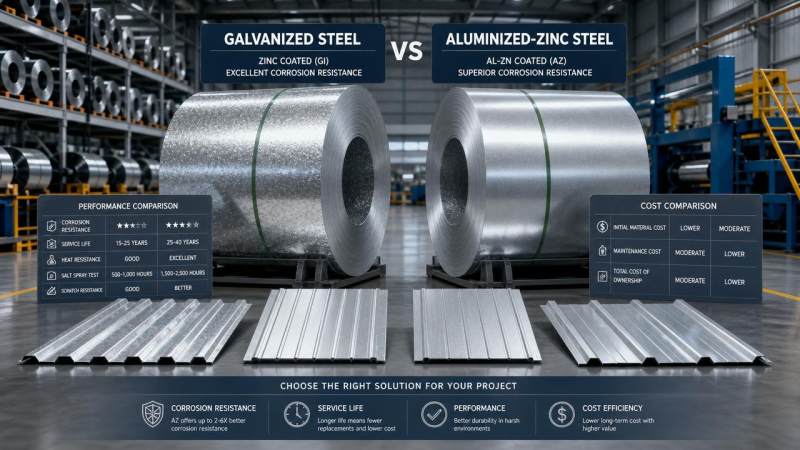
The main difference is the coating composition.
Galvanized steel uses a zinc coating.
Galvalume steel uses a coating made from aluminum, zinc, and silicon.
This coating blend gives galvalume steel stronger barrier protection in many outdoor environments.
Galvanized steel performs well too, especially where edge protection and sacrificial zinc behavior matter.
In simple terms, galvanized steel fights corrosion by sacrificing zinc first.
Galvalume steel resists corrosion through a more stable coating surface.
That is why galvalume steel is often selected for roofing, wall panels, and exposed building envelopes.
Galvanized steel remains common in framing, fabricated parts, structural accessories, and general industrial use.
Which material has the lower initial cost?
In many markets, galvanized steel has the lower upfront price.
The price gap depends on coating weight, base steel thickness, order volume, and regional supply.
Galvalume steel usually costs more per ton or per square meter.
However, purchase price alone does not show total value.
A cheaper coated steel may lead to earlier repainting, replacement, or maintenance in aggressive exposure conditions.
That changes the full lifecycle cost.
For dry, moderate, and non-coastal environments, galvanized steel can be highly cost-effective.
For long-exposure roofing or cladding, galvalume steel may justify the extra initial spend.
The right comparison should include:
- material price
- expected coating durability
- fabrication and installation conditions
- maintenance cycle
- replacement cost and downtime
Does galvalume steel last longer than galvanized steel?
In many exposed applications, yes.
Galvalume steel often provides longer service life than standard galvanized steel.
This is especially true in atmospheric exposure and roofing systems.
Its aluminum-rich coating helps slow surface corrosion over time.
Still, service life is never fixed by coating type alone.
Lifespan depends on several factors:
- coastal salt exposure
- industrial pollution
- humidity and rainfall frequency
- cut edge condition
- coating thickness
- drainage design and water retention
Galvanized steel may outperform expectations in sheltered, inland, or lower-corrosion environments.
Galvalume steel tends to show stronger longevity on roofs and panels with proper design.
But direct contact with wet concrete, alkaline runoff, or certain chemicals can reduce its advantage.
Where is each coating better suited in real projects?
Application matters as much as chemistry.
Galvalume steel is widely used in roofing sheets, wall cladding, agricultural buildings, and metal envelope systems.
It is a strong option where appearance retention and broad-area corrosion resistance are important.
Galvanized steel fits structural supports, brackets, guard systems, utility hardware, and fabricated accessories.
It is also practical for parts that require welding, cutting, or hot-dip corrosion protection.
For related anti-corrosion applications, Galvanized Round Steel is commonly used in power towers, highways, street light poles, marine components, and building steel structure parts.
Typical specifications include DC01 material, diameter 16-250 mm, customized length, and tensile strength of 570-820 MPa.
With hot dip galvanized processing, surface control, and compliance with ASTM, EN, JIS, and GB, it supports demanding outdoor service.
This shows an important point.
Coated steel selection should match form, fabrication method, and final environment, not coating name alone.
What risks or misunderstandings affect the choice?
One common mistake is assuming galvalume steel is always better.
It is often better for exposed panels, but not every component is a panel.
Complex fabricated parts may need different processing, tolerances, or coating methods.
Another mistake is ignoring cut edges and fastener compatibility.
Poor edge treatment can shorten the service life of both galvanized and galvalume steel.
Incorrect fasteners may trigger galvanic corrosion.
Drainage design is also critical.
Standing water, debris buildup, and trapped moisture can damage coated steel faster than expected.
A further misunderstanding concerns lifespan claims.
Published durability ranges are usually based on specific exposure assumptions.
Local climate and maintenance practices may produce different results.
Quick risk checklist
- Confirm the actual corrosive environment.
- Check coating type and coating weight.
- Review cut edges, joints, and fasteners.
- Avoid water traps in design.
- Match the steel form to fabrication needs.
How should cost and lifespan be compared in a practical way?
A practical comparison combines price, exposure, and service expectations.
Use a simple total ownership view instead of focusing only on the invoice value.
If the project requires long-term exposed roofing, galvalume steel may offer better lifecycle value.
If the project includes diverse fabricated steel parts, galvanized steel may be the more practical balance.
A simple decision path
- Define the exposure level.
- Estimate the required service life.
- Compare maintenance access and replacement difficulty.
- Review fabrication and standard requirements.
- Choose the lower total long-term cost.
So, which one offers better value over time?
There is no universal winner.
Galvalume steel often delivers better long-term value in exposed roofing and cladding applications.
Its stronger atmospheric corrosion resistance can extend service life and lower maintenance frequency.
Galvanized steel often offers better value where lower initial cost, fabrication flexibility, and broad structural use are priorities.
The best decision comes from matching environment, product form, and lifecycle target.
For steel projects requiring reliable coated materials, stable quality, and international standard compliance, working with an experienced structural steel supplier helps reduce sourcing risk.
Hongteng Fengda supplies structural steel products and customized solutions for global construction and industrial applications.
A careful review of corrosion conditions, specifications, and processing needs will lead to a smarter comparison between galvalume steel and galvanized steel.
If needed, the next step is simple: compare the intended use, expected lifespan, and coating requirement before final material selection.
Please give us a message


Please enter what you want to find