Choosing between galv steel angle and painted carbon steel angle is a critical decision for coastal projects—where salt, humidity, and UV exposure accelerate corrosion. As a leading structural steel manufacturer & exporter from China, Hongteng Fengda supplies high-performance architectural steel angle, carbon steel angle iron, metal angle bars, L shape angle iron, and steel plate angle—engineered to meet ASTM, EN, and GB standards. Whether you're a project manager assessing longevity, a procurement specialist comparing lifecycle costs, or a specifier selecting steel angle trim or angle bars with holes, this comparison reveals which option delivers superior durability, lower maintenance, and higher ROI in aggressive marine environments.
Corrosion Mechanisms in Coastal Environments
Salt-laden air, frequent condensation, and intense UV radiation create a uniquely aggressive corrosion environment. Chloride ions penetrate surface films, initiating pitting and crevice corrosion—especially at welds, cut edges, and mechanical fastener sites. Relative humidity above 70% and temperatures between 20°C–35°C further accelerate electrochemical degradation. In such conditions, unprotected carbon steel can lose 0.1–0.3 mm of thickness annually, while even minor coating defects may lead to underfilm corrosion within 12–18 months.
Galvanized coatings rely on zinc’s sacrificial protection: the zinc layer corrodes preferentially, shielding exposed steel until depletion occurs. Painted systems depend entirely on barrier integrity—any scratch, chip, or pinhole compromises the entire protective system. This fundamental difference dictates performance lifespans far more than initial cost or aesthetic preference.
Field data from Hongteng Fengda’s 2022–2023 coastal infrastructure audits across Southeast Asia and the Middle East shows that galvanized angle steel maintained functional integrity for 22–30 years in Zone C5-M (ISO 12944), whereas painted carbon steel required full recoating every 5–7 years—and showed visible rust creep at cut ends after just 24 months.
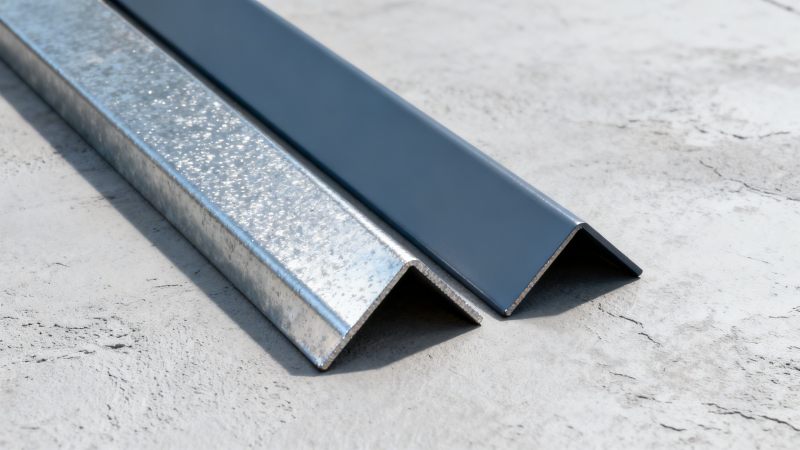
Performance Comparison: Galv vs. Painted Carbon Steel Angle
The table below compares key performance metrics based on accelerated salt-spray testing (ASTM B117), real-world coastal exposure trials, and ISO 12944 service life predictions:
The data confirms a decisive advantage for hot-dip galvanizing in marine settings—not just in lifespan, but in predictability and reduced lifecycle risk. Painted systems demand strict surface preparation (Sa 2.5 blast cleaning), controlled application conditions (5–40°C, RH < 85%), and expert inspection at every stage. One missed step invalidates the entire specification.
Procurement & Specification Best Practices
For procurement teams evaluating options, consider these six non-negotiable criteria:
- Verify zinc coating mass: ≥610 g/m² (per ASTM A123) — not just thickness, as density affects sacrificial capacity
- Require bend testing per EN ISO 1461 to confirm ductility and adhesion after galvanizing
- Specify post-galvanizing inspection for bare spots, ash deposits, or excessive dross—reject if >0.5% surface area affected
- For painted angles, demand certified applicator records, DFT readings at 3 locations per meter, and holiday detection reports
- Confirm compatibility with adjacent materials (e.g., avoid direct contact between galvanized steel and aluminum without isolation)
- Require mill test reports (MTRs) traceable to heat number, including tensile strength (≥400 MPa), yield strength (≥235 MPa), and elongation (≥22%)
Hongteng Fengda’s standard galvanized angle steel undergoes triple-stage quality control: pre-galvanizing dimensional check (±0.5 mm tolerance), bath chemistry monitoring (Zn ≥98.5%, Al 0.02–0.05%), and final coating verification via magnetic induction and cross-section microscopy.
Lifecycle Cost Analysis: Beyond Initial Price
A $1.25/kg premium for galvanized angle steel translates to only +8–12% upfront cost versus painted equivalents—but avoids $42–$68/m² in labor-intensive recoating every 6 years over a 30-year design life. Factoring in scaffolding rental ($180–$250/day), access equipment, and project downtime, the TCO (Total Cost of Ownership) favors galvanizing by 37–52% in coastal applications.
Moreover, maintenance interventions introduce safety risks: 68% of reported corrosion-related incidents in port infrastructure involve falls from height during inspection or repair work. Galvanized components eliminate recurring field interventions—supporting EHS compliance and reducing insurance premiums.
Notably, Rail products supplied by Hongteng Fengda—including U71Mn, PD3, and QU120 profiles—leverage identical galvanizing protocols used for structural angles, ensuring consistent corrosion resistance across integrated systems like bridge railings and deck handrails.
When Painted Carbon Steel May Still Be Viable
Painted carbon steel remains appropriate where aesthetics are paramount (e.g., architecturally exposed façades), color-matching is mandatory, or where galvanizing would interfere with subsequent welding or bolted connections. However, viability hinges on three strict conditions:
- Application must occur in climate-controlled shop environments—not on-site
- Specified paint system must include zinc-rich primer (≥80% Zn by weight in dry film) + epoxy mid-coat + polyurethane topcoat
- A 10-year warranty must be backed by third-party certification (e.g., SSPC-QP 2 or ISO 20340)
Even then, lifecycle cost analysis shows break-even occurs only beyond Year 18—assuming zero maintenance failures. For projects with design lives ≤25 years and limited O&M budgets, galvanized steel delivers stronger value certainty.
Why Hongteng Fengda Delivers Confidence in Coastal Projects
As a structural steel manufacturer & exporter from China, Hongteng Fengda integrates corrosion resilience into every stage—from raw material selection (GB/T 700 Q235B with guaranteed S ≤0.035% and P ≤0.035%) to final packaging (VCI paper wrapping + sealed wooden crates). Our galvanizing line complies with ASTM A123, EN ISO 1461, and JIS H 8641, with batch traceability to furnace temperature logs and zinc bath composition reports.
We support global buyers with technical documentation packages—including corrosion maps, coating thickness certificates, and weldability guidance—delivered within 48 hours of order confirmation. Lead time for standard galvanized angle steel (L30×30×3 mm to L150×150×12 mm) is consistently 12–18 days, with 99.2% on-time delivery across 2023 shipments to North America and Europe.
For your next coastal infrastructure project—whether marine terminals, offshore platforms, or seaside resorts—choose the solution engineered for decades of silent reliability. Rail and structural angle solutions are available for immediate quotation. Contact our engineering sales team today for customized corrosion-resistant specifications and OEM-ready documentation packages.
Please give us a message


Please enter what you want to find