Why the conduit choice matters in wet and aggressive environments
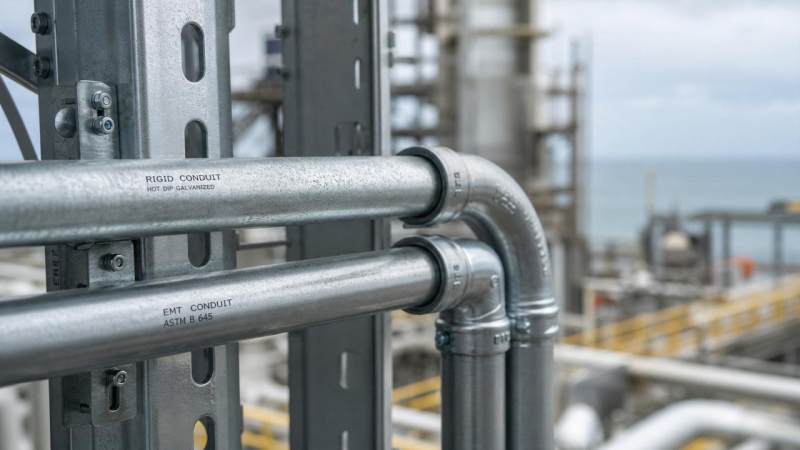
Choosing between galv electrical conduit and EMT is not a minor material decision.
In damp plants, coastal facilities, wastewater sites, and outdoor structures, conduit failure often starts quietly.
Surface corrosion, damaged coating, trapped moisture, and poor fittings can shorten service life long before cables fail.
That is why the comparison between galv electrical conduit and EMT deserves close attention in steel-intensive projects.
The issue is not only corrosion resistance.
It also affects installation speed, structural coordination, inspection outcomes, maintenance frequency, and total lifecycle cost.
For projects involving steel frames, support brackets, equipment skids, and exposed service runs, conduit selection should match the actual environmental load.
A supplier with experience in international steel standards, such as ASTM, EN, JIS, and GB, often understands this coordination better.
That broader material perspective matters when electrical raceways interact with structural steel and fabricated supports.
Galv electrical conduit and EMT are related, but not equal
EMT, or Electrical Metallic Tubing, is a thin-wall steel raceway used widely in commercial and light industrial installations.
It is valued for lower weight, faster bending, and easier handling on site.
Galv electrical conduit usually refers to galvanized steel conduit with a zinc coating that improves corrosion resistance.
In many discussions, it points to galvanized rigid conduit or intermediate metal conduit, though market wording can vary.
That distinction is important.
Some teams compare EMT with galvanized rigid conduit as if they were direct substitutes in all locations.
In practice, they serve overlapping but not identical purposes.
Simple material labels do not tell the full story.
Coating quality, site chemistry, installation details, and fitting compatibility often decide whether the system lasts.
What damp and corrosive areas actually demand
A damp area is not automatically a corrosive area.
However, repeated condensation, washdown cycles, salt exposure, fertilizer dust, chemicals, or industrial fumes can quickly change the risk level.
In real projects, the environment usually falls into one of several patterns.
- Covered outdoor spaces with rain, humidity, and occasional splashing.
- Marine or coastal locations with salt-laden air.
- Industrial plants with alkaline, acidic, or solvent-rich atmospheres.
- Water treatment and food processing lines with frequent washdown.
- Steel structures where dissimilar metals and standing water create local corrosion points.
Under these conditions, EMT may still perform well in selected indoor zones.
But exposed runs often need the added robustness of galv electrical conduit, especially where impact and moisture occur together.
This is one reason industrial buyers rarely choose raceway only by initial price.
They look at service life, shutdown risk, and replacement difficulty after commissioning.
Where each option usually fits best
EMT has a clear place in projects that need speed and cost control.
It is often practical for interior utility rooms, dry service corridors, covered commercial spaces, and protected mechanical zones.
It also works well where routing changes are likely during installation.
Galv electrical conduit is usually favored when the site asks for more than basic containment.
Typical examples include outdoor pipe racks, bridge-adjacent electrical runs, pump stations, loading areas, and exposed plant perimeters.
It becomes even more relevant when conduit is mounted directly to structural steel, cold formed supports, or fabricated brackets.
In those assemblies, the conduit system is part of a broader steel package.
Consistency in coating quality, fabrication tolerances, and standard compliance reduces coordination issues across trades.
That is where an experienced structural steel exporter can add value beyond supplying raw sections.
Hongteng Fengda, for example, serves global construction and industrial projects with standardized steel products and OEM solutions.
That background supports better matching between raceway support systems, steel framing, and long-term corrosion expectations.
Decision points that matter more than catalog descriptions
Many selection errors happen because the environment is described too generally.
“Outdoor,” “humid,” or “industrial” are not precise enough for conduit planning.
A more reliable evaluation checks several details together.
Exposure profile
Identify whether moisture comes from weather, process washdown, condensation, or chemical splash.
Each source affects zinc coating and fittings differently.
Mechanical stress
If forklifts, vibration, maintenance traffic, or exposed steel framing create impact risk, heavier conduit often earns its cost.
Connection details
Failure commonly starts at threads, couplings, bends, or cut ends.
The best galv electrical conduit can still underperform if accessories are mismatched.
Maintenance access
Difficult access changes the cost equation.
A cheaper raceway is rarely cheaper if replacement requires shutdowns, scaffold work, or coating repairs on nearby steel.
Steel coordination is part of the conduit decision
Conduit does not exist in isolation.
It is fixed to supports, embedded in structures, or routed across fabricated assemblies.
That makes surrounding steel quality relevant to electrical reliability.
For support plates, bridge panels, mounting bases, and equipment racks, material stability and corrosion behavior must align with the raceway design.
In these situations, components such as Mild Steel Plate Supplier solutions can fit naturally into the support system.
Grades such as A572 or S355JR are often selected where strength, forming, and fabrication consistency are needed.
Typical plate formats include flat plate and rectangle forms, with widths from 100 mm to 3000 mm.
Lengths can reach 12 m, and thickness can range from 0.1 mm to 400 mm.
That flexibility helps when designing mechanical mounting plates, support plates, racks, and transmission tower parts around conduit routes.
It is not about turning an electrical choice into a plate purchase.
It is about recognizing that corrosion performance depends on the whole steel assembly, not only the conduit tube.
A practical way to choose on real projects
A sound decision process usually starts with environment mapping, not product preference.
- Divide the site into dry, damp, washed, chemically exposed, and outdoor zones.
- Mark where conduit is concealed, protected, or fully exposed.
- Check whether steel supports may trap water or accelerate coating damage.
- Confirm standards, local code expectations, and inspection preferences early.
- Compare material cost against maintenance labor and outage risk.
If the environment is mildly damp and mechanically protected, EMT may be the efficient choice.
If the location combines moisture, corrosive agents, and physical exposure, galv electrical conduit usually offers the safer long-term answer.
Mixed-use projects often benefit from using both, assigned by zone rather than by habit.
That approach controls budget without ignoring high-risk areas.
Before finalizing, it helps to review raceway choice together with support steel, plate details, coatings, and fabrication standards.
A structured comparison at that stage prevents costly changes after installation and gives the project a clearer path from design to operation.
Please give us a message


Please enter what you want to find