G90 Galvanized Steel Coil: Is the Extra Coating Worth It?
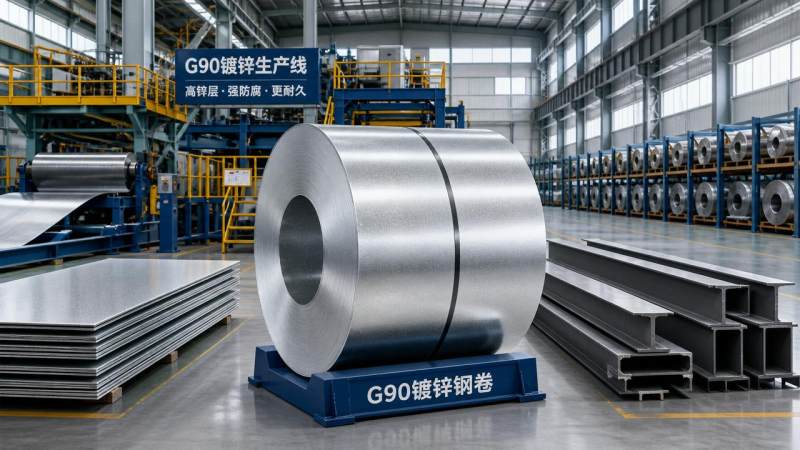
For finance-minded buyers, choosing G90 galvanized steel coil is not just a technical decision. It is a direct test of cost control, service life, and project risk.
The heavier zinc coating of G90 galvanized steel coil often means stronger corrosion protection. That can reduce repainting, replacement, and shutdown costs over time.
Still, the higher purchase price raises a fair question. Is the extra coating really worth paying for when budgets are tight?
In practical sourcing, the answer depends on exposure conditions, expected lifespan, and the cost of failure. A cheaper coil can become expensive very quickly.
This article breaks down how G90 galvanized steel coil performs in real purchasing decisions. The goal is simple: compare upfront cost against total return.
What G90 galvanized steel coil actually means
G90 refers to the zinc coating weight on galvanized steel. In ASTM terms, it means about 0.90 ounces of zinc per square foot.
That extra zinc layer acts like a protective shield. It slows rust formation when the steel faces moisture, weather, and contaminated air.
Compared with lighter coatings, G90 galvanized steel coil usually performs better in outdoor, humid, or industrial conditions. That difference matters when maintenance access is difficult.
For buyers reviewing line items, coating class may look minor. In reality, it influences replacement timing, warranty risk, and long-term asset value.
Why coating weight matters to cost
A steel coil is never just a material cost. It carries installation labor, transport, fabrication time, and possible disruption if corrosion appears early.
When the coating is too light for the job, the savings disappear fast. Surface failure can trigger repairs that cost far more than the original price gap.
Where the premium makes financial sense
The extra cost of G90 galvanized steel coil is easier to justify in environments that punish bare or lightly coated steel.
- Outdoor structures exposed to frequent rain or humidity
- Industrial sites with chemical vapor or airborne contaminants
- Agricultural buildings with condensation and corrosive residues
- Roofing, cladding, and framing systems with long service expectations
- Projects where maintenance shutdowns are expensive
In these cases, G90 galvanized steel coil supports a more stable lifecycle budget. That makes approval easier because the investment reduces future uncertainty.
This is even more relevant for infrastructure work. For example, marine and water-control projects often demand higher durability from every steel component.
In related applications, Steel Sheet Piles are selected for deep water construction and cofferdam formation because strength, waterproof performance, and reuse value directly affect project economics.
The same purchasing logic applies here. When the operating environment is severe, paying more for stronger protection is often the lower-risk choice.
When G90 galvanized steel coil may not be necessary
Not every project needs the heavier coating. There are situations where a lower coating class may be enough.
- Indoor applications with stable, dry conditions
- Temporary structures with short service life
- Components hidden inside protected assemblies
- Projects where post-treatment protection is already planned
In these cases, the premium on G90 galvanized steel coil may offer limited financial return. A lower-cost option could deliver acceptable performance.
That said, “acceptable” should be defined carefully. Short-term savings only help when the application scope, exposure level, and replacement plan are truly clear.
A simple way to compare total ownership cost
The best way to judge G90 galvanized steel coil is not by unit price alone. It should be measured through total ownership cost.
This comparison often changes the discussion. A higher-priced coil can become the better financial decision when it lowers future spend.
Questions worth asking suppliers
- What zinc coating standard is used and how is it tested?
- What service life is expected in the actual application?
- What failure cases have appeared in similar climates?
- Can the supplier keep coating consistency across batches?
- Are ASTM, EN, JIS, or GB requirements matched to the project?
These questions help move the conversation from price to risk-adjusted value. That is where sound procurement decisions usually become clearer.
How supplier capability changes the equation
Even the right coating class can disappoint if production quality is inconsistent. Coating performance depends on process control, inspection, and reliable delivery.
Hongteng Fengda is a professional structural steel manufacturer and exporter from China. The company supports global construction, industrial, and manufacturing projects.
Its product range includes angle steel, channel steel, steel beams, cold formed steel profiles, and customized structural steel components.
With modern manufacturing facilities and strict quality control, products comply with major international standards such as ASTM, EN, JIS, and GB.
For buyers, that matters because consistent quality reduces hidden procurement costs. Fewer disputes, steadier lead times, and lower rework all support better cash planning.
Serving North America, Europe, the Middle East, and Southeast Asia, the company helps reduce sourcing risks while maintaining dependable production capacity.
How to decide if the extra coating is worth it
A practical decision framework can make the answer easier.
- Check exposure: humidity, chemicals, salt, and weather cycles
- Estimate service life: short-term use or long-term asset
- Measure replacement impact: labor, access, downtime, and penalties
- Verify standards: match coating level to project specification
- Review supplier stability: quality control and delivery reliability
If corrosion failure would damage schedules or create repair exposure, G90 galvanized steel coil is often the smarter buy.
If the environment is mild and the service window is short, the premium may be harder to recover. The key is matching specification to real use.
Final takeaway
G90 galvanized steel coil is not automatically the best option for every project. But in many demanding applications, it delivers value beyond the invoice price.
The extra coating can extend service life, reduce maintenance, and improve budget predictability. Those gains matter when failure costs are high.
In short, the premium is worth it when it cuts lifecycle risk. That is the real benchmark behind a strong purchasing decision.
Before placing an order, compare exposure conditions, total ownership cost, and supplier reliability side by side. That approach turns G90 galvanized steel coil from a price question into a value decision.
Please give us a message


Please enter what you want to find