Picture this: You are staring at a complex forming limits diagram (FLD) on your monitor, trying to push the boundaries of a newly designed structural component. The geometry is aggressive, the draw ratio is high, and the material specified is a high-strength galvanised steel sheet. As a technical evaluator, you know that getting this part out of the press without tearing the base metal is only half the battle. The real challenge lies in what happens to that protective zinc coating when subjected to extreme biaxial stretching. It is a delicate balancing act between structural integrity, corrosion resistance, and manufacturing feasibility.
Understanding the precise formability limits of galvanised steel sheet is essential for technical evaluators optimizing deep drawing processes. When we talk about formability, we are not just looking at the steel substrate; we are evaluating a composite system. The zinc layer, while crucial for corrosion protection, fundamentally alters the tribological conditions at the sheet-metal interface. Let us dive into the technical realities that dictate successful forming operations and how to navigate these constraints without compromising your project's lifespan.
The Friction and Coating Paradox in Deep Drawing
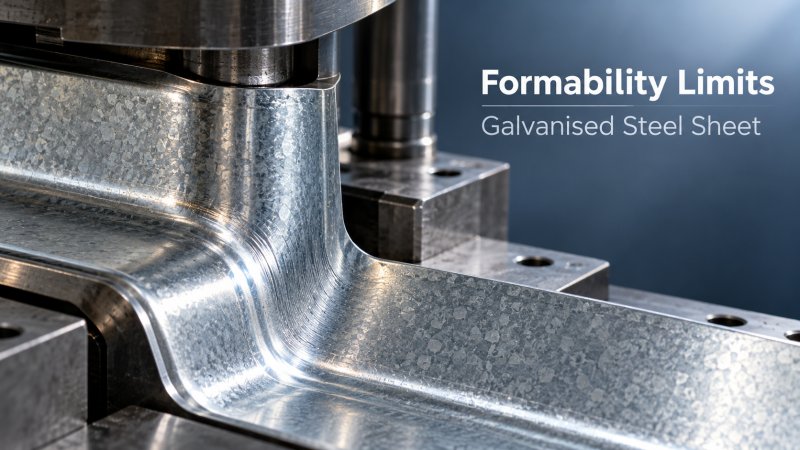
Unlike bare cold-rolled steel, a galvanised surface introduces a unique friction paradox. Zinc is significantly softer than the underlying steel substrate. During the deep drawing process, as the sheet flows over the die radius and into the draw ring, the zinc layer tends to smear, adhere to the tooling, and eventually flake off. This phenomenon, often referred to as zinc pick-up or powdering, drastically increases the coefficient of friction.
For the technical evaluator, this means the forming forces required will be higher than those predicted for bare steel. If the lubrication strategy is not specifically tailored for galvanised surfaces, the increased friction can lead to localized thinning of the sheet. You might achieve the desired geometry, but the wall thickness in the critical corner radii could drop below the minimum tolerance, creating a hidden vulnerability. Therefore, evaluating the formability of a galvanised steel sheet requires a simultaneous assessment of the lubricant's extreme pressure (EP) additives and their compatibility with zinc coatings.
Strain Thresholds and the Reality of Micro-cracking
Every galvanised steel grade has a specific forming limits curve, but the presence of the coating effectively lowers the practical strain threshold before visible damage occurs. When the local major strain exceeds the critical limit of the zinc-iron alloy layers, micro-cracks begin to form on the surface. While these micro-cracks might not immediately compromise the structural strength of the steel base, they expose the underlying metal to the environment, defeating the primary purpose of galvanisation.
Technical evaluators must distinguish between the forming limit of the bare steel and the coating fracture limit. In many high-strength low-alloy (HSLA) galvanised sheets, the coating fracture limit is reached well before the steel substrate necks or tears. This necessitates a conservative approach in tool design. Incorporating larger draw radii, optimizing the blank holder force distribution, and potentially utilizing multi-stage drawing operations can help distribute the strain more evenly, keeping the local deformation below the coating's fracture threshold.
System-Level Material Evaluation: Beyond the Sheet Metal
Often, the formability limits of galvanised steel sheet become a bottleneck when designing highly complex, deep-drawn enclosures or structural housings that also demand exceptional, long-term corrosion resistance. When pushing the zinc coating to its absolute physical limits results in unacceptable micro-cracking, technical evaluators must step back and look at the entire material matrix of the project.
If the deep-drawn exterior shell cannot guarantee sufficient corrosion protection due to forming constraints, the internal systems must compensate. In such scenarios, evaluating alternative materials for critical internal structures or fluid transport systems becomes paramount. For instance, transitioning internal piping or structural support columns to an ultra-low-carbon material like a 304L Stainless Steel Pipe can dramatically shift the project's risk profile. By addressing the susceptibility to intergranular corrosion and retaining superior toughness, 304L stainless components ensure that even if the outer galvanised shell experiences minor coating degradation, the core structural and functional integrity remains uncompromised. This holistic approach to material selection allows engineers to push the forming limits of carbon steel sheets while maintaining overall system reliability.
The Hidden Variable: Batch Consistency and Supply Chain Risks
Here is a reality that rarely makes it into academic textbooks but keeps production managers awake at night: the formability limits you calculate in the lab are only valid if the material properties are perfectly consistent. In the real world, the yield strength and r-value (plastic strain ratio) of galvanised steel sheet can fluctuate between different coils, or even within the same coil, depending on the manufacturer's rolling and galvanising parameters.
A slight increase in yield strength from one batch to the next can push a marginal deep drawing operation from a "safe" zone into the "tearing" zone on the FLD. This is why selecting premium, standard-compliant steel from reliable manufacturers is not just a procurement checkbox; it is a critical engineering decision. Partners like Hongteng Fengda understand this nuance. By maintaining modern manufacturing facilities and enforcing strict quality control that complies with major international standards such as ASTM, EN, JIS, and GB, they minimize batch-to-batch property variations. For a technical evaluator, sourcing from a dependable structural steel manufacturer and exporter means the forming limits you simulate are the forming limits you actually get on the press floor, significantly reducing sourcing uncertainties and trial-and-error costs.
A Pragmatic Framework for Technical Evaluators
Navigating the formability limits of galvanised steel sheet in deep drawing is rarely about finding a single "perfect" solution. It is about managing trade-offs. When you are finalizing your material and process selection, consider this practical evaluation framework:
- Define the True Corrosion Requirement: Does the component need a heavy zinc coating (e.g., Z275) for harsh environments, or will a lighter coating (e.g., Z100) suffice? Thicker coatings are more prone to flaking during severe deep drawing.
- Map the Strain Distribution Early: Use finite element analysis (FEA) not just to predict steel tearing, but specifically to map the thinning and strain on the coating layer. Identify areas where the major strain approaches the coating fracture limit.
- Optimize Tooling for Zinc: Design dies with specialized surface treatments or coatings (like PVD or CVD) to reduce zinc pick-up, and ensure lubrication channels are optimized for high-friction scenarios.
- Establish Clear Acceptance Criteria: Work with the end-user to define what constitutes an acceptable level of coating micro-cracking. If zero micro-cracking is required, you may need to anneal the part post-drawing or reconsider the material grade.
- Validate with Physical Trials: Never rely solely on simulations. Conduct physical deep drawing trials using production-intent lubricants and actual press speeds to validate the FLD predictions.
Ultimately, mastering the deep drawing of galvanised steel sheet requires a blend of metallurgical understanding, tribological awareness, and pragmatic supply chain management. By respecting the physical limits of the coating, planning for friction, and partnering with manufacturers who prioritize consistency, you can transform a potentially problematic forming operation into a robust, repeatable manufacturing process. The goal is not just to make the part; it is to make the part right, the first time, and ensure it performs flawlessly in the field for years to come.
Please give us a message


Please enter what you want to find