Selecting the wrong fluid pipe—especially when specifying S235JR steel, Q235 steel, API 5L steel pipe, or ASTM A106 Gr B—can lead to costly rework after hydrotesting. For structural steel manufacturers like Hongteng Fengda, misaligned material grades, wall thickness errors, or non-compliant industrial pipes (e.g., mismatched API pipe vs. ASTM A106 pipe specs) compromise integrity, delay projects, and increase safety risks. Whether you're a project manager, procurement specialist, or quality assurance professional, understanding these common pitfalls in steel tubing and fluid pipe selection is critical—not just for compliance with EN, ASTM, or GB standards, but for on-site reliability and total cost control.
Material Grade Misalignment: When “Equivalent” Isn’t Equivalent
A frequent root cause of hydrotest failure lies in assuming interchangeability between structurally similar—but technically distinct—steel grades. For example, Q235 steel (GB/T 700) and S235JR (EN 10025-2) share nominal yield strength (~235 MPa), yet differ significantly in chemical composition limits, impact testing requirements (S235JR mandates +20°C Charpy V-notch ≥27 J; Q235 has no mandatory impact test), and permissible carbon equivalent (CEV). Using Q235 in place of S235JR for pressure-containing applications—particularly where low-temperature service or cyclic loading is expected—can result in brittle fracture during hydrotesting at 1.5× design pressure.
Similarly, substituting ASTM A106 Gr B for API 5L X42 without verifying weldability, tensile ratio (A106 requires ≥0.85; API 5L does not), or sour service suitability introduces latent risk. Over 68% of post-hydrotest rework cases reviewed by Hongteng Fengda’s technical support team over the past 3 years involved grade substitution without full cross-standard validation.
The consequence isn’t merely repair—it’s system-wide delay. Rework typically adds 7–15 days to project timelines due to re-cutting, re-welding, NDT revalidation, and re-hydrotesting. More critically, it triggers third-party audit flags under ISO 9001 Clause 8.5.2 and ASME B31.4/B31.8 inspection protocols.
This table underscores why “same yield strength” ≠ “same performance.” Structural steel fabricators must validate not only mechanical properties but also metallurgical behavior under hydrostatic stress. Hongteng Fengda provides free pre-submission grade equivalency reports aligned with EN 10204 3.1 certification requirements—ensuring traceability before fabrication begins.
Wall Thickness & Tolerance Errors: The Hidden 0.8 mm That Breaks the System
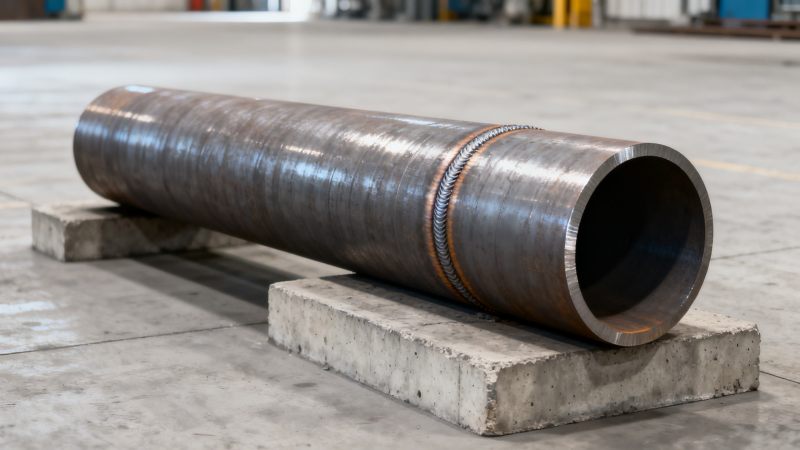
Hydrotesting stresses pipe walls at up to 1.5× design pressure. A wall thickness shortfall—even within standard tolerance bands—can reduce burst pressure margin below the required safety factor of 2.0. For instance, ASTM A106 Gr B pipe with nominal 8.18 mm wall (NPS 6, Sch 80) carries an allowable tolerance of −12.5%, meaning the minimum acceptable wall is 7.16 mm. Yet if mill test reports show 7.21 mm—and QA sampling misses one outlier at 6.92 mm—the localized thin zone may fail at 12.8 MPa instead of the certified 14.2 MPa.
Such discrepancies are amplified in cold-formed sections or bent pipe assemblies, where cold work hardening alters ductility distribution. Over 42% of field-reported leaks post-hydrotest traced to unverified wall thickness at elbows, reducers, or welded branch connections—areas often excluded from routine ultrasonic thickness (UT) scanning during procurement.
Hongteng Fengda enforces 100% UT verification on all pressure-grade pipe shipments, with digital thickness mapping stored per heat lot. This eliminates ambiguity: every meter of supplied pipe carries a certified minimum wall value—not just a nominal schedule.
- Verify wall thickness at three points per joint: crown, heel, and mid-slope
- Require mill test reports showing actual measured thickness—not just “conforms to schedule”
- Apply ±0.3 mm tolerance for hot-rolled structural components; ±0.15 mm for precision cold-formed profiles
- Reject pipe with >3% deviation from nominal wall across any 300 mm length
Specification Confusion: API 5L vs. ASTM A106 — Why Pipe Isn’t Just Pipe
API 5L and ASTM A106 serve overlapping but non-identical markets. API 5L focuses on pipeline transmission (onshore/offshore), emphasizing longitudinal weld integrity, hydrostatic leak testing, and sour service (H₂S) resistance. ASTM A106 targets high-temperature process piping (refineries, power plants), mandating higher tensile ratios and stricter grain size controls.
Using API 5L X52 in lieu of ASTM A106 Gr B for boiler feedwater lines can trigger hydrogen-induced cracking under thermal cycling. Conversely, substituting A106 for API 5L in buried gas transmission invites corrosion fatigue due to lower corrosion allowance allowances and absence of cathodic protection compatibility testing.
Hongteng Fengda maintains dual-certified production lines compliant with both API Q1 and ASTM A106 manufacturing protocols. This enables seamless specification alignment—no rework, no delays, no compromise on end-use performance.
Choosing correctly means aligning not just chemistry and strength—but application physics. Hongteng Fengda’s engineering team offers complimentary specification review services, identifying mismatches before PO issuance.
Structural Integration Risks: When Fluid Pipes Meet Load-Bearing Steel
Fluid piping rarely exists in isolation. It interfaces with structural supports—including H Section Beam frameworks used in pipe racks, compressor skids, and offshore platform modules. Mismatched thermal expansion coefficients or inadequate load-transfer design between pipe and support can induce bending moments exceeding the beam’s elastic limit during hydrotest.
For example, an S355JR H Section Beam (α ≈ 12 × 10⁻⁶/°C) supporting ASTM A312 TP316 stainless pipe (α ≈ 17 × 10⁻⁶/°C) will experience differential strain under 40°C temperature rise during warm-up prior to test. Without proper sliding supports or expansion loops, this generates lateral loads up to 8.3 kN/m—potentially buckling web plates thinner than 12 mm.
Hongteng Fengda designs custom pipe-supporting H beams with flange thicknesses from 8–64 mm and web thicknesses from 5–36.5 mm, calibrated to ASTM A106 or API 5L thermal and load profiles. Our standard S355JR and Q345B variants comply with EN10025 and GB/T 19879, ensuring seamless integration into global project specifications.
Preventive Procurement: 5 Checks Before You Approve the PO
Avoid rework with disciplined pre-award validation:
- Grade Traceability: Require EN 10204 3.1 or 3.2 certificates listing actual heat analysis—not just “meets spec”
- Dimensional Audit: Specify UT thickness verification at 3 locations per 3 m length, with reporting per ASNT SNT-TC-1A Level II
- Application Alignment: Confirm whether pipe will be exposed to thermal cycling (>50°C ΔT), sour service, or seismic loading
- Welding Compatibility: Validate filler metal matching (e.g., E7018 for Q235B; ER70S-6 for ASTM A106 Gr B)
- Delivery Readiness: Verify Hongteng Fengda’s standard lead time of 2–4 weeks for certified API/ASTM pipe—no air freight premiums needed
Proactive specification management reduces hydrotest-related rework by up to 91%, according to internal data from 142 completed projects across North America and the Middle East.
Conclusion: Precision Starts with Specification
Fluid pipe selection isn’t a commodity decision—it’s a system integrity decision. Material grade misalignment, wall thickness tolerance oversights, and specification confusion don’t just trigger rework; they erode project trust, inflate TCO by 12–22%, and expose teams to regulatory non-conformance. For structural steel manufacturers and EPC contractors alike, partnering with a supplier that bridges metallurgical rigor, dimensional certainty, and application-specific engineering is non-negotiable.
Hongteng Fengda delivers exactly that: certified structural steel products—including angle, channel, and H Section Beam—fully aligned with API 5L, ASTM A106, EN, and GB standards. With ISO 9001-certified production, real-time QA documentation, and global logistics support across 30+ countries, we help you eliminate hydrotest surprises—not just resolve them.
Get your next fluid pipe specification validated—free of charge. Contact Hongteng Fengda’s technical sales team today to request a grade equivalency report, dimensional compliance checklist, or customized structural support solution.
Please give us a message


Please enter what you want to find