When selecting between flexible steel wire and stainless steel wire for outdoor applications—especially in fencing, structural reinforcement, or dynamic load environments—bending endurance is critical. As a leading structural steel manufacturer & exporter from China, Hongteng Fengda supplies high-strength steel tubing, steel wire for fencing, galvanized sheet for roofing, and precision-engineered products like lightweight steel tube and structural steel grades. Whether you're evaluating steel wire gauge, steel rod diameter, or H-beam weight chart data, understanding material fatigue resistance helps procurement teams, engineers, and project managers make safer, cost-effective decisions—without compromising durability or compliance with ASTM/EN standards.
How Bending Fatigue Impacts Outdoor Structural Wire Performance
Repeated bending induces cyclic stress that accelerates micro-crack formation—particularly at surface defects, weld zones, or grain boundaries. In outdoor settings, this fatigue is compounded by thermal cycling (−20°C to +60°C), UV exposure, and corrosive agents like salt spray or industrial pollutants. For fencing systems, cable railings, tensioned mesh facades, or movable agricultural gates, wires may undergo >10,000 bending cycles over 5–10 years. Failure here isn’t just mechanical—it risks safety compliance, warranty voidance, and unplanned maintenance costs.
Conventional carbon steel wire offers high tensile strength (up to 1,800 MPa) but low ductility (elongation <12%). Its surface oxide layer degrades rapidly in humid or saline air, accelerating pitting and reducing fatigue life by up to 40% compared to controlled lab conditions. Stainless steel, especially austenitic grades, resists corrosion-induced crack initiation—but not all variants perform equally under repeated flexing.
Key fatigue-limiting factors include: (1) work-hardening capacity during cold drawing, (2) grain structure uniformity (ASTM E112 Grade 5+ required), and (3) residual stress distribution post-drawing. These are measurable via bend test protocols per ISO 7801 (mandrel diameter = 1× wire diameter, 180° bend, 5 cycles minimum).
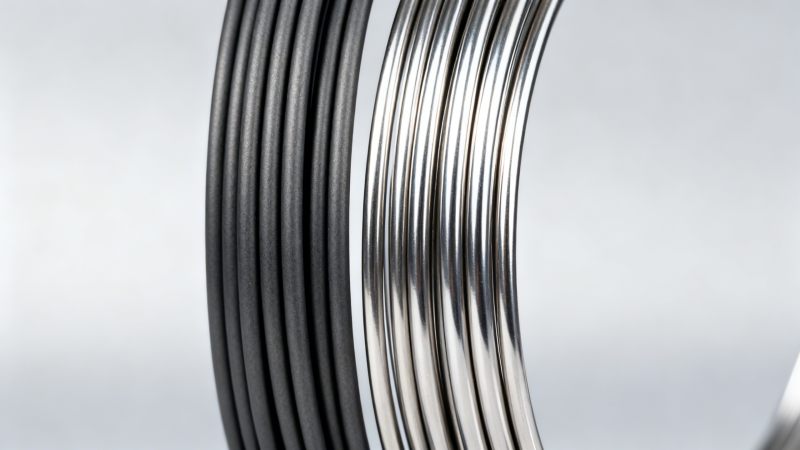
Flexible Steel Wire vs. Stainless Steel Wire: A Technical Comparison
“Flexible steel wire” typically refers to high-carbon, cold-drawn low-alloy wire (e.g., SAE 1065–1085), often phosphated and lubricated for enhanced drawability. It achieves flexibility through fine grain size and optimized heat treatment—but sacrifices long-term corrosion resistance. Stainless steel wire—especially 201 grade—delivers balanced formability and environmental resilience without nickel-intensive chemistry.
The table reveals a decisive trade-off: while carbon wire delivers higher initial strength, its low elongation and corrosion vulnerability severely limit service life in repeated-bend outdoor use. By contrast, 201 Stainless Steel Coil leverages high manganese (5.5–7.5%) and nitrogen stabilization to achieve superior ductility and strain hardening—enabling >55% elongation without sacrificing yield strength (≥275 MPa). This directly translates to longer fatigue life under dynamic loading.
Why 201 Stainless Excels in Outdoor Flex Applications
- Higher formability than 300-series grades—ideal for tight-radius coiling, weaving, or spring forming in fencing hardware;
- Cold-work hardening increases surface hardness up to 100 HRB after bending—delaying crack propagation;
- Low-nickel composition (3.5–5.5%) reduces raw material volatility while maintaining ASTM A666 compliance for outdoor exposure;
- BA and 2B surface finishes enhance reflectivity and reduce dirt adhesion on architectural façades.
Procurement Criteria for High-Cycle Outdoor Wire Projects
Procurement teams must evaluate beyond nominal diameter or tensile rating. For outdoor bending-critical applications, prioritize these 4 verification points:
- Surface finish certification: BA or 2B finish verified per ASTM A480, with Ra ≤ 0.4 μm to minimize stress concentration;
- Bend test report: Minimum 5× 180° bends over 1× diameter mandrel without cracking (per ISO 7801);
- Chemical traceability: Mill test report confirming Mn ≥5.5%, Ni ≤5.5%, and Cr ≥16.0% for consistent work hardening;
- Coil uniformity: Tolerance on coil OD ±2 mm and thickness variation ≤±0.05 mm across 2000mm length.
Hongteng Fengda applies 100% ultrasonic testing on all 201 Stainless Steel Coil batches and provides full EN 10204 3.1 documentation—including dimensional reports, tensile curves, and intergranular corrosion test results (ASTM A262 Practice E).
Why Global Buyers Choose Hongteng Fengda for Outdoor Structural Wire
As a structural steel manufacturer & exporter from China, Hongteng Fengda integrates material science with real-world deployment needs. Our production line includes continuous annealing furnaces (temperature control ±3°C), precision cold-drawing units (tolerance ±0.02 mm), and automated surface inspection systems—ensuring every coil meets ASTM A580, EN 10088-3, and GB/T 4237 specifications.
We support global procurement with: (1) lead times of 15–25 days for standard sizes (2.5–10.0 mm thickness, 610–2000 mm width); (2) OEM packaging for direct site delivery; (3) third-party SGS/BV pre-shipment inspection; and (4) technical consultation on wire-to-structure interface design (e.g., anchor point stress modeling, thermal expansion compensation).
Whether you’re specifying wire for coastal perimeter fencing, seismic-resistant façade cables, or modular agricultural enclosures—our engineering team helps align material selection with lifecycle cost, safety compliance, and installation efficiency. Contact us today for bend test samples, customized coil configurations, or ASTM/EN certification documentation.
Please give us a message


Please enter what you want to find