Why equal angle iron selection changes by project scenario
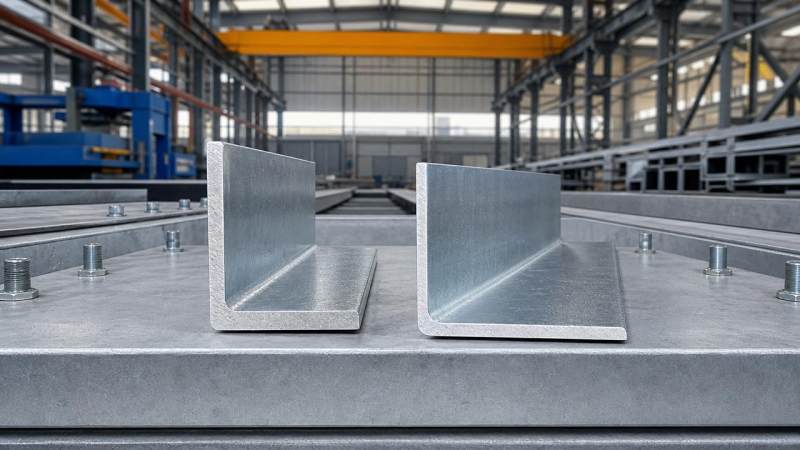
When selecting structural steel, section shape affects strength, joining speed, and total installed cost.
The comparison between equal angle iron and unequal angle options is not only geometric.
It directly influences load paths, connection details, corrosion protection, and fabrication waste.
For steel projects, the best choice depends on where the section will work.
A bracing frame, equipment support, stair member, or edge reinforcement can require different priorities.
That is why equal angle iron should be evaluated in application context, not as a default option.
Hongteng Fengda supplies structural steel products built to ASTM, EN, JIS, and GB standards.
This supports consistent sourcing for construction, industrial fabrication, and customized steel assemblies worldwide.
How application background determines the better angle profile
Equal angle iron has two legs with the same width.
Unequal angle sections use one longer leg and one shorter leg.
That simple difference changes the centroid position, stiffness balance, and attachment flexibility.
In symmetrical load conditions, equal angle iron often simplifies design and detailing.
In offset or one-sided connections, unequal angle can reduce eccentricity and improve fit.
Projects also vary by fabrication route.
Welded assemblies, bolted frames, and cold-formed integrations do not use angle sections in the same way.
Environmental exposure matters too.
If corrosion protection is critical, section choice may be reviewed together with coating systems.
For related sheet and enclosure applications, Galvanized Steel Coil Sheet can complement structural members where zinc protection and standard compliance are required.
Scenario 1: Building bracing and frames often favor balanced geometry
When equal loading is expected
In roof bracing, tower bracing, and secondary frames, equal angle iron is commonly preferred.
Its symmetric legs help create more predictable behavior under axial and reversal loads.
Connection layouts are usually easier to standardize.
This can lower shop time and improve installation speed on repetitive work.
What matters most here
- Axial load behavior and buckling checks
- Connection symmetry and hole alignment
- Ease of repeated fabrication
- Inventory simplicity across similar members
If standardization is a major target, equal angle iron usually offers stronger practical value.
Scenario 2: Equipment supports and offset connections may suit unequal angles better
When one leg needs more contact area
Industrial skids, machine bases, and platform edge supports often have one-sided attachment conditions.
In these cases, unequal angle can provide a wider leg where bolts, welds, or bearing contact are concentrated.
That may reduce the need for extra plates or awkward fit-up adjustments.
What matters most here
- Support eccentricity and local bearing demand
- Required weld length on one side
- Available assembly space
- How the member interfaces with channels, beams, or plates
If geometry is constrained, equal angle iron may look simpler but perform less efficiently in fabrication.
Scenario 3: Stair, rack, and shelf components need a fit-for-use decision
Not every project is heavily loaded.
Some uses prioritize edge stiffness, clean detailing, and material economy.
For stair trims, rack bracing, shelf supports, and guard components, the choice depends on attachment direction.
Equal angle iron works well when the member must look uniform and align evenly from both faces.
Unequal angles are often selected when a broader seating leg improves panel support or fastening access.
In many fabricated assemblies, the best option is the one that minimizes secondary processing.
That includes fewer shims, shorter weld preparation, and less drilling variation.
Scenario 4: Outdoor and coated steel systems require a broader materials view
For outdoor steelwork, section choice should be reviewed together with corrosion control.
Equal angle iron may be structurally suitable, yet coating durability can decide lifecycle cost.
When projects combine framing, cladding, trims, and formed parts, galvanized materials can improve consistency.
For example, Galvanized Steel Coil Sheet is available in grades such as DX51D+Z, SGCC, and S350GD+Z.
Thickness ranges from 0.12mm to 3.5mm, with widths from 600mm to 1500mm.
Zinc coatings including Z80, Z120, Z180, and Z275 support different exposure demands.
This matters when angle sections connect to sheet-based enclosures, trays, guards, or support skins.
Key demand differences between equal and unequal angle applications
How to choose the right angle profile for your actual use case
- Define whether the load is centered, offset, static, or reversing.
- Review connection space, bolt pattern, weld access, and adjacent parts.
- Compare section efficiency against fabrication complexity, not weight alone.
- Check whether equal angle iron can reduce drawing variations across the project.
- Consider coating method, exposure class, and compatibility with other steel products.
- Confirm compliance needs under ASTM, EN, JIS, or GB standards.
A practical decision should balance structural performance with workshop and site realities.
The lowest material weight does not always produce the lowest delivered project cost.
Common mistakes when comparing equal angle iron and unequal alternatives
One frequent mistake is choosing by habit rather than connection condition.
Equal angle iron is versatile, but not automatically best for every support detail.
Another mistake is checking section size without checking fabrication consequences.
A theoretically suitable profile may still cause difficult drilling, weld crowding, or fit-up delays.
Corrosion planning is also often separated from profile selection.
That can create mismatched durability between structural members and sheet-based accessories.
Finally, some evaluations focus only on section shape and ignore supplier capability.
Reliable dimensions, stable lead times, and standard compliance are equally important in global steel sourcing.
What matters most before the final decision
Equal angle iron is often the stronger choice for balanced loads, repetitive details, and uniform framing layouts.
Unequal angle becomes attractive when one-sided fastening, offset support, or space limitations dominate the design.
The key is to judge the section in the real application scenario.
Review load direction, joint geometry, coating needs, and total fabrication effort together.
For projects requiring structural steel supply with consistent standards and customization support, Hongteng Fengda provides dependable options across angle steel and related steel products.
A clearer angle profile decision today can reduce sourcing risk, installation trouble, and maintenance cost later.
Please give us a message


Please enter what you want to find