A stainless identification plate can look acceptable immediately after engraving and still fail its purpose months later. In plant rooms, coastal installations, washdown areas, and outdoor equipment yards, the usual problems are not limited to the engraved characters themselves: glare can hide shallow text, a rough finish can retain contamination, and a thin plate can distort during fixing or after thermal exposure. For durable marking, the practical starting point is to select the finish and thickness as a matched system, then choose an engraving process that suits that surface.
For most technical evaluations, a brushed or satin finish on adequately rigid stainless steel is the safest general choice for readable industrial plates. A fine matte surface controls reflection and supports contrast, while thickness must be sufficient for the plate size, mounting method, engraving depth, and service environment. Polished sheets, very thin gauges, and deeply textured finishes can work, but only under narrower conditions. The correct specification for engraving stainless steel plate is therefore driven by readability in service rather than appearance at delivery.
Begin with the conditions that make markings difficult to read
Before specifying a surface, identify how the plate will be seen and what will act on it. A serial-number plate inside a dry electrical cabinet has different requirements from a tag mounted on process equipment exposed to cleaning chemicals, dust, vibration, sunlight, and handling. When the plate is reviewed only under indoor lighting, an overly reflective finish may seem attractive; once installed outside, reflected sky or work lights can make the same characters difficult to read from normal inspection angles.
Document the following conditions before requesting material:
- Viewing distance and lighting: Close-up maintenance tags can accept smaller characters than safety or asset plates read from a standing position. Direct lighting increases glare on polished surfaces.
- Exposure: Moisture, chlorides, cleaning agents, oils, abrasion, and ultraviolet exposure influence both stainless grade selection and the usefulness of filled engraving.
- Mounting: Rivets, screws, adhesive bonding, welding, or formed tabs create different flatness and thickness requirements.
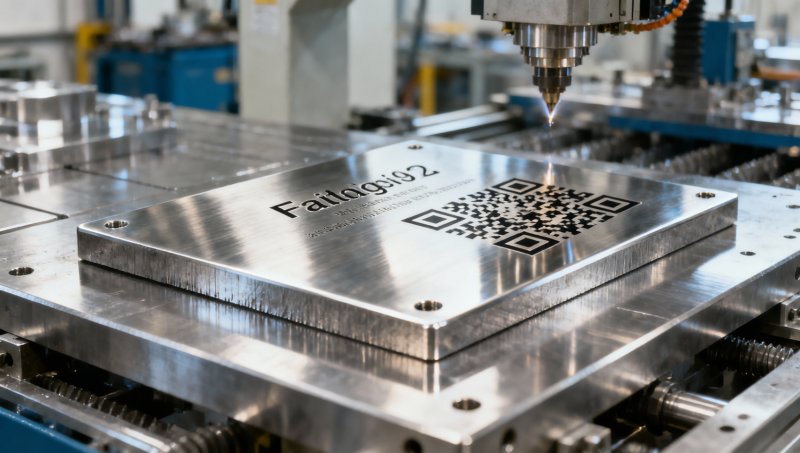
- Marking content: Fine QR codes, small logos, variable serial numbers, and deep machine-readable marks do not all respond equally to the same finish.
- Post-processing: Bending, punching, drilling, passivation, coating, or heat exposure can alter the visible face or introduce distortion.
These details prevent a common specification error: defining only alloy grade and plate dimensions while leaving surface condition as “standard mill finish.” Mill finish may be acceptable for hidden components, but it is not a sufficiently precise requirement where permanent legibility is the function of the part.
Choose the finish for contrast, cleanliness, and process stability
Surface finish has a direct effect on how engraved lines appear. It also affects how the plate handles fingerprints, residues, cleaning, and visual inspection. The best finish is not necessarily the smoothest one. It is the finish that lets the chosen marking method create stable contrast without introducing a difficult-to-maintain surface.
Brushed or satin finishes: the usual industrial default
A directional brushed or satin finish is widely suitable for equipment labels, control-panel plates, machinery tags, architectural identifiers, and fabricated structural markers. Its lower reflectivity improves visual contrast in varied lighting. Fine engraved text is easier to inspect than on a bright mirror surface, particularly where a technician is reading a tag at an angle.
The brushing direction should be specified when visual consistency matters. For rectangular plates, grain direction is usually aligned with the longer dimension or a defined installed orientation. Mixing grain directions across a set of tags can make otherwise matching plates look inconsistent. Deep engraving across a pronounced grain can also show different edge characteristics than engraving along it, so this should be checked when the design uses very small text.
Polished finishes: use only when appearance has a clear purpose
Bright polished stainless can be appropriate for decorative plaques, clean indoor displays, or applications where the surrounding equipment has a polished finish. It is less forgiving for functional identification. Glare is the main issue, but scratches and handling marks are also highly visible. A shallow laser mark may have limited contrast on a reflective plate, especially once the surface has accumulated fingerprints or light abrasion.
Where a polished face is mandatory, consider deeper mechanical engraving, a controlled dark marking process, or a recessed fill compatible with the operating environment. Confirm that any fill will withstand cleaning chemicals and temperature variation; paint or pigment that fails before the plate itself undermines the original purpose of using stainless steel.
Matte, bead-blasted, and textured surfaces
Matte and bead-blasted finishes reduce glare effectively and can give a uniform technical appearance. However, texture must be evaluated carefully. A coarse surface can soften the edge of fine characters and may retain dirt in exposed locations. It can also make it harder to obtain reliable contrast from light laser etching. These finishes are generally better suited to larger text, simple symbols, and plates that will not require repeated close reading of dense information.
A fine non-directional matte finish offers a useful middle ground when grain orientation is undesirable. It is especially practical for square plates, circular discs, or parts that may be installed in multiple orientations. The evaluator should request a representative marked sample rather than approving the blank sheet alone.
Mill finish and coated surfaces
Unfinished mill surfaces vary in appearance and are rarely ideal for precision identification. They may be acceptable for temporary tracking plates or internal components, but surface variation can make engraved output inconsistent. Protective films should also be removed before final engraving trials because heat, residue, or adhesive transfer can affect laser results.
Coated stainless plate introduces another decision layer. Engraving through a coating can produce strong contrast, but the coating—not the stainless substrate—becomes the primary durability concern. This approach may suit controlled indoor service, yet it should not be assumed equivalent to a deeply engraved or chemically marked stainless face in aggressive environments.
Thickness is a mechanical decision, not an engraving setting
Engraving machines can mark thin sheet, but that does not mean thin sheet is suitable for the finished plate. Thickness influences flatness, resistance to denting, edge quality after cutting, and the amount of material available for deep engraving. It also determines whether the plate remains stable once holes, corner radii, bends, or welded attachments are introduced.
For small, supported labels fixed over most of their area, thin stainless sheet may be adequate. The risk increases when a plate spans a gap, has only two fixing points, carries a protruding edge, or is expected to withstand repeated contact. A thin tag can oil-can, bend around fasteners, or vibrate against its substrate. Such movement may not erase the engraving, but it reduces readability and can lead to fatigue around holes.
The required thickness should be assessed against plate length and width, not chosen in isolation. A small rectangular tag and a long narrow strip can have the same nominal thickness but very different stiffness. The same applies to plates with large cutouts or closely spaced mounting holes. When deep mechanical engraving is planned, leave a reasonable base thickness beneath the engraved field and avoid placing deep marks near bends, holes, or narrow unsupported edges.
Match engraving method to the selected face
The marking method should be finalized only after the finish and thickness are defined. Laser engraving, laser annealing, mechanical engraving, chemical etching, and dot peen marking produce different surface conditions and depths. They should not be judged solely by how dark the mark looks on the first sample.
Laser engraving removes or modifies material and can create a visible mark with limited physical depth. It works well for detailed artwork and serial information, but output depends on alloy, surface finish, power settings, focus, and cleaning. On a brushed surface, it often provides good legibility; on highly reflective finishes, a process trial is essential.
Laser annealing can create dark contrast while retaining a relatively smooth surface. It is useful where avoiding a pronounced recess matters, but it is not automatically suitable for every grade or exposure condition. The mark should be assessed for contrast after normal cleaning and handling, not only immediately after processing.
Mechanical engraving creates a physical recess and is often selected for long-life information in abrasive or dirty service. It generally benefits from a finish that does not hide the engraved edges. The process can produce burrs, especially around small fonts and tight curves, so deburring and edge inspection should be included in the acceptance criteria.
Chemical etching can produce fine, consistent detail across larger areas. It may be useful for dense identification layouts, though process control, cleaning, and any subsequent filling need review for the intended environment. A technically attractive etched plate can still become difficult to read if its contrast treatment is not compatible with field cleaning.
Do not separate plate selection from fabrication sequence
A flat blank engraved before fabrication may look different after drilling, bending, welding, or surface treatment. Heat near the marked area can alter color, create scale, or affect the visual uniformity of the finish. Forming can stretch the grain on brushed sheet, and mechanical handling can scratch a polished or satin face. For plates that require fabrication, establish the sequence early: cut and form first where possible, clean the surface, then complete final marking after the risk of visible damage has passed.
There are exceptions. Variable data may need to be engraved after assembly, and some plates must be marked before a later operation for traceability. In those situations, protect the marked face and define acceptable cosmetic changes. Where welds are involved, keep identification fields away from heat-affected zones unless the marking method has been qualified for that sequence.
This planning is also relevant when stainless identification elements are supplied alongside construction steel. A project may use Wire rod in grades such as HRB335, HRB400, or HRB500 for reinforced concrete and structural work, while using stainless tags for durable asset identification on associated fabricated items. These products perform different functions, so a steel grade suitable for reinforcement should not be treated as a substitute for a corrosion-resistant engraved plate. Their connection is logistical or application-based, not material equivalence.
Specify the information a fabricator can actually control
“Stainless steel engraved plate” is too broad for a reliable purchase specification. The drawing or order should state the alloy grade required by the service environment, nominal thickness with tolerance expectations, plate dimensions, corner treatment, finish type, grain direction where relevant, engraving method, required character height, location of variable data, and mounting-hole details. If color fill, passivation, protective film, or rear-side adhesive is required, list each item separately.
Acceptance should be based on the installed function. Useful checks include whether all characters remain legible under expected lighting, whether the plate lies flat after mounting, whether engraved edges are free from objectionable burrs, and whether the visible finish is consistent across the batch. Where machine-readable codes are used, verify them after marking and after any cleaning process expected in service. A code that scans on a clean bench but fails when viewed through normal field contamination is not a robust identification method.
Frequent selection mistakes
The most persistent mistake is selecting a mirror-like face because it appears premium, then using shallow marks that disappear in reflection. The correction is not always a different laser setting; a satin or fine matte face may solve the operational problem more effectively.
Another mistake is using the thinnest available sheet to reduce weight or cost without considering mounting geometry. A small saving at material stage can produce warped plates, distorted holes, and poor presentation after installation. Review stiffness after all cutouts and bends, not just the blank thickness.
Technical teams also sometimes specify engraving depth without relating it to character size. Very small text cannot always remain sharp when engraved deeply, while large warning text may not need excessive depth if surface contrast is good. Marking depth, font selection, line spacing, and finish should be tested together on the actual alloy and surface condition.
Questions that often arise during plate evaluation
Is a thicker plate always better for engraving?
No. Extra thickness improves rigidity and supports deeper engraving, but it can add cost and complicate forming or attachment. The correct choice is the minimum thickness that remains flat, resists expected handling, and retains enough material beneath the engraved area.
Can a brushed finish be used outdoors?
Yes, provided the stainless grade suits the exposure and the finish can be cleaned. The finish helps with glare control but does not replace alloy selection for chloride-rich, wet, or chemically exposed locations.
Should engraving be filled with paint?
Filling can improve contrast, particularly for deep mechanical engraving. It should be treated as an additional material with its own resistance limits. In harsh cleaning or outdoor conditions, unfilled deep engraving or a proven marking process may be more dependable than relying on a decorative fill.
Please give us a message


Please enter what you want to find