When specifying galvanized structural steel or components for demanding projects, the choice between electro-galvanized and hot-dip galvanized finishes is rarely about which is universally superior. It is about matching the coating's physical characteristics to the specific environmental and mechanical demands of the application.
For technical evaluators, the initial rule of thumb is straightforward: hot-dip galvanizing provides a metallurgically bonded, thick zinc layer ideal for heavy-duty outdoor corrosion protection, while electro-galvanizing offers a thinner, uniform coating that preserves tight dimensional tolerances and provides a smoother surface finish for indoor or less aggressive environments. Real-world engineering decisions require looking past these basic definitions to understand how each process affects fabrication, lifespan, and total project costs.
The Metallurgical Reality: Alloy Layers vs. Pure Zinc
The fundamental difference lies in how the zinc interacts with the base steel. Hot-dip galvanizing involves submerging cleaned steel into a bath of molten zinc at approximately 450°C. This triggers a metallurgical reaction, creating a series of zinc-iron alloy layers between the steel substrate and the outer pure zinc layer. These alloy layers are actually harder than the base steel itself, providing exceptional resistance to mechanical damage, abrasion, and handling impacts during transport and construction.
Electro-galvanizing, conversely, is an electrolytic process. Zinc is deposited onto the steel surface using an electrical current in a zinc salt solution. There is no metallurgical reaction; the zinc simply adheres to the surface. The resulting coating is almost entirely pure zinc, which is softer and more ductile. While this makes it highly suitable for severe forming and drawing operations without flaking, it lacks the abrasion resistance of the hot-dip alloy layers. If a component will face frequent friction, handling, or particulate blasting during its service life, the electro-galvanized surface will wear away much faster.
For technical evaluators managing steel procurement, the silicon and phosphorus content in the base steel can also influence the hot-dip process. High silicon levels can accelerate the metallurgical reaction, resulting in a thicker, more brittle alloy layer with a dull gray matte finish rather than a bright, continuous spangle. Specifying steels with controlled silicon levels is necessary when a uniform hot-dip finish is required for both protection and aesthetics.
Dimensional Tolerances and Internal Clearances
Coating thickness directly impacts dimensional tolerances, a critical factor for technical evaluators designing precision assemblies. Hot-dip galvanizing typically applies a coating ranging from 50 to 150 microns, depending on the steel's chemistry and the bath dynamics. This added thickness can alter thread engagements, clog tapped holes, and reduce the internal diameter of small tubes. For threaded components, the added thickness often requires threads to be tapped oversize before galvanizing or centrifuged to clear excess zinc, which can slightly compromise the fatigue strength of the threads.
Electro-galvanizing applies a much thinner layer, usually between 5 and 25 microns. It maintains the original dimensional profile of the steel with high precision. When dealing with fluid transfer systems or precision components where internal clearance is critical, maintaining the exact original dimensions is essential. For instance, if you are sourcing an A36 Steel Pipe for tubular heat exchangers or condensers, an electro-galvanized finish will not significantly alter the minimum wall thicknesses or the internal flow dynamics, whereas a hot-dip process might require oversizing the initial specification to compensate for internal coating buildup.
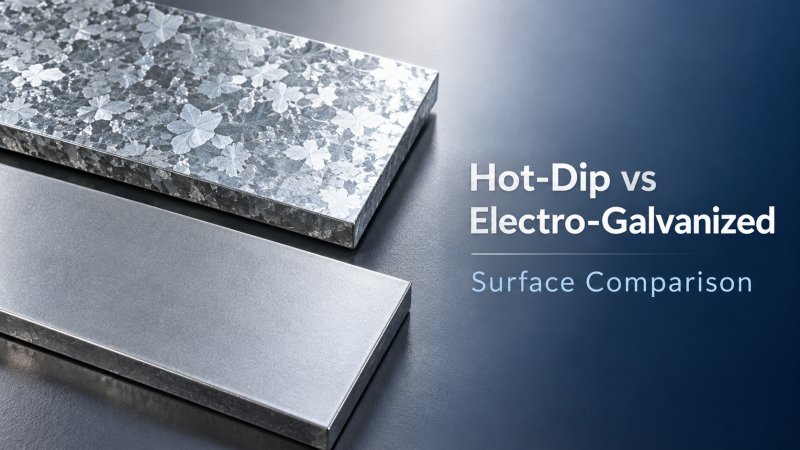
The surface finish also differs drastically. Hot-dip galvanizing produces a crystalline pattern known as spangle, which can be rough and uneven. Electro-galvanizing yields a smooth, uniform, matte-gray surface that is often preferred when the component will be painted or powder-coated, as it requires less surface preparation and provides a more consistent aesthetic base.
Corrosion Mechanisms and Environmental Limits
Both processes protect steel through barrier protection and cathodic (sacrificial) protection. However, the volume of zinc available to sacrifice itself dictates the service life.
In rural atmospheres, a standard hot-dip galvanized coating can last 50 years or more. In industrial or coastal environments, where sulfur dioxide or chloride ions accelerate zinc consumption, the lifespan typically ranges from 20 to 25 years. The thicker the initial coating, the longer the time before the zinc is fully consumed and the base steel begins to rust.
Electro-galvanized coatings, being significantly thinner, are generally limited to indoor applications or mild outdoor environments where they are shielded from direct, continuous moisture. In these conditions, they can provide 5 to 10 years of maintenance-free protection. Once the thin pure zinc layer is consumed, corrosion of the base steel begins rapidly. Specifying electro-galvanized steel for an outdoor structural application in a coastal region is a common specification error that leads to premature failure.
Fabrication Constraints and Welding Considerations
The sequence of fabrication relative to galvanizing is a major decision point. If components are galvanized after fabrication, hot-dip galvanizing is the standard for heavy structures. However, welding hot-dip galvanized steel requires strict safety protocols. The high heat of the arc vaporizes the zinc coating, producing zinc oxide fumes that can cause metal fume fever. Additionally, the welding process burns away the coating in the weld zone, leaving the joint vulnerable. This area must be cleaned and repaired using zinc-rich paints to restore corrosion protection.
Electro-galvanized steel is often fabricated after coating, particularly in sheet metal and light gauge applications. Because the coating is thinner and pure zinc, it generates fewer fumes during welding, though ventilation is still mandatory. The ductility of the electro-galvanized layer allows the steel to be bent, stamped, and formed without the coating cracking or peeling, a limitation frequently encountered with hot-dip coatings on tight-radius bends.
Evaluating the Total Cost of Ownership
Initial cost per ton or per square meter often favors electro-galvanizing for thin sheets and small parts, as the process consumes less zinc and energy. However, for heavy structural sections like beams, channels, and thick plates, hot-dip galvanizing becomes highly cost-competitive. The economics shift when evaluating the total cost of ownership over the asset's lifecycle.
If an electro-galvanized component is used in an environment that exceeds its corrosion resistance limits, the costs associated with early replacement, scaffolding, and maintenance painting will far exceed the initial savings. Hot-dip galvanizing requires zero maintenance for decades in most environments, making its lifecycle cost significantly lower for infrastructure, utility, and heavy industrial projects.
Decision Matrix for Technical Evaluators
Selecting the right galvanized finish requires aligning the project parameters with the physical realities of the coatings.
- Choose Hot-Dip Galvanizing when: The component will be exposed to outdoor, industrial, or marine environments; maximum corrosion resistance and a long, maintenance-free lifecycle are primary requirements; the steel section is thick, and dimensional changes of 50-150 microns are acceptable; or the component requires high abrasion resistance during handling or service.
- Choose Electro-Galvanizing when: The application is strictly indoor or in a highly controlled, mild environment; tight dimensional tolerances must be maintained, such as in precision machined parts or small-diameter fluid lines; the steel will undergo severe forming, drawing, or bending after the coating is applied; or a smooth, uniform surface finish is required for subsequent painting.
Understanding these boundaries ensures that the specified galvanized steel performs as intended, balancing upfront procurement costs with long-term structural integrity.
Please give us a message


Please enter what you want to find