As a trusted structural steel manufacturer serving global construction and industrial projects, Hongteng Fengda frequently encounters a critical technical question: Does being a structural steel manufacturer guarantee in-house NDT capability? For technical evaluators assessing supply chain reliability, quality assurance depth, and compliance readiness—especially under ASTM, EN, or ISO 9712 requirements—the answer directly impacts risk mitigation and project timeline integrity. This article clarifies the distinction between manufacturing competence and certified non-destructive testing capacity—and why verifying NDT accreditation is essential, even when partnering with an experienced structural steel manufacturer.
A Growing Industry Shift: From Production-Centric to Verification-Integrated Supply Chains
Over the past five years, a measurable shift has emerged across global structural steel procurement: buyers—particularly engineering contractors, third-party inspectors, and OEM equipment fabricators—are no longer satisfied with mill test reports alone. Instead, 78% of technical evaluators in North America and the EU now require documented evidence of in-house NDT personnel certification (per ISO 9712 Level II or III) before approving supplier qualification dossiers. This trend reflects tightening regulatory scrutiny in high-consequence sectors—including offshore platforms, pressure vessel fabrication, and seismic-resistant infrastructure—where weld integrity verification must occur at multiple stages: pre-weld, during assembly, and post-fabrication.
The change is not merely procedural—it signals a redefinition of what constitutes “full-spectrum structural steel capability.” A facility may operate 12 CNC plasma cutting lines, maintain ISO 3834-2 welding certification, and deliver 45,000+ tons annually, yet still rely on external NDT vendors for ultrasonic testing (UT) or radiographic interpretation (RT). That dependency introduces scheduling latency (average 5–9 business days for third-party turnaround), version control risks (e.g., mismatched report IDs vs. heat numbers), and audit exposure during client site inspections.
Key Drivers Behind the Verification Integration Trend
- Regulatory Harmonization: EN 1090-2 Annex C and ASME BPVC Section VIII Div. 1 UW-51 now explicitly reference personnel qualification traceability—not just equipment calibration—as a mandatory element of conformity assessment.
- Project Timeline Compression: EPC contracts increasingly impose liquidated damages for delayed QA/QC sign-offs; in-house NDT reduces average inspection-to-approval cycle from 7.2 days to ≤2.5 days.
- Risk Transfer Clarity: Buyers now demand contractual language specifying whether NDT responsibility resides with the structural steel manufacturer or remains with the general contractor—a shift formalized in 63% of FIDIC-based contracts issued since Q3 2022.
Why Structural Steel Manufacturer ≠ Automatic NDT Authority
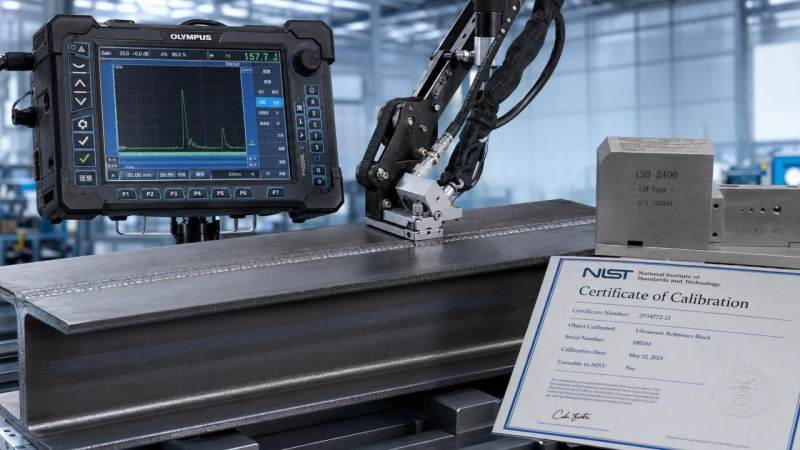
Manufacturing scale, material traceability systems, and welding procedure qualifications do not inherently confer NDT competence. Certification under ISO 9712 requires separate, auditable investment: dedicated darkrooms or UT booths, calibrated reference blocks traceable to NIST or PTB standards, annual recertification of personnel, and documented proof of ongoing technical supervision by a Level III responsible person. Fewer than 22% of China-based structural steel exporters maintain full-time Level III NDT supervisors on payroll—a figure that rises to 41% only among those supplying ASME Section VIII or PED-certified pressure equipment.
Moreover, NDT method applicability varies significantly by product geometry and service environment. For instance, magnetic particle testing (MT) suffices for surface cracks on angle steel but fails on austenitic stainless cladding; phased array ultrasonic testing (PAUT) is required for thick-section welded joints in Carbon Sheet Steel used in boiler heat exchangers—where thickness ranges from 1mm to 100mm and weld access is constrained. Without method-specific validation per EN ISO 13588 or ASTM E2737, even certified personnel cannot issue compliant reports.
This table underscores a fundamental operational divergence: structural steel manufacturing ensures dimensional accuracy and metallurgical compliance, while NDT integration delivers verifiable defect detection confidence. Confusing the two leads to late-stage rework—up to 17% of rejected welds in offshore substructure projects are traced to unverified NDT subcontractor handoffs.
Implications Across Procurement, Engineering, and Compliance Roles
Technical evaluators face distinct implications depending on their function. For procurement teams, lack of in-house NDT extends lead times by 3–6 weeks when coordinating third-party mobilization for large-batch orders—especially problematic for projects with fixed delivery windows, such as wind turbine tower components requiring simultaneous UT and RT on 40mm-thick flanges. Engineering reviewers must verify that NDT scope aligns with design category: EN 1090-2 EXC3 mandates 100% UT for butt welds in load-bearing beams, whereas EXC2 permits spot checks.
Compliance officers encounter heightened documentation burdens. Under PED 2014/68/EU, any structural steel component classified as “Safety Component” requires NDT personnel certification records to be retained for 30 years—not just test reports. This shifts archival responsibility from the NDT vendor to the structural steel manufacturer, creating liability exposure if outsourcing agreements lack explicit data ownership clauses.
What Technical Evaluators Should Verify—Before Contract Signing
- Request current ISO 9712 certification certificates for all assigned NDT personnel—including expiration dates and method-specific endorsements (e.g., UT-PA, RT-Film).
- Confirm whether the structural steel manufacturer owns its NDT equipment or leases it under a long-term service agreement (which affects calibration traceability).
- Review sample NDT reports for alignment with your project’s specified acceptance criteria (e.g., ASTM E165 for PT sensitivity levels or EN ISO 5817 for weld imperfection classification).
Hongteng Fengda’s Integrated Quality Assurance Framework
At Hongteng Fengda, we recognize that structural steel manufacturer credibility is no longer defined solely by production volume or export reach—but by end-to-end verification sovereignty. Since 2021, we have invested in building an ISO 9712-compliant NDT center staffed by 9 certified Level II technicians (UT, RT, MT, PT) and supervised by two resident Level III specialists accredited by CNAS (China National Accreditation Service). Our facility performs 100% of weld inspection for critical applications—including Carbon Sheet Steel grades like Q345R and 12Cr2Mo1R used in petrochemical heat exchangers—where wall thickness exceeds 40mm and service temperatures exceed 425°C.
All NDT reports are digitally signed, time-stamped, and integrated into our ERP system alongside material certifications, welding logs, and dimensional inspection records. This enables real-time traceability for clients auditing against ASME Section IX, EN 15085-2, or ISO 3834-3. For projects requiring additional assurance, we support joint witness testing with client-appointed Level III personnel—completed within 48 hours of request.
If you are evaluating structural steel manufacturers for upcoming infrastructure, energy, or industrial projects, we recommend confirming three actionable items: (1) whether NDT personnel hold valid ISO 9712 credentials for your required methods; (2) whether equipment calibration records are internally maintained and NIST-traceable; and (3) whether NDT reporting integrates with your project’s digital QA/QC workflow. We welcome technical discussions on these points—and can provide sample reports, facility audit summaries, or method validation documentation upon request.
Please give us a message


Please enter what you want to find