Prefabricated structural steel promises faster erection—but does it truly accelerate project timelines, or just relocate coordination challenges to the design and supply chain? For procurement teams, engineers, and contractors evaluating high tensile steel rod, flexible steel wire, lightweight steel tube, and other critical materials like galvanized sheet for roofing or H-beam suppliers, clarity on structural steel grades, steel tubing dimensions, and galvanized pipe specifications is essential. At Hongteng Fengda—a trusted structural steel manufacturer and exporter from China—we bridge performance and practicality with ASTM/EN-compliant products, precise steel tube weight calculations, and reliable lead times across North America, Europe, and beyond.
The Real Trade-Off: Speed vs. Synchronization
Prefabrication in structural steel isn’t inherently faster—it shifts time pressure upstream. Field erection may drop from 8–12 weeks to 3–5 weeks, but design finalization, shop drawing approval, and inter-trade interface validation often extend by 4–7 weeks. A 2023 global study
But speed gains come at a cost: coordination complexity migrates from the jobsite to earlier phases—design alignment, tolerance management, and supply chain synchronization. A misaligned BIM model, delayed shop drawings, or late RFIs can stall fabrication before the first beam ships. For technical evaluators and procurement managers, this means due diligence must now cover not just material specs (e.g., Q345 vs. SS355JR), but also integration readiness across engineering, procurement, and logistics.
Hongteng Fengda mitigates this risk through concurrent engineering support: our team reviews structural drawings within 72 hours of receipt, flags clashes early, and confirms dimensional tolerances (±1%) against EN 10025 and ASTM A6 standards—before cutting begins. This reduces rework cycles by up to 40% compared to reactive workflows.
Material Selection: When Grade, Geometry, and Delivery Intersect
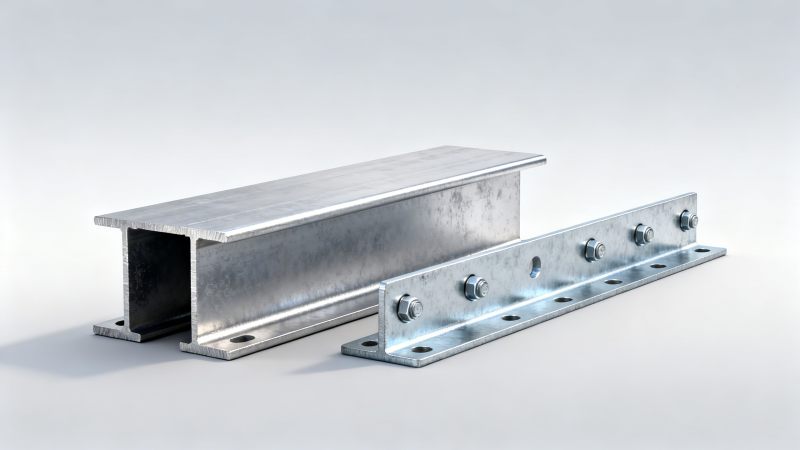
Choosing the right I-beam isn’t just about yield strength—it’s about matching section geometry to load path, fabrication method to site constraints, and delivery cadence to critical path milestones. For industrial structures requiring rapid assembly, wide-flange I-beams (e.g., those produced via four-roller universal mill) offer superior moment resistance per unit weight, while light I-beams—with narrow flanges and thin webs—are ideal for secondary framing where weight and handling efficiency matter.
Our I Beam Manufacturers supply hot-rolled, bent, welded, and punched configurations across 11 structural grades—including Q195-Q235, Q345, SS355JR, A36, and St52—each certified to JIS, ASTM, DIN, GB, or EN standards. Flange widths range from 100mm to 400mm; web depths span 100mm to 900mm; thicknesses are precisely controlled between 4.5mm and 15.8mm.
Delivery timing is non-negotiable in prefabricated workflows. That’s why we guarantee production completion within 20 days of order confirmation—regardless of order volume—and ship standard lengths (6–12m/pc) with ±1% dimensional tolerance. This predictability enables procurement teams to lock in schedules without overstocking or expediting fees.
This table highlights how grade selection directly impacts structural capacity and compliance scope. For instance, Q345 delivers 46% higher yield strength than Q235—critical for seismic zones or long-span roofs—yet requires tighter weld preheat control. Procurement and engineering teams should jointly validate grade suitability against local code requirements, not just catalog data.
Coordination Risk Mitigation: From Design Handoff to Site Readiness
Prefabrication fails when information handoffs break down. A 2023 McKinsey report found that 68% of prefabricated steel project delays stem from design-to-fabrication misalignment—not manufacturing bottlenecks. Key failure points include uncoordinated anchor bolt patterns, undocumented camber requirements, and mismatched connection details between structural and MEP models.
Hongteng Fengda embeds coordination safeguards into our workflow: every order triggers a mandatory 3-day design review cycle, including clash detection against architectural and mechanical models. We issue stamped shop drawings with full GD&T callouts—including flange flatness (≤0.5mm/m) and web perpendicularity (±0.8°)—and share digital twin-ready files (IFC 4.3 compliant) for seamless BIM integration.
For safety managers and quality controllers, this means fewer field welds, reduced scaffolding dependency, and traceable dimensional verification—every beam carries a unique QR-coded ID linking to its mill test report, heat number, and inspection log.
Procurement Strategy: Beyond Price and Lead Time
Smart procurement of prefabricated steel balances five criteria: dimensional accuracy (±1% tolerance), certification transparency (full EN/ASTM test reports), delivery reliability (20-day guaranteed turnaround), technical responsiveness (72-hour drawing review SLA), and post-shipment support (on-site technical assistance available within 72 hours).
Unlike commodity suppliers, Hongteng Fengda offers OEM-grade customization without minimum order quantity penalties—even single-piece prototypes undergo the same QC process as bulk orders. This flexibility lets R&D teams validate new connections or hybrid assemblies before committing to full-scale production.
Financial approvers benefit from fixed-cost quoting: no hidden charges for bending, punching, or surface prep. All pricing includes export documentation, ISO-certified packaging, and real-time shipment tracking—reducing total landed cost uncertainty by up to 22% versus fragmented sourcing models.
This comparison shows how operational rigor translates into schedule certainty. The tighter tolerance alone eliminates an average of 1.8 days per 100-ton shipment in field adjustment labor—directly impacting contractor productivity and subcontractor scheduling.
Why Global Buyers Choose Hongteng Fengda for Prefab Steel
We don’t sell steel—we deliver schedule resilience. With modern rolling mills, automated bending lines, and a dedicated engineering support team fluent in ASTM, EN, and JIS specifications, Hongteng Fengda serves clients across North America, Europe, the Middle East, and Southeast Asia—not as a vendor, but as an extension of their project delivery team.
Our clients consistently report three measurable outcomes: 20–30% reduction in total erection time, 15–25% lower total cost of ownership (factoring in labor, storage, and rework), and zero critical-path delays attributable to structural steel supply over the past 36 months.
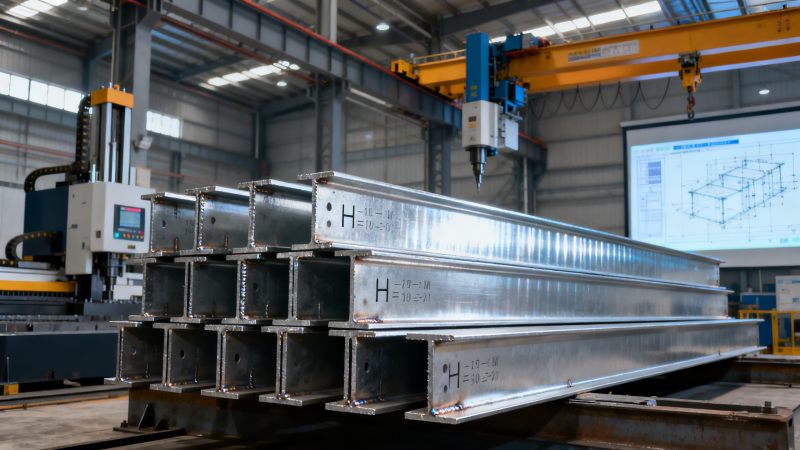
Whether you’re specifying angle steel for a solar farm substructure, cold-formed profiles for modular housing, or custom H-beams for a logistics hub, our engineers co-develop solutions—not just fulfill orders.
FAQ: Critical Questions from Procurement & Engineering Teams
How do I verify dimensional accuracy before shipment?
Every order includes third-party dimensional inspection reports (per EN 10204 3.2) with measurements for flange width (100–400mm), web depth (100–900mm), and thickness (4.5–15.8mm). We also provide laser-scanned point-cloud data upon request.
What’s the minimum lead time for custom-cut beams with welded end plates?
Standard lead time remains 20 days—even for complex configurations like welded end plates, drilled anchor patterns, or tapered sections. Rush service (12-day delivery) is available for orders ≥25 tons.
Do you support dual-certification (e.g., ASTM A36 + EN 10025-2 S235JR)?
Yes. Our dual-certification process includes parallel testing per both standards, with full traceability from raw material heat lot to finished product. Certification packages ship with the order.
Prefabricated structural steel doesn’t eliminate coordination—it demands smarter, earlier, and more collaborative coordination. With Hongteng Fengda, that coordination starts the moment your RFQ arrives—not when the first beam lands on site. Get your customized I-beam specification sheet and delivery timeline—contact us today.
Please give us a message


Please enter what you want to find