When comparing corrosion resistance, cost efficiency, and long-term performance, DX53D Galvalume Steel Coil stands out among common coating options. For business evaluators sourcing steel for construction or industrial use, understanding these differences is essential to reducing procurement risk, controlling lifecycle costs, and selecting the most suitable material for demanding project environments.
In B2B steel purchasing, coating selection is rarely a simple price comparison. A lower initial cost can lead to faster red rust, earlier repainting, more frequent replacement, or unexpected warranty disputes within 3–8 years of service. For projects exposed to humidity, industrial atmosphere, coastal air, or wide temperature swings, the choice between DX53D Galvalume Steel Coil and other coated steel products directly affects maintenance budgets, fabrication efficiency, and project durability.
For procurement teams, technical evaluators, and sourcing managers, the key question is not only which coating is cheaper per ton, but which option performs better over the full service cycle. This article compares DX53D Galvalume Steel Coil with common coating alternatives, explains where each option fits, and outlines practical decision criteria for industrial and construction buyers working with international supply chains.
What Makes DX53D Galvalume Steel Coil Different
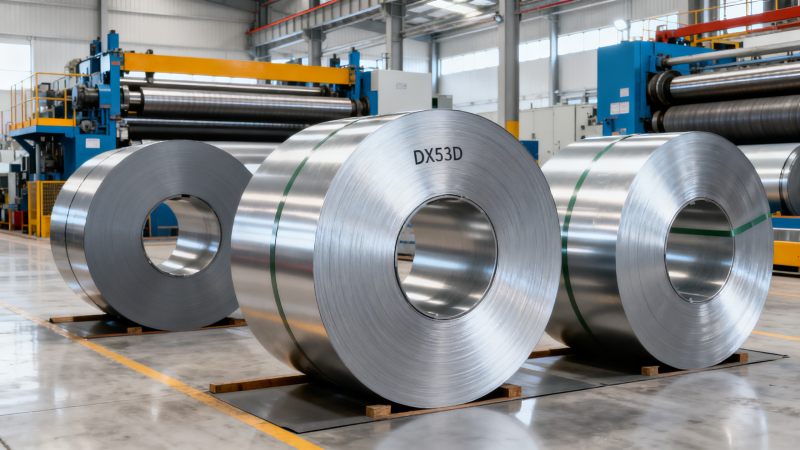
DX53D is a commonly specified substrate grade for forming applications, while Galvalume refers to an aluminum-zinc alloy coating designed to improve corrosion resistance and heat reflectivity. In many commercial supply arrangements, the coating composition is typically around 55% aluminum, 43.4% zinc, and 1.6% silicon. That balance gives the surface two important advantages: barrier protection from aluminum and sacrificial protection from zinc.
Why business evaluators focus on this grade
DX53D Galvalume Steel Coil is often selected when buyers need both formability and corrosion resistance. Compared with harder or less formable substrates, DX53D is suitable for bending, roll forming, profiling, and fabrication of panels, ducts, framing accessories, and industrial components. That matters when a project includes multiple forming steps, tight tolerances, or complex profiles that can crack weaker coating systems during processing.
From a commercial perspective, this material is attractive because it can lower lifecycle cost in applications where service life targets exceed 10 years and may extend to 15–25 years under moderate environments, depending on coating mass, design details, and local exposure conditions. Actual durability always depends on installation, edge treatment, ventilation, runoff control, and maintenance schedule.
Typical evaluation points
- Corrosion resistance in rural, urban, industrial, or marine-adjacent environments
- Formability during 2–4 processing stages such as slitting, roll forming, bending, and stamping
- Surface quality requirements for exposed versus concealed applications
- Expected maintenance interval, often measured in 5-year review cycles
- Compatibility with ASTM, EN, JIS, or GB-based project specifications
Before comparing options in detail, it helps to look at how DX53D Galvalume Steel Coil performs against common alternatives used in steel construction and manufacturing supply chains.
The table shows a common procurement pattern: buyers choose DX53D Galvalume Steel Coil when they need a practical middle ground between fabrication flexibility and longer outdoor durability. Galvanized steel remains a valid choice for cost-sensitive or lower-exposure projects, while painted systems are preferred when appearance is as important as protection.
DX53D Galvalume Steel Coil vs Common Coating Options
A business evaluator should compare coating systems across at least 4 dimensions: corrosion resistance, processing suitability, total installed cost, and service life risk. Initial material price alone can be misleading, especially when a project spans 12–36 months of construction and 10+ years of operational use.
1. Corrosion resistance in real project environments
In many atmospheric conditions, Galvalume-coated steel outperforms standard zinc-coated steel in long-term surface stability. This is particularly relevant for roofing, cladding subcomponents, industrial housings, and factory systems exposed to periodic condensation, rainfall, or heat cycling. However, no coated steel is universal. In direct contact with wet concrete, heavy animal waste, or strongly alkaline runoff, performance can vary and detail design becomes critical.
For inland industrial projects, DX53D Galvalume Steel Coil is often considered when maintenance access is difficult or shutdown costs are high. A plant that requires panel replacement every 6–8 years can become significantly more expensive than one needing only inspection and localized treatment over 12–15 years.
2. Formability and fabrication risk
DX53D substrate chemistry and mechanical behavior support forming operations better than many buyers assume. For roll forming lines, light-gauge framing accessories, and fabricated steel components, coating integrity after bending is a practical issue. If the material is too brittle or the bend radius is too tight, micro-cracks can start corrosion earlier than expected.
This is why procurement specifications should define at least 3 processing factors: minimum bend radius, target coating mass, and whether the final part has exposed cut edges. These details matter more than broad descriptions such as “anti-rust steel” or “outdoor grade steel.”
3. Cost efficiency over the lifecycle
If a coated coil costs 5%–12% more at purchase but extends inspection intervals, reduces repainting, and avoids early replacement, the total ownership case may still be stronger. This is especially true in export procurement, where replacement involves freight, customs coordination, and downtime. Business evaluators should calculate delivered cost, processing yield, maintenance frequency, and replacement exposure rather than comparing ex-works price alone.
The following comparison framework can help teams make a more disciplined decision across common coating choices.
For evaluators, the main takeaway is that DX53D Galvalume Steel Coil usually delivers the best value when corrosion exposure is moderate to demanding, the part requires forming, and replacement cost is materially higher than the small difference in initial steel price.
How to Specify the Right Coated Steel for Procurement
A strong RFQ should include more than grade and thickness. In practice, 5 specification gaps cause many sourcing disputes: missing coating mass, undefined surface quality, vague tolerance expectations, unclear end use, and absent packaging requirements. These gaps increase the chance of receiving material that is technically compliant on paper but operationally unsuitable in fabrication or installation.
Key specification checklist
- Base steel grade and forming requirement, such as DX53D for profiling or bending.
- Coating type and target coating mass or designation.
- Thickness range, width range, and coil weight limits for the processing line.
- Surface finish requirement for exposed versus concealed use.
- Applicable standard such as ASTM, EN, JIS, or GB.
- Delivery terms, testing documents, and inspection method before shipment.
Practical buying thresholds
For many export transactions, buyers review at least 6 checkpoints before approval: chemical composition, mechanical properties, coating consistency, dimensional tolerance, coil packaging, and document completeness. Lead times commonly range from 15–35 days depending on tonnage, production schedule, and whether slit coil, cut sheet, or OEM forming is required.
At Hongteng Fengda, the value for international buyers lies in combining standard compliance with practical production support. As a structural steel manufacturer and exporter from China, the company supplies angle steel, channel steel, beams, cold formed steel profiles, and customized structural steel components, helping buyers align product selection with project conditions, fabrication needs, and delivery planning.
Related Project Materials and Mid-Project Integration Needs
In many infrastructure packages, coated coil products are not purchased alone. Evaluators often source them alongside structural sections, formed profiles, or foundation materials within the same 2-stage or 3-stage procurement plan. That is why supplier capability matters beyond one item. The ability to coordinate multiple steel categories can reduce communication gaps, shorten review cycles, and improve consistency in documentation and shipment planning.
For example, marine-adjacent or water-retaining construction may combine corrosion-resistant sheet products with heavy foundation systems such as Steel Sheet Piles. These products are available in steel grades including S275, S355, S390, S430, SY295, SY390, and ASTM A690, and are produced to EN10248, EN10249, JIS5528, JIS5523, and ASTM standards.
Typical application scenarios include deep water construction and cofferdam formation. From a procurement perspective, notable parameters include single lengths of over 80 m, flexible dimension options, and certifications such as ISO9001, ISO14001, ISO18001, and CE FPC. Their advantages include high strength, reusable service potential, easier penetration into hard soil layers, and good waterproof performance in temporary or semi-permanent containment structures.
This type of inserted product planning is relevant because business evaluators rarely assess materials in isolation. They assess how one steel category affects the wider project package, from logistics and inspection to fabrication sequencing and total risk allocation.
Common Risks, Misunderstandings, and Selection Advice
A frequent misunderstanding is assuming all “anti-corrosion” coated steel behaves similarly. In reality, coating chemistry, coating mass, substrate grade, environmental exposure, and installation details can change outcomes significantly within 12–24 months. Selecting the wrong coating for the wrong service condition often leads to complaints that are actually specification errors rather than manufacturing defects.
Common risk points
- Specifying outdoor use without identifying humidity level, salt exposure, or industrial contamination
- Ignoring cut-edge treatment in formed parts with high edge exposure ratios
- Using a price-only comparison without estimating 10-year maintenance cost
- Choosing decorative painted material when the project mainly needs structural durability
- Failing to confirm whether the supplier can provide consistent documentation for export inspection
Selection advice for evaluators
If the project environment is moderate, the design life target is above 10 years, and the steel needs forming, DX53D Galvalume Steel Coil is often a strong candidate. If the project is temporary, low-exposure, or heavily cost-constrained, standard galvanized options may still be commercially reasonable. If appearance, color retention, and branding are priorities, a prepainted system may deserve closer review despite different maintenance considerations.
For cross-border buyers, supplier coordination is equally important. A manufacturer with stable production capacity, quality control, and familiarity with ASTM, EN, JIS, and GB expectations can help reduce preventable sourcing risks. This becomes more valuable when one supplier supports multiple structural steel categories and can align product schedules across a broader project bill of materials.
Final Decision Framework for B2B Buyers
For most commercial evaluations, the decision can be simplified into 4 questions. First, what environment will the steel face over the next 10–20 years? Second, how much forming or fabrication will occur before installation? Third, what is the real cost of maintenance or replacement if the coating underperforms? Fourth, can the supplier deliver consistent standards, documentation, and lead times across the full order scope?
DX53D Galvalume Steel Coil offers a strong balance of corrosion resistance, processability, and long-term value in many construction and industrial applications. It is especially relevant for buyers who need more than low upfront pricing and want a material choice that supports durability, predictable maintenance planning, and reduced sourcing uncertainty.
Hongteng Fengda supports global buyers with structural steel products, customized solutions, stable manufacturing capability, and export-focused service. If you are comparing coated steel options for your next project, contact us now to get a tailored material recommendation, discuss technical details, or request a quotation based on your required standards, dimensions, and application conditions.
Please give us a message


Please enter what you want to find