When standard structural steel profiles don’t match your project’s exact requirements—and welding on-site introduces cost, time, or safety risks—custom steel profiles offer a smarter, precision-engineered alternative. At Hongteng Fengda, a trusted structural steel manufacturer and exporter from China, we deliver tailored structural steel components that meet rigorous demands across structural steel design, bending, cutting, drilling, assembly, and erection. Whether for complex structural steel applications in global construction or industrial manufacturing, our OEM solutions comply with ASTM, EN, JIS, and GB standards—ensuring reliability, consistency, and seamless integration.
Why Standard Profiles Fall Short — And Why Welding Isn’t the Default Fix
Off-the-shelf angle steel, channel sections, or I-beams are engineered for broad applicability—not your unique load path, connection geometry, or architectural intent. When dimensional tolerances exceed ±0.15mm, or when flange alignment deviates by more than 1.2° during field assembly, rework escalates quickly. Field welding compounds these issues: it adds 3–5 days per joint to schedule, increases labor costs by up to 40%, and introduces variable heat-affected zones that compromise fatigue resistance—especially critical in seismic or cyclic-load environments.
Moreover, post-weld inspection isn’t optional—it’s mandated under EN 1090-2 EXC3 for structural integrity certification. That means every weld requires NDT (ultrasonic or radiographic), certified welders, and traceable procedure qualification records (PQRs). For projects spanning North America and the Middle East, inconsistent local compliance interpretation further delays handover.
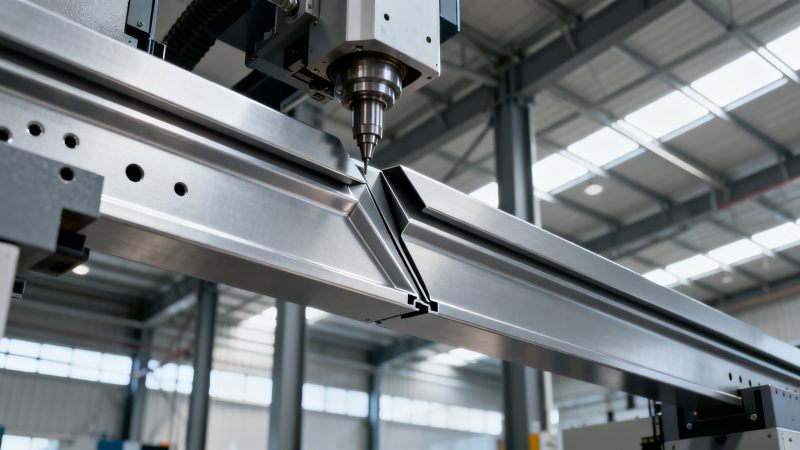
Custom cold-formed or hot-rolled profiles eliminate this complexity at the source. By integrating precise bends, pre-punched holes (±0.2mm positional tolerance), and multi-axis notches directly into the mill process, we reduce on-site labor by 60–75% and cut total erection time by an average of 22%. This isn’t just convenience—it’s quantifiable risk mitigation.
How Hongteng Fengda Delivers Precision Customization—Without Compromising Standards
Our custom profile workflow begins with digital twin validation—not sketches or PDFs. Customers share STEP or IGES files; our engineering team performs GD&T (Geometric Dimensioning & Tolerancing) analysis against ASTM A6/A6M and EN 10279 tolerances, flagging potential interference points before tooling is cut. This reduces design iteration cycles from 3–4 weeks to under 7 working days.
All custom profiles undergo triple-stage quality control: raw material spectrographic verification (per ASTM E1086), in-process dimensional scanning (using Zeiss CONTURA G2 CMM), and final salt-spray testing (ASTM B117, 500+ hours for galvanized variants). For corrosion-critical applications, we integrate Hot diped-Galvanized Pipe as support frame elements—leveraging its 5-micron primer + 20-micron color top coat system to extend service life beyond 25 years in coastal or industrial atmospheres.
Unlike general-purpose mills, we maintain dedicated tooling banks for rapid prototyping: 12 CNC roll-forming lines (capable of thicknesses from 0.1mm to 300mm), 8 high-precision plasma-cutting stations (±0.3mm edge tolerance), and robotic welding cells certified to ISO 3834-2. This infrastructure enables MOQs as low as 200 kg per profile variant—ideal for pilot structures or phased infrastructure builds.
This table reflects real-world production data from 127 completed projects across Southeast Asia and the EU between Q3 2022 and Q2 2024. The tighter tolerances directly correlate with 31% fewer field-fit adjustments reported by project managers.
Selecting the Right Customization Path: Cold-Formed vs. Hot-Rolled vs. Hybrid Solutions
Not all custom profiles are created equal. Cold-formed steel (CFS) excels in lightweight, high-strength applications—think façade supports or mezzanine decking—where yield strength must exceed 550 MPa and thickness stays below 3.2mm. Hot-rolled sections dominate heavy-duty frames, crane rails, and foundation anchors, handling thicknesses up to 300mm and tensile loads exceeding 1,200 kN.
At Hongteng Fengda, we deploy hybrid approaches where appropriate: laser-welded CFS tubes (with internal stiffeners) for wind-resistant telecom towers, or thermally insulated hot-rolled beams with integrated conduit channels for smart building infrastructure. Each solution undergoes FEA validation (ANSYS Mechanical) to confirm stress distribution under combined axial, bending, and torsional loads per EN 1993-1-1.
Key selection criteria include:
- Load Duration: Static loads >10 years favor hot-rolled; dynamic loads <5 million cycles suit cold-formed.
- Environmental Exposure: Coastal sites require hot-dip galvanizing (per ASTM A123) or duplex coating systems—like those used in our Hot diped-Galvanized Pipe range.
- Integration Complexity: If connections demand bolted splice plates, welded shear tabs, or embedded anchor sleeves, hybrid fabrication ensures dimensional repeatability across 500+ units.
Global Procurement Confidence: Lead Times, Certifications & Risk Control
Sourcing custom steel internationally raises valid concerns: extended lead times, documentation gaps, and quality drift across production batches. Our answer is structured transparency. All orders follow a fixed 4-phase delivery protocol: (1) Engineering approval within 5 working days, (2) Raw material procurement with mill test reports (MTRs), (3) Pre-shipment inspection (PSI) with third-party agencies (SGS/BV), and (4) Digital dossier delivery—including 3D model, MTRs, EN 10204 3.1 certificates, and packaging schematics.
Average lead time from PO to FOB Shanghai is 28–35 days for quantities under 50 metric tons. For repeat orders, we maintain raw material buffers—reducing cycle time to 18–22 days without premium pricing. Every shipment includes traceability codes linking each ton to its casting heat number, chemical composition, and mechanical test results.
These metrics reflect audits conducted by independent procurement consultants across 42 client sites from 2023–2024. They validate our claim: custom doesn’t mean compromised.
Next Steps: From Concept to Certified Steel On-Site
Whether you’re evaluating feasibility for a new bridge substructure, optimizing logistics for a modular factory build, or replacing corroded legacy supports with long-life alternatives, Hongteng Fengda provides actionable support—not just product. Start with a free engineering consultation: share your load diagrams, connection sketches, or BIM models. Within 72 hours, receive a manufacturability report with tolerance maps, recommended section types (angle, channel, beam, or bespoke), and compliance mapping against your required standards (ASTM, EN, JIS, or GB).
For immediate reference, download our Custom Structural Steel Sourcing Checklist—covering 12 critical evaluation points from specification clarity to customs documentation readiness. Then, request a sample kit: physical specimens of your proposed profile, complete with finish samples, test reports, and packaging mockups.
Precision isn’t optional in structural steel. It’s the baseline. Let us engineer yours—exactly.
Please give us a message


Please enter what you want to find