Tolerance Expectations for Custom Steel Tubing Are Becoming More Cost Sensitive
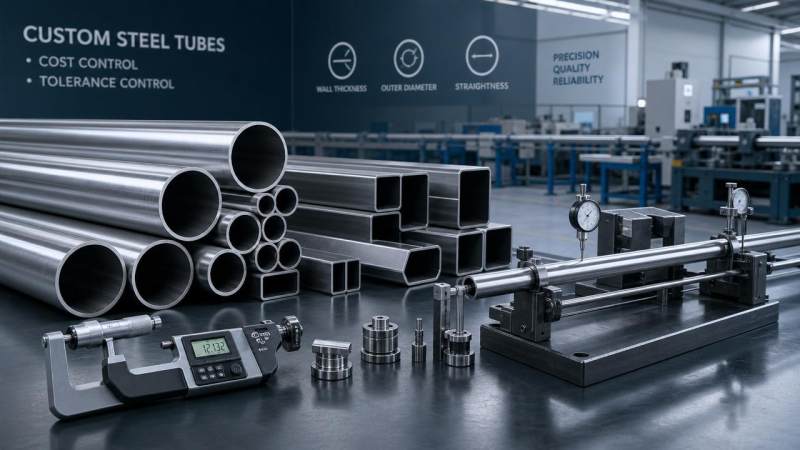
When sourcing custom steel tubing, buyers often compare base steel prices first.
Yet the real cost often changes because of tolerance requirements.
In today’s steel market, tighter control is requested more often.
That shift affects production routes, inspection effort, scrap, and delivery risk.
For custom steel tubing, not every tight tolerance adds equal value.
Some limits are essential for fit-up, welding, or automation.
Others simply raise cost without improving end-use performance.
Understanding this difference helps control budgets while meeting technical demands.
Market Signals Show a Shift Toward Functional, Not Maximum, Precision
Across construction, machinery, and fabrication, tolerance requests are changing.
Projects now ask for better consistency where assembly speed matters most.
At the same time, cost pressure is forcing careful review of every specification.
This creates a practical trend in custom steel tubing sourcing.
The focus is moving from “tight everywhere” to “tight where performance depends on it.”
That trend is especially visible in hollow sections, formed profiles, and welded tubing.
International buyers also expect suppliers to align with ASTM, EN, JIS, and GB standards.
As a result, custom steel tubing quotes increasingly separate standard tolerances from premium tolerances.
Why the cost gap is widening
- Raw material variation must be corrected during forming or finishing.
- More exact roll setups increase machine adjustment time.
- Tighter limits create more off-spec pieces and higher scrap rates.
- Extra inspection adds labor, gauges, and reporting cost.
- Premium tolerances can reduce production speed and available capacity.
Which Tolerances Raise the Cost of Custom Steel Tubing the Most
The largest cost increases usually come from tolerances that are difficult to maintain continuously.
These are not always the most visible dimensions on a drawing.
Below is where custom steel tubing pricing often changes fastest.
Wall thickness tolerance often drives the biggest premium
Wall thickness is critical for strength, welding, and downstream machining.
However, very tight wall thickness tolerance is expensive in custom steel tubing.
It depends on incoming coil consistency and process stability across the full run.
If the project only needs structural performance, standard mill ranges may be enough.
Straightness and twist can quietly increase total production cost
Straightness issues affect automated assembly, cutting, and fit-up accuracy.
To improve straightness, suppliers may slow the line or add corrective operations.
The same applies to twist and end squareness.
These requirements can matter more than nominal width or height in some applications.
The Main Drivers Behind Tighter Custom Steel Tubing Specifications
Tolerance inflation does not happen without reason.
Several technical and commercial forces are pushing tighter custom steel tubing requirements.
- Automated fabrication systems require more repeatable dimensions.
- Modular construction reduces tolerance stacking room on site.
- Lightweight design leaves less margin for dimensional deviation.
- Global quality documentation demands more traceable inspection records.
- Shorter project schedules increase the value of smooth installation.
Even so, tighter is not always smarter.
The best custom steel tubing specifications match the real function of the part.
They do not simply copy the most restrictive drawing from another project.
How Tolerance Choices Affect Supply Chains, Fabrication, and Project Results
Tolerance decisions influence more than unit price.
They shape lead time, production planning, acceptance risk, and downstream efficiency.
Effects across the business chain
- Production: narrower process windows reduce usable output.
- Quality control: more checkpoints increase testing and reporting needs.
- Logistics: rework or sorting can delay shipment schedules.
- Fabrication: better fit may lower labor cost during welding or assembly.
- Project execution: fewer field corrections can improve installation speed.
This is why custom steel tubing should be evaluated by total installed cost.
A higher mill price may still save money if it prevents assembly delays.
But unnecessary premium tolerances often deliver little return.
In some projects, related material choices also support better durability planning.
For corrosion-sensitive applications, Steel Coil Galvanized can complement structural steel solutions.
Common grades include DX51D+Z, SGCC, and S350GD+Z.
Thickness ranges from 0.12mm to 3.5mm, with zinc coatings up to 275g/m².
What Deserves the Closest Attention Before Approving a Custom Steel Tubing Quote
A quote should be reviewed against application risk, not only drawing notes.
Several points deserve closer attention before confirming custom steel tubing tolerances.
- Identify which tolerance affects structural performance directly.
- Separate appearance demands from assembly-critical requirements.
- Confirm whether standard industry tolerances already meet the purpose.
- Ask how tighter limits influence scrap, lead time, and inspection scope.
- Define acceptance methods clearly before production starts.
Questions that reduce avoidable cost
A Smarter Response Is to Prioritize Value-Based Precision
The best response is not to reject tight tolerances entirely.
It is to apply them selectively in custom steel tubing specifications.
Use stricter limits where welding alignment, robotic handling, or final fit depend on them.
Use standard limits where the function allows normal variation.
This approach protects both technical performance and sourcing efficiency.
Reliable structural steel partners can also help compare cost scenarios early.
That is especially useful for global projects requiring stable quality and dependable lead times.
For next-step planning, review each custom steel tubing tolerance by function, measurement method, and cost impact.
Then request quotations with both standard and tightened options.
That side-by-side comparison makes hidden cost drivers visible.
It also creates a stronger basis for quality, budget, and delivery decisions.
Please give us a message


Please enter what you want to find