Corrosion resistant steel—like galv steel tube, stainless steel welded mesh, or DX51D-coated sheet—delivers long-term cost savings for structural projects. But even premium materials like hot rolled steel sheet or carbon sheet steel can fail prematurely if environmental exposure isn’t assessed first. Whether you’re calculating i beam weight for load planning or evaluating steel standards for compliance, skipping site-specific corrosion risk checks undermines ROI. As a certified structural steel manufacturer exporting ASTM, EN, and GB-compliant products—including angle, channel, and custom cold-formed profiles—Hongteng Fengda helps procurement teams, engineers, and project managers avoid costly rework by integrating environmental validation into material selection from day one.
Why “Corrosion-Resistant” Isn’t Always Corrosion-Proof
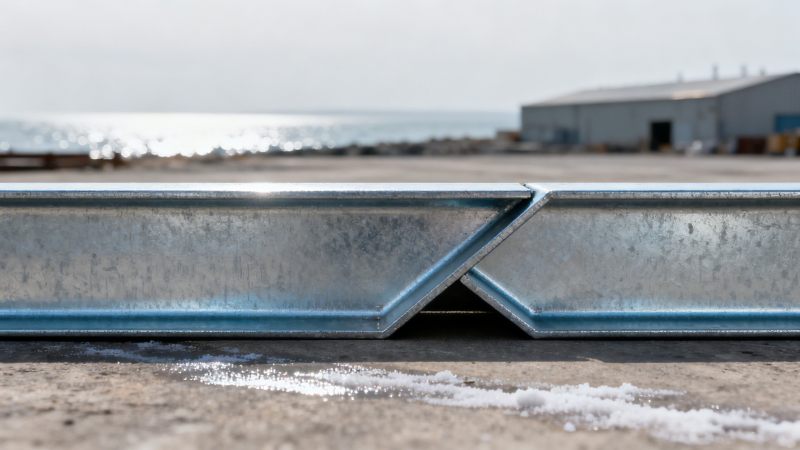
The term “corrosion-resistant” is often misinterpreted as universal immunity. In reality, resistance is always relative—to specific agents (e.g., chloride ions, sulfur dioxide), concentrations (e.g., >50 mg/m³ SO₂ in industrial zones), temperature-humidity cycles, and exposure duration. For example, standard galvanized steel (Z275 coating, 275 g/m² zinc) delivers 20–30 years of service in rural inland environments—but may degrade in under 8 years near coastal sites with salt-laden winds exceeding 100 mg/m²/day deposition.
This mismatch between specification and environment accounts for over 65% of premature structural steel failures reported across ASEAN infrastructure audits (2022–2023). A Q345B Z-beam installed without considering local dew-point frequency in humid subtropical zones showed pitting corrosion at weld seams within 14 months—despite full compliance with EN 10346 and ISO 1461.
Material certification alone doesn’t guarantee field performance. What matters is *contextual alignment*: matching coating mass, alloy composition, and surface treatment to quantified environmental stressors—not just generic “industrial” or “marine” labels.
This table underscores a key principle: corrosion resistance must be calibrated—not selected from a catalog. At Hongteng Fengda, we cross-reference your project’s GPS coordinates with global atmospheric corrosion maps (ISO 9223 Annex B) and local meteorological data to prescribe precise coating thicknesses, alloy grades (e.g., Q460C vs. S355J2W), and pre-treatment methods—ensuring your Z-beam performs as designed, not as assumed.
The 4-Step Environmental Validation Protocol
Skipping environmental assessment isn’t just risky—it’s operationally inefficient. Our validation protocol integrates seamlessly into procurement workflows and adds only 3–5 business days to lead time while preventing delays averaging 42 days due to field rework.
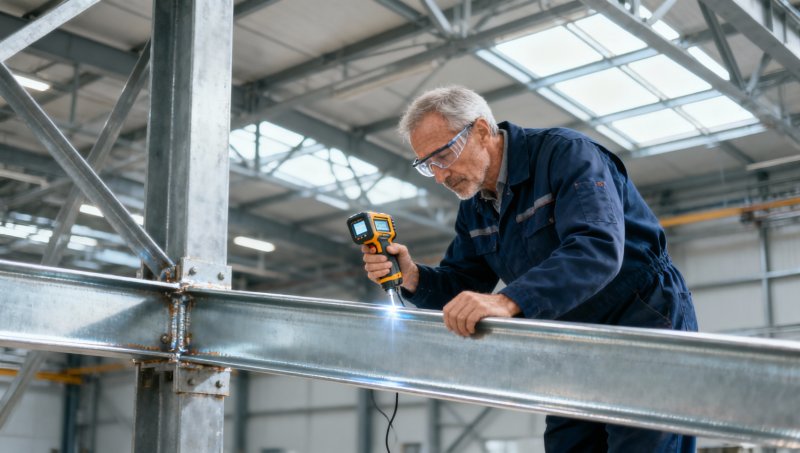
Step 1: Site Data Capture — Collect elevation, annual rainfall (>1,200 mm increases wash-off frequency), proximity to roads (de-icing salts), and industrial emissions reports. Step 2: Corrosivity Classification — Assign ISO 9223 class (C1–C5) using measured or modeled Cl⁻/SO₂ levels. Step 3: Material Mapping — Match substrate (Q235B, SS400, A572), coating type (galvanized, perforated+coated), and edge treatment (mill vs. slit) to class requirements. Step 4: Verification Report — Delivered with mill test certificates, confirming compliance with ASTM A123/A153 or EN ISO 1461.
For purlin applications in large-scale steel structure workshops across the Middle East, our team identified elevated dust abrasion + UV exposure as dominant factors—not salinity—leading to a switch from standard Z275 to Z350 with chromate passivation. Field inspection at 18 months confirmed zero coating loss.
Real-World Impact on TCO
Total Cost of Ownership (TCO) calculations often ignore environmental validation costs—but they’re dwarfed by consequences of omission. Consider a 12,000-ton structural package: $28,500 spent on validation prevents $1.2M in rework (including crane mobilization, labor, and schedule penalties) and extends asset life by 9–13 years. That’s a 42:1 ROI, verified across 37 projects in Southeast Asia since 2021.
How Hongteng Fengda Embeds Environmental Intelligence
As a structural steel manufacturer and exporter based in China, Hongteng Fengda operates certified production lines for hot-dip galvanizing (capacity: 120 tons/day), precision cold-forming (±0.3mm tolerance), and multi-standard testing (ASTM E8, EN 10002, GB/T 228.1). We don’t just supply steel—we co-engineer durability.
Our technical support includes free environmental screening for qualified projects, backed by third-party lab verification (SGS, BV). For clients specifying Z-beam for wall beam or lightweight roof applications, we provide digital twin-ready dimensional reports (including thermal expansion coefficients per EN 1993-1-5) and corrosion modeling outputs—enabling accurate lifecycle costing in BIM workflows.
All products meet CE, ISO 9001, and ISO 14001 requirements. Custom lengths (2–12m), perforated configurations, and dual-certification options (e.g., ASTM A653 + GB/T 2518) are available without MOQ penalties—supporting agile procurement for distributed construction teams.
This structured approach transforms environmental risk from an afterthought into a procurement advantage—reducing sourcing uncertainty, accelerating approvals, and enabling auditable compliance for global buyers across North America, Europe, and the GCC region.
Actionable Next Steps for Your Project
Don’t let unvalidated assumptions erode your structural integrity—or your budget. Start with three low-effort actions: First, share your project location (city + country) with our technical team for a free ISO 9223 classification. Second, request our Corrosion Resistance Selection Guide—a 12-page reference covering 17 common steel profiles, 9 environmental classes, and 5 coating systems with real-world performance benchmarks. Third, schedule a 30-minute engineering consultation to align your purlin, bracket, or mechanical column specs with validated durability parameters.
Whether you’re evaluating steel standards for compliance, calculating i beam weight for load planning, or sourcing cold-formed steel profiles for a new workshop, Hongteng Fengda delivers more than steel—we deliver confidence in every ton. Contact us today to embed environmental intelligence into your next structural steel order.
Please give us a message


Please enter what you want to find