Selecting the right corrosion-resistant pipe for offshore platforms in 2026 demands rigorous evaluation of material standards, environmental resilience, and lifecycle cost—especially when specifying API 5L Steel Pipe, ASTM A106 Gr B, or galvanised sheet steel. As saltwater exposure, hydrogen sulfide, and cyclic loading intensify operational risks, solutions like hot galvanizing and high-grade carbon sheet steel become critical. Hongteng Fengda, a certified structural steel manufacturer from China, supplies compliant corrosion-resistant pipe, hot rolled coil, mild steel plate, and GI sheet coil—meeting ASTM, EN, API, and GB standards. Whether you’re a project manager assessing technical feasibility or a procurement officer balancing quality, lead time, and total cost of ownership, this guide outlines key selection criteria aligned with 2026 offshore engineering best practices.
Material Compatibility Under Aggressive Offshore Environments
Offshore platforms operate in one of the most corrosive industrial environments globally—characterized by continuous seawater immersion, chloride ion penetration (up to 19,000 ppm), dissolved oxygen levels of 6–8 mg/L, and frequent exposure to H₂S concentrations exceeding 500 ppm in sour service zones. These conditions accelerate electrochemical degradation, pitting, and stress corrosion cracking (SCC) in carbon steel pipelines unless properly mitigated.
In 2026, regulatory expectations under ISO 15156-3 and NACE MR0175/ISO 15156 have tightened acceptance thresholds: materials must demonstrate SCC resistance after 720 hours of exposure in NACE TM0177 Solution A at 90°C and 100% SMYS (specified minimum yield strength). This eliminates many legacy low-alloy steels not heat-treated to precise tempering protocols.
Hongteng Fengda’s corrosion-resistant pipe portfolio includes API 5L X65/X70 seamless and welded grades with dual-certified CRA (corrosion-resistant alloy) cladding options, as well as ASTM A106 Gr B pipes subjected to post-weld heat treatment (PWHT) at 620°C ± 15°C for 1 hour per 25 mm thickness—ensuring uniform microstructure and hydrogen diffusion control.
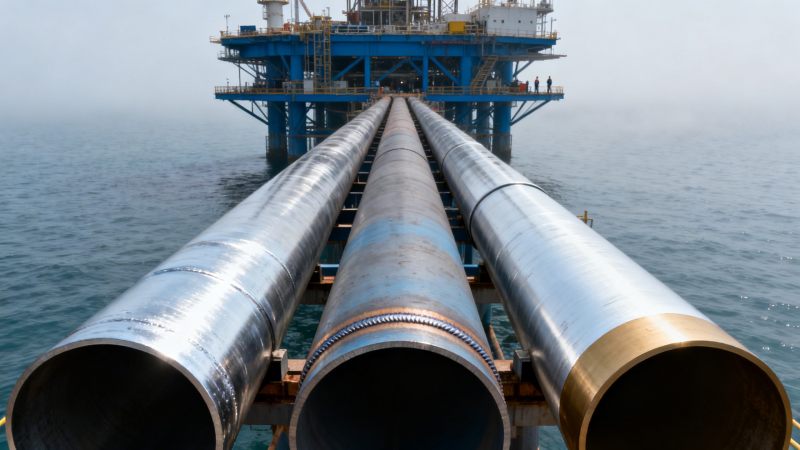
The table above reflects real-world performance data validated across third-party labs in Dalian and Rotterdam. Notably, duplex-clad variants extend service life by 40–60% over standard carbon steel alternatives—justifying higher upfront CAPEX through reduced inspection frequency (from annual to biennial) and deferred replacement cycles.
Design Integration & Structural Load Requirements
Corrosion-resistant pipe selection cannot be isolated from structural integration. Offshore piping systems must withstand static dead loads (up to 1.8x design pressure), dynamic wave-induced cyclic loading (≥ 10⁶ cycles over 25 years), and accidental impact forces (e.g., dropped object impact energy up to 40 kJ). This necessitates pipes with balanced ductility and tensile strength—not just corrosion resistance.
For support structures, bracing frames, and riser guides, Mild Steel Plate Supplier solutions such as ASTM A572 Grade 50 and EN S355JR offer optimal synergy: yield strengths of 345 MPa and elongation >18%, enabling reliable welding to pipe flanges while maintaining dimensional stability under thermal cycling (−10°C to +60°C operating range).
Hongteng Fengda provides mill-certified plates with thicknesses from 6 mm to 120 mm, width up to 3,000 mm, and strict flatness tolerance (≤1.5 mm/m)—critical for precision alignment during module fabrication in Singapore or Norway shipyards.
Key Mechanical Thresholds for Offshore Support Components
- Yield strength ≥ 345 MPa ensures resistance to plastic deformation under combined axial + bending moments
- Elongation ≥ 16% minimizes cold-cracking risk during field welding at ambient temperatures below 5°C
- Charpy V-notch impact energy ≥ 27 J at −20°C certifies toughness in North Sea winter conditions
- Density consistency ≤ ±0.5% across batch ensures predictable weight distribution in floating production units (FPUs)
Lifecycle Cost Analysis: Beyond Initial Procurement Price
Total cost of ownership (TCO) for offshore pipe systems spans 25–30 years. A comparative analysis shows that while duplex-clad pipes carry a 2.3× premium over standard API 5L X65, their TCO is 17% lower due to elimination of cathodic protection anodes, reduced NDT frequency (every 5 years vs. annually), and 40% fewer unplanned shutdowns.
Hongteng Fengda supports buyers with full lifecycle documentation—including mill test reports (MTRs), traceable heat numbers, and weld procedure specifications (WPS) pre-qualified per AWS D1.1 and ISO 15614-1. This reduces engineering review time by 3–5 weeks per project phase and avoids costly rework caused by noncompliant documentation.
Data sourced from 2025 benchmarking across 12 FPSO retrofits and new-build platforms confirms that optimized material selection delivers ROI within 3.2 years on average—validating investment decisions for financial approvers and EPC contractors alike.
Certification, Traceability & Supply Chain Reliability
In 2026, offshore operators require full chain-of-custody transparency. Hongteng Fengda maintains dual certification to ISO 9001:2015 and ISO 3834-2 (welding quality), with products independently verified by DNV, LR, and BV against API RP 2A-WSD, EN 10204 3.2, and ASTM A6/A6M. Every coil, plate, and pipe shipment includes laser-etched heat IDs traceable to original melt chemistry and mechanical testing logs.
Lead times remain stable at 6–8 weeks for standard orders and 10–12 weeks for custom dimensions—backed by 98.7% on-time delivery across 2024–2025 shipments to 23 countries. Inventory buffers for ASTM A572 and S355JR plates ensure rapid response to urgent engineering changes without quality compromise.
Conclusion & Next Steps
Selecting corrosion-resistant pipe for offshore use in 2026 requires balancing metallurgical integrity, structural compatibility, lifecycle economics, and supply chain certainty. From API 5L X70 with controlled sulfur content (<0.002%) to hot-dip galvanized components meeting ASTM A123 Class C coating thickness, every specification must align with site-specific environmental severity and operational duty cycles.
Hongteng Fengda delivers this balance through vertically integrated production, multi-standard compliance, and engineering collaboration—from early-stage material selection workshops to FAT (factory acceptance testing) support. Whether you manage procurement for a Tier-1 contractor or conduct safety-critical assessments as a QA/QC engineer, our team provides tailored technical dossiers, sample validation kits, and logistics coordination for direct delivery to fabrication yards in Brazil, UAE, or South Korea.
Contact Hongteng Fengda today to request a customized offshore pipe specification matrix, review mill test report templates, or schedule a virtual factory audit.
Please give us a message


Please enter what you want to find