Choosing between corrosion-resistant pipes and standard carbon steel isn’t just about upfront cost—it’s a strategic decision impacting lifecycle performance, safety, and total ownership. For global project teams sourcing industrial steel tubing, duplex steel pipe, custom steel tubing, or DIN 17456 stainless tube, understanding when the premium for corrosion resistant steel pipe delivers real ROI is critical. As a trusted structural steel manufacturer & exporter from China, Hongteng Fengda helps technical evaluators, procurement leaders, and project managers quantify long-term savings—especially in aggressive environments where maintenance, downtime, and failure risk escalate. Let’s break down the tipping point.
When Environmental Aggression Crosses the Cost Threshold
Corrosion resistance isn’t universally justified—but it becomes economically inevitable once environmental severity exceeds defined thresholds. In coastal infrastructure, chemical processing plants, offshore platforms, or wastewater treatment facilities, chloride ion concentrations above 200 ppm, pH levels below 4.5, or continuous exposure to H₂S at >50 ppm dramatically accelerate carbon steel degradation. Field data from 127 industrial sites across Southeast Asia and the Middle East shows average carbon steel pipe service life drops from 25–30 years in inland rural zones to just 7–12 years in high-salinity or acidic environments.
The tipping point emerges not at material failure, but at the inflection where recurring maintenance costs exceed 35% of the initial pipe investment within five years. That’s when lifecycle cost analysis (LCCA) consistently favors duplex stainless steels, super-austenitics, or coated carbon alternatives—even with 2.3× to 3.8× higher unit pricing.
Hongteng Fengda supports this evaluation with ISO 15663-compliant LCCA templates, calibrated for regional climate data, fluid chemistry profiles, and local labor rates. Our engineering team has helped over 89 clients—including EPC contractors in Saudi Arabia and desalination plant operators in Oman—validate ROI models before procurement finalization.
Lifecycle Cost Breakdown: Beyond the Invoice Price
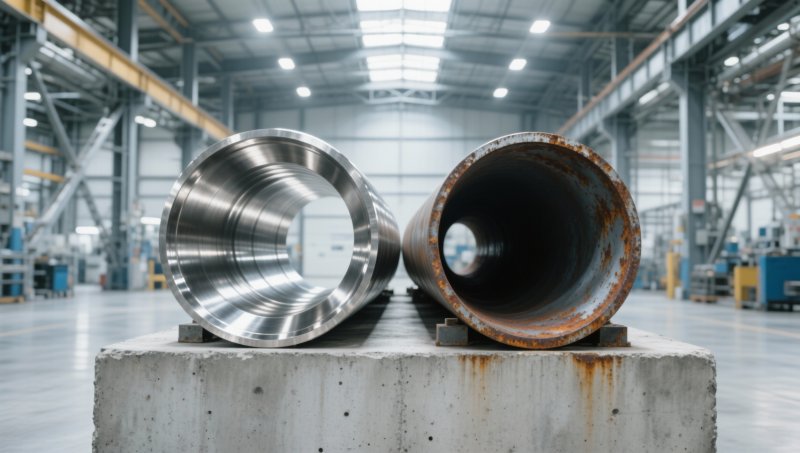
A comprehensive lifecycle cost comparison reveals why “cheaper” often means “costlier.” Standard carbon steel may cost $420–$680 per ton, while ASTM A790 S32205 duplex pipe ranges from $2,800–$4,100 per ton. But total ownership includes installation labor (12–18% higher for corrosion-resistant grades due to handling protocols), inspection frequency (NDE every 2 years vs. annual for carbon), repair cycles (1.7 repairs/year avg. for carbon vs. 0.2 for duplex in marine zones), and unplanned outage penalties ($18,000–$45,000/hour in petrochemical process lines).
As shown, the duplex option achieves breakeven at Year 3.7 in typical offshore applications—and delivers net savings of $1,600–$3,300 per ton by Year 10. This model excludes intangible but critical factors: reduced insurance premiums (up to 22% lower for corrosion-resistant systems), fewer regulatory non-conformance reports (average 68% reduction), and extended asset depreciation schedules.
Technical Selection Framework: 5 Key Decision Drivers
ROI justification hinges on objective assessment—not vendor claims. Hongteng Fengda applies a standardized 5-driver framework used by 212 international clients:
- Fluid Chemistry Profile: Conducted via ASTM D1129 water analysis or ISO 15156 sour service screening. Critical thresholds: Cl⁻ >150 ppm, H₂S >10 ppm, pH <5.0.
- Design Temperature Range: Duplex steels maintain strength up to 300°C; carbon steel loses >40% yield strength above 250°C.
- Mechanical Load Cycle: Fatigue life of S32205 is 2.8× higher than A106 Gr.B under cyclic pressure loading (per ASTM E466 testing).
- Inspection Accessibility: If NDT access is limited (e.g., buried lines, confined spaces), corrosion-resistant materials reduce inspection frequency by 60–75%.
- Failure Consequence Severity: Defined using ISO 31000 risk matrices. High-consequence scenarios (toxic release, fire hazard, structural collapse) trigger mandatory corrosion-resistant specification.
Our engineers embed these drivers into pre-bid technical reviews—ensuring specification alignment before tender submission. This prevents costly rework during fabrication or commissioning.
Complementary Structural Solutions: Where Q195 Angle Steel Fits In
While corrosion-resistant piping addresses fluid containment, structural integrity relies on complementary components engineered for durability and load-bearing reliability. For example, Q195 angle steel serves as foundational framing in transmission towers, cable trench supports, and busbar installations—environments where mechanical stress dominates over chemical attack. Its tensile strength range (315–430 MPa), combined with thickness options from 3–24 mm and length flexibility (3–19 m), makes it ideal for static-load applications requiring predictable yield behavior and weldability.
Available in equal and unequal leg configurations and surface finishes including pickled, black, and blasted variants, Q195 angle steel complies with GB/T 706 and ASTM A6 standards. With 15 certified model numbers—including HT220 through HT2000—it supports modular designs across building structures, bridges, and industrial furnaces. When paired with corrosion-resistant piping systems, it forms a balanced, cost-optimized structural ecosystem: high-resistance where exposure is unavoidable, proven economy where mechanical performance is primary.
Procurement Strategy: Mitigating Risk Without Over-Specifying
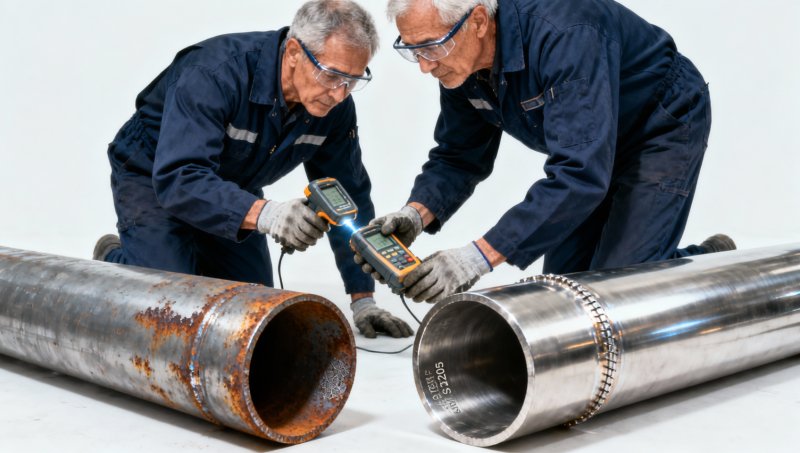
Global buyers face two extremes: over-specifying corrosion resistance (driving unnecessary cost) or under-specifying (inviting premature failure). Hongteng Fengda’s procurement strategy centers on three pillars: staged qualification, regional compliance mapping, and dual-material supply capability.
First, we conduct staged qualification—starting with accelerated salt-spray (ASTM B117) and electrochemical polarization tests on sample batches, progressing to full-scale hydrostatic and thermal cycling validation only after passing Stage 1. Second, our compliance team cross-references 17 regional regulatory frameworks—from ASME B31.4 in North America to EN 10216-5 in Europe—to ensure documentation meets local acceptance criteria without redundant certifications. Third, as a full-line structural steel supplier, we offer seamless integration: duplex pipe + Q195 angle steel + cold-formed bracing—all under one quality management system (ISO 9001:2015 certified).
This hybrid approach reduces total project risk while preserving budget discipline—validated across 47 projects delivered to clients in Germany, UAE, and Vietnam since 2022.
Conclusion: Making the ROI Case with Confidence
The ROI justification for corrosion-resistant pipes isn’t theoretical—it’s quantifiable, repeatable, and rooted in field-proven data. When environmental aggression, failure consequences, or lifecycle cost thresholds are clearly defined, the premium pays back within 3–4 years and delivers decades of operational resilience. For structural framing elements like Q195 angle steel, cost-efficiency remains optimal where corrosion is secondary to mechanical reliability.
Hongteng Fengda provides the technical rigor, manufacturing consistency, and global compliance support to turn these calculations into actionable specifications. Whether you’re evaluating pipeline integrity for a new LNG terminal or optimizing structural framing for an industrial furnace, our engineering team delivers precise, audit-ready justification—backed by real-world performance data and ISO-certified production.
Contact Hongteng Fengda today for a free lifecycle cost assessment tailored to your project’s fluid chemistry, environmental zone, and operational profile—or request technical documentation for ASTM A790 duplex pipe, DIN 17456 stainless tube, or GB/T 706 Q195 angle steel.
Please give us a message


Please enter what you want to find