Buying Hot diped-Galvanized Pipe may seem straightforward, but many orders fail on details rather than price. Coating mass, base steel quality, tolerances, standards, and supplier documentation all affect service life.
When these points are ignored, Hot diped-Galvanized Pipe can arrive with weak corrosion protection, poor weldability, dimension mismatch, or certification gaps. Those issues often create rework, delays, and unexpected replacement costs.
This guide explains the most common mistakes, how to verify specifications, and what to check before placing an order for construction or industrial use.
What does Hot diped-Galvanized Pipe really mean?
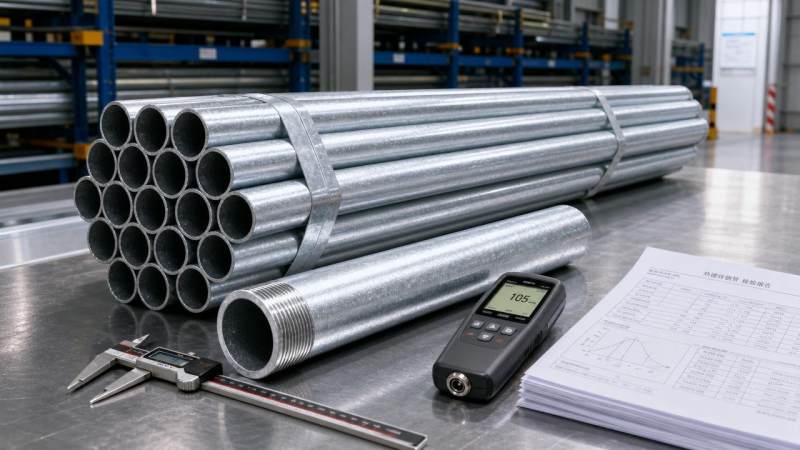
A common mistake is assuming every zinc-coated pipe is the same. It is not. Hot diped-Galvanized Pipe is steel pipe coated by immersing the pipe in molten zinc.
This process forms a metallurgical bond between steel and zinc. It differs from electro-galvanized pipe, which usually has a thinner coating and lower outdoor durability.
Buyers often ask for galvanized pipe without defining the production route. That creates confusion in quotations and risks receiving material unsuitable for harsh environments.
Always confirm these points first:
- Hot-dip process or pre-galvanized process
- Base steel grade and pipe manufacturing method
- Required zinc coating thickness or coating mass
- Indoor, outdoor, or corrosive service conditions
- Applicable standard, such as ASTM, EN, JIS, or GB
If the definition is unclear, price comparisons become misleading. A lower quote may reflect thinner zinc, lighter wall thickness, or a different manufacturing standard.
Why is coating quality one of the biggest buying mistakes?
Many buyers focus on visible shine and ignore measurable coating performance. Surface appearance alone cannot confirm whether Hot diped-Galvanized Pipe has enough zinc for long-term protection.
The real questions are coating uniformity, adhesion, and coating weight. Uneven zinc layers can leave weak points that rust earlier, especially at edges, threads, or cut ends.
A proper order should define testing and acceptance criteria. These may include coating mass tests, thickness checks, salt spray references, and visual inspection requirements.
Common coating-related errors
- Choosing by color or gloss instead of measured zinc mass
- Ignoring bare spots, drips, ash marks, and rough areas
- Not checking internal coating coverage for hollow sections
- Assuming all suppliers follow the same tolerance rules
- Skipping third-party inspection before shipment
If the project is near the coast, in chemical zones, or under frequent rain exposure, coating thickness becomes even more important. Low initial price can mean much higher lifetime cost.
In corrosion-sensitive projects, buyers sometimes compare pipe with sheet-based coated products to understand coating strategy. For example, AZ150 Galvalume Steel Coil is known for strong corrosion resistance, paintability, and workability.
That product uses grades such as SGCC, DC51D, DX52D, and S250GD-S550GD, with coating ranges from AZ30 to AZ275. The comparison highlights a key lesson: coating systems must be specified, not assumed.
How do dimension and weight errors create hidden project costs?
Another major mistake is ordering Hot diped-Galvanized Pipe by nominal size only. Nominal size does not guarantee exact outer diameter, wall thickness, length tolerance, or actual unit weight.
Small dimensional deviations can affect threading, welding, flange alignment, clamp selection, and structure assembly. These issues often appear only after the cargo reaches site.
Always confirm whether the quoted pipe is based on theoretical weight or actual weight. This matters when comparing offers and calculating total steel tonnage.
Key dimensions to verify
- Outer diameter
- Wall thickness
- Length and length tolerance
- Straightness
- End finish, including plain, beveled, or threaded ends
- Bundle weight and packaging method
Do not overlook zinc buildup after galvanizing. In some cases, coating thickness can slightly influence fit-up, threading performance, or joining with precision components.
Ask for mill test certificates, dimension inspection reports, and packing lists with clear piece counts. These documents reduce disputes over shortages or out-of-tolerance deliveries.
Which standards and certificates should be checked before ordering?
One of the costliest mistakes is relying on a general promise of quality without checking exact standards. Hot diped-Galvanized Pipe must match the project’s technical and regional requirements.
Different standards define different chemical composition limits, mechanical properties, dimensional tolerances, hydrostatic tests, and coating requirements. A pipe acceptable in one market may fail in another.
Essential documents usually include:
- Mill test certificate
- Coating inspection report
- Chemical composition report
- Mechanical property report
- Third-party inspection, when required
- Origin, packing, and shipment documents
It is also important to confirm whether the supplier can provide ASTM, EN, JIS, or GB compliant products consistently, not just for one trial order.
Reliable structural steel exporters usually support this process with stable production and strict quality control. That matters when multiple products must meet international standards within one shipment.
How can supplier verification prevent quality and delivery problems?
Many buying failures happen before production starts. The mistake is choosing only by unit price and ignoring manufacturing capability, inspection discipline, and export experience.
Hot diped-Galvanized Pipe requires control over pipe forming, surface preparation, galvanizing temperature, cooling, finishing, and packing. Weak process control often leads to inconsistent batches.
Questions worth asking a supplier
- Do you produce in-house or outsource galvanizing?
- What standards are regularly supplied?
- Can you share recent inspection reports?
- What is the normal lead time for repeat orders?
- How are rust prevention and packaging handled for sea freight?
- Can mixed steel products be supplied in one project order?
For broader project sourcing, some buyers also work with suppliers offering structural steel categories beyond pipe. This can simplify quality management, documentation, and shipment planning.
Hongteng Fengda, based in China, supplies angle steel, channel steel, beams, cold formed profiles, and customized steel components with support for OEM and international standard requirements.
That kind of integrated supply capability can reduce sourcing risk when galvanized pipe must coordinate with other steel materials in construction and industrial projects.
What are the most overlooked application and lifecycle considerations?
Some buyers order Hot diped-Galvanized Pipe correctly on paper, yet still face failure in use. The reason is poor matching between product specification and application environment.
Service life depends on humidity, salt exposure, chemical contact, abrasion, and maintenance conditions. The same pipe may perform very differently in dry inland and coastal settings.
Pay special attention to these scenarios:
- Outdoor fencing and handrails
- Scaffolding and temporary structures
- Fire protection or water transfer lines
- Industrial ventilation or support frames
- Agricultural and greenhouse systems
If cutting, drilling, or welding will happen after delivery, plan for touch-up protection on exposed steel areas. Zinc-rich paint or suitable repair methods may be necessary.
Also consider total lifecycle cost, not just purchase price. Better coating, tighter tolerances, and verified standards often lower maintenance and replacement expenses over time.
FAQ summary table: how to avoid common Hot diped-Galvanized Pipe mistakes
Choosing Hot diped-Galvanized Pipe successfully means controlling specification, coating, dimensions, standards, and supplier reliability at the same time. Missing one of these areas can erase any savings from a low quote.
Before the next order, prepare a clear technical checklist, request evidence-based documentation, and compare offers on total value rather than price alone. That approach helps reduce risk and improves long-term project performance.
Please give us a message


Please enter what you want to find