Selecting the right steel beam for bridge projects in corrosive environments requires more than basic load calculations. For technical evaluators, material grade, protective treatment, compliance standards, and long-term maintenance costs all affect project reliability and procurement value. This guide explores how to assess structural performance, corrosion resistance, and manufacturing quality when choosing bridge steel for demanding service conditions.
Why a checklist approach works better for corrosive bridge conditions
When evaluating a steel beam for bridge use in marine, coastal, industrial, or de-icing salt environments, the main risk is not only whether the section can carry the design load on day 1. The more important question is whether it can maintain section integrity, fatigue performance, and inspection accessibility over 20 to 50 years of service. A checklist method helps technical teams avoid over-focusing on nominal strength while missing corrosion-driven life-cycle issues.
For most bridge procurement reviews, the decision process involves at least 5 linked dimensions: structural demand, environmental severity, steel grade, protective system, and fabrication quality. If any one of these is weak, the whole bridge package may face higher maintenance frequency, premature section loss, coating failure, or difficult replacement work. That is why a structured review path is more practical than a purely descriptive specification review.
Technical evaluators also need to compare offers from different manufacturers and exporters on a like-for-like basis. A beam with a lower initial price may become less competitive if it requires a heavier coating system, shorter repainting intervals, or more frequent inspection in splash-zone or chemical exposure areas. In many projects, a 3% to 8% difference in supply cost can be outweighed by much larger maintenance cost differences over the first 10 to 15 years.
Priority questions to confirm before detailed comparison
- What is the actual exposure class: coastal salt spray, tidal wet-dry cycling, industrial emissions, chemical splash, or road de-icing?
- Is the steel beam for bridge work a primary girder, cross beam, bearing stiffener zone, bracing member, or secondary access structure?
- What design life is expected: 20 years, 30 years, 50 years, or longer with staged maintenance?
- Which standards govern the material and fabrication package, such as ASTM, EN, JIS, or GB-based project specifications?
- Can the geometry be fully blasted, coated, drained, and inspected after erection?
These questions define the evaluation path early. Without them, teams often compare beam sizes and yield strengths but miss practical serviceability factors that directly affect corrosion performance and procurement value.
Core checklist for choosing a steel beam for bridge durability
The first technical review should combine section performance with environmental durability. For a steel beam for bridge structures, corrosion allowance, weld detail exposure, coating compatibility, and drainage behavior should be checked at the same stage as bending, shear, and deflection. In aggressive sites, even a strong beam can become a poor choice if water traps or crevice details accelerate localized attack.
As a practical rule, evaluators should review at least 8 to 10 selection points before moving to commercial comparison. This reduces the risk of accepting a beam that is structurally adequate in drawings but difficult to protect in service. The following checklist can be used during technical screening, vendor qualification, or internal design review.
Primary evaluation checklist
- Confirm the required section type and load effects, including bending moment, shear, fatigue range, and deflection limits.
- Check base material grade and verify compatibility with project standards and welding procedures.
- Review expected corrosion category and whether atmospheric, splash, or chemical exposure dominates.
- Verify if hot-dip galvanizing, metallizing, paint systems, or duplex protection is technically suitable for the beam size and detail shape.
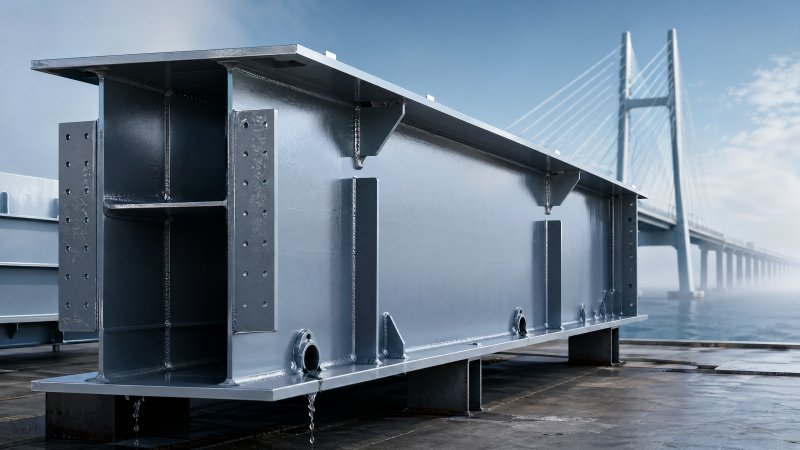
- Examine fabrication details such as stiffener terminations, drainage holes, weld continuity, and crevice-prone joints.
- Assess whether inspection access is possible every 6 to 12 months in high-risk areas.
- Check dimensional tolerance, straightness, and residual distortion control after welding or treatment.
- Require mill test documents, traceability, and quality records for key batches.
The checklist above is especially useful when sourcing from international suppliers because bridge work often combines project-specific dimensions with standard mill products. It helps separate technically aligned suppliers from those offering only generic steel without sufficient durability control.
The table below summarizes a practical comparison framework for technical evaluators selecting a steel beam for bridge applications in corrosive service conditions.
In practice, the best option is rarely the one with the highest nominal strength alone. A balanced package of material compliance, protective treatment, fabrication quality, and inspectable detailing usually delivers better bridge performance over the long term.
How to match beam material and protection system to the environment
Environmental matching is where many bridge evaluations become too general. A steel beam for bridge service in inland humidity is not assessed the same way as one installed near seawater, fertilizer runoff, or chemical processing zones. Technical teams should classify the dominant exposure mechanism first, then select the base steel and protective system accordingly.
For example, atmospheric corrosion rates can differ significantly between dry inland sites and marine splash areas. Even when exact project data is limited, it is reasonable to divide conditions into low, moderate, high, and severe exposure bands. This supports practical decisions on whether standard paint, hot-dip galvanizing, metallizing, or a duplex system should be considered.
In some bridge packages, supplementary galvanized sheet products are also used for enclosure panels, walkways, drainage covers, cable protection, or maintenance access components. Where such auxiliary items are needed, buyers may also review Galvanised Sheet Steel Suppliers for compatible corrosion-resistant materials. Typical grades such as DX51D, SGCC, S250GD, or S350GD, with thickness ranges from 0.12 mm to 6.00 mm and widths from 600 mm to 1500 mm, are commonly selected for secondary fabricated parts rather than primary bridge girders.
Environmental matching checklist
- For coastal or salt-laden locations, prioritize protective systems that perform well under wet-dry chloride cycling and edge exposure.
- For industrial zones, check for sulfur-bearing emissions, acidic condensate, or particulate deposition that may shorten coating life.
- For de-icing salt bridges, pay attention to lower flange surfaces, connection zones, and drainage discharge paths.
- For enclosed or boxed details, confirm whether moisture can be trapped for periods longer than 48 to 72 hours.
- For auxiliary components, verify whether galvanized sheet or zinc-aluminum coated materials are suitable for non-primary structural parts.
The next table provides a simplified decision guide for matching exposure conditions to protective strategies. Final specification should always align with project standards and detailing constraints, but this matrix helps technical evaluators narrow options quickly.
A useful evaluation point is whether the protection system can be realistically applied to the actual beam geometry. Deep stiffeners, closed crevices, and difficult weld corners often reduce real-world coating quality, even when the specification itself looks adequate on paper.
Manufacturing and quality checks that should not be skipped
For technical evaluators, supplier capability matters nearly as much as material selection. A steel beam for bridge projects in corrosive environments should come from a manufacturer able to control raw material sourcing, cutting, welding, straightening, hole processing, surface preparation, and final inspection. Even small fabrication defects can become corrosion initiation points after installation.
Quality review should include both product compliance and process consistency. A factory may supply ASTM, EN, JIS, or GB compliant materials, but the bridge package still needs verification of dimensional tolerance, weld appearance, surface cleanliness, and treatment continuity. For international projects, traceability by heat number or batch number is particularly important during acceptance and later maintenance records.
Factory qualification checklist
- Confirm whether the supplier can provide standard sections, fabricated beams, and customized structural steel components within the required tolerance range.
- Check if production supports common global standards such as ASTM, EN, JIS, and GB for material and dimensional reference.
- Review surface treatment workflow, including blasting grade, galvanizing coordination, or coating application sequence.
- Ask for inspection records covering dimensions, weld zones, visual condition, and document traceability before shipment.
- Verify realistic lead time, which may range from 3 to 8 weeks depending on beam size, fabrication depth, and coating requirements.
A reliable supplier should also explain where process limits exist. For example, some oversized beam assemblies may be difficult to galvanize as one piece, while certain welded zones may require different treatment planning. Transparent discussion at the quotation stage reduces revision risk later.
Documents worth requesting during evaluation
At minimum, request material test certificates, section size confirmation, applicable standard references, coating or galvanizing specifications, and inspection reports for critical dimensions. If the bridge design includes repetitive fabricated members, sample drawings or process photos can also help the evaluator judge consistency before bulk production begins.
For exporters serving North America, Europe, the Middle East, and Southeast Asia, stable lead time and packing quality are also practical review points. Corrosion-resistant bridge steel can still suffer logistics-related damage if edge protection, bundling, or moisture control during transport is poorly managed over shipping periods of 2 to 6 weeks.
Common oversights that increase bridge life-cycle cost
Many project teams choose a steel beam for bridge work based on section efficiency and unit price, then discover later that maintenance access is poor or corrosion develops faster at details than on open surfaces. These failures are usually not caused by one dramatic mistake. They come from several overlooked items during design review and procurement comparison.
One frequent oversight is ignoring water management. If flange geometry, connection plates, or diaphragms allow standing water after rain or spray events, local attack can become much more severe than general atmospheric corrosion. Another common issue is inadequate edge preparation, where sharp corners reduce coating thickness and shorten repainting intervals.
A third oversight is assuming all corrosion-resistant options behave equally across all structural details. In reality, a system that performs well on open sheet components may not be ideal for thick, welded bridge beams with complex attachments. Evaluation must stay detail-specific.
Risk reminder list for technical evaluators
- Do not assess beam durability without checking drainage and venting details.
- Do not compare quotations unless surface treatment scope is clearly aligned item by item.
- Do not rely on nominal grade alone; weldability and fabrication sequence can change actual performance.
- Do not overlook inspection access, especially for underside flanges, bearing zones, and connection nodes.
- Do not separate transport and packing from quality review when overseas shipment is involved.
Addressing these issues early can reduce rework, shorten approval cycles, and improve long-term budget control. In many bridge procurements, preventing one specification mismatch saves more time than negotiating a small price reduction after technical clarification.
Execution plan: what to prepare before requesting quotations
If your team is moving from concept review to supplier inquiry, the fastest path is to prepare a compact but complete technical package. For a steel beam for bridge project, suppliers can respond more accurately when environmental, structural, and treatment requirements are already defined in a structured way. This improves quote comparability and reduces clarification rounds.
A good inquiry package should include beam type, section size range, estimated tonnage, project standard references, corrosion environment description, and required treatment route. If custom fabricated components are involved, indicate hole patterns, stiffeners, weld scope, and whether trial assembly or third-party inspection may be needed. Even 6 to 8 clearly defined data points can significantly improve quotation quality.
Recommended pre-inquiry checklist
- Beam designation, section dimensions, length range, and estimated total quantity.
- Applicable standard set, such as ASTM, EN, JIS, or GB-related project requirements.
- Target environment description, including chloride, humidity, industrial pollution, or chemical exposure.
- Requested corrosion protection method and any minimum inspection expectations.
- Required documents: MTC, dimensional report, coating record, packing list, and shipping marks.
- Expected delivery window, for example 30, 45, or 60 days from drawing approval.
Hongteng Fengda, as a structural steel manufacturer and exporter from China, supports global construction, industrial, and manufacturing projects with steel beams, angle steel, channel steel, cold formed profiles, and customized structural steel components. For technical buyers, the practical value lies in stable production capacity, standard-based manufacturing, and the ability to coordinate both standard specifications and OEM requirements across international markets.
Why choose us
If you are evaluating a steel beam for bridge applications in corrosive environments, we can support your review with material options, section selection input, fabrication feasibility feedback, and export supply coordination. Our manufacturing scope covers common structural steel products and customized components, with reference to major international standards including ASTM, EN, JIS, and GB.
You can contact us to discuss beam parameters, corrosion protection direction, standard compliance, fabrication details, lead time planning, sample support, and quotation comparison. If your bridge project also includes secondary galvanized components, we can help align material selection and supply planning to reduce sourcing risk and improve overall procurement efficiency.
For a faster technical review, send your section list, drawings, environment notes, required standards, and delivery schedule. We will help you confirm product suitability, customization options, documentation requirements, and commercial feasibility before order placement.
Please give us a message


Please enter what you want to find