When carbon steel tube suppliers substitute ASTM A53 for A106—common among industrial galvanized pipe, galvanized steel conduit, and coated steel pipe offerings—the pressure rating at elevated temperatures drops significantly. This seemingly minor spec swap impacts safety, compliance, and system integrity, especially for seamless CS pipe, A106 carbon steel pipe, and black pipe tube applications in oil, gas, and power projects. As a trusted carbon steel pipe manufacturer and galvanised steel pipe supplier from China, Hongteng Fengda ensures precise material traceability, ASTM-compliant testing, and transparent specification alignment—helping procurement teams, engineers, and project managers avoid costly field failures or non-conformance.
Why A53 ≠ A106: Critical Differences Beyond Chemistry
ASTM A53 and A106 are both carbon steel pipe standards—but they serve fundamentally different design envelopes. A53 (Gr A/B) is primarily intended for low-pressure, ambient-temperature applications such as structural supports, fencing, and non-critical utility conduits. In contrast, A106 (Gr A/B/C) is engineered for high-temperature service up to 815°C and elevated-pressure environments—common in refinery piping, steam lines, and boiler feed systems.
The key divergence lies in manufacturing process control and mechanical property validation. A106 mandates seamless production for Grades B and C, with strict grain size requirements (ASTM E112), tensile strength minimums of 415 MPa (Grade B), and Charpy V-notch impact testing at −29°C for critical applications. A53 permits welded pipe in all grades and does not require impact testing—even when used in cold-climate installations.
At 427°C, the allowable stress value for A106 Grade B drops to 87 MPa, while A53 Grade B falls to just 55 MPa—a 37% reduction. This difference directly governs maximum operating pressure per ASME B31.1 and B31.4. Substituting without re-rating can breach design margins by up to 2.3× under thermal cycling conditions.
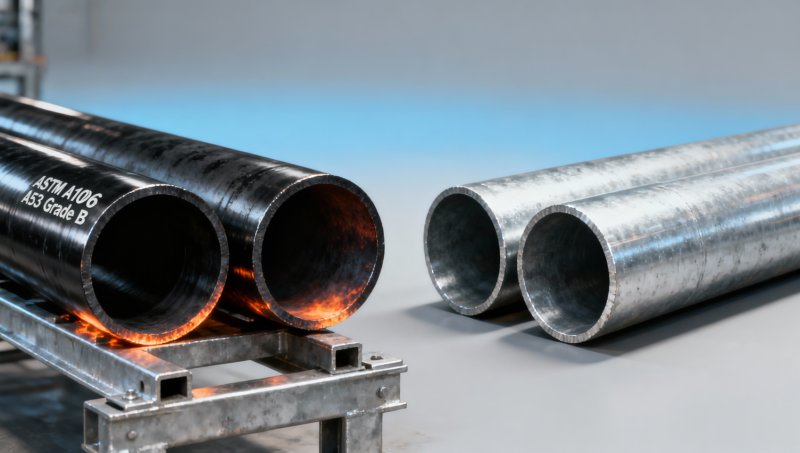
This table highlights why “equivalent” is misleading: identical nominal strength values mask divergent thermal stability, weldability validation, and long-term creep resistance. For projects requiring ASME Section I or III compliance, A53 substitution invalidates design certification—even if dimensional tolerances match.
Where Substitution Risks Multiply: 4 High-Exposure Scenarios
Substitution risk isn’t uniform—it concentrates where temperature, pressure, and regulatory scrutiny intersect. First, in offshore platform firewater systems, A53’s lower notch toughness increases brittle fracture probability during rapid cooldown after fire suppression. Second, in district heating networks operating at 120–150°C, A53’s accelerated oxidation rate reduces service life by 30–40% versus A106.
Third, in LNG vaporizer headers, A53’s unverified low-temperature performance fails API RP 14E velocity limits—raising erosion-corrosion risk above 1.5 m/s. Fourth, in pharmaceutical clean steam lines (Class VI), A53’s optional mill test report (MTR) format doesn’t satisfy FDA 21 CFR Part 211 requirements for full heat-lot traceability.
Hongteng Fengda mitigates these risks through dual-certification production: every A106 order undergoes independent third-party verification (SGS/BV) against ASTM A106-22 Annex A1, including microstructure analysis and hydrostatic retest at 1.5× design pressure. This eliminates ambiguity for end-users across North America, Europe, and the Middle East.
Procurement Checklist: 5 Non-Negotiable Verification Steps
- Require full MTR showing actual tensile/yield values—not just “meets spec” declarations
- Confirm seamless designation (not “seamless or welded”) on packing list and mill certificate
- Validate heat number traceability from raw billet log to final pipe bundle (minimum 10-year retention)
- Verify hydrotest pressure and duration: A106 requires ≥1.5× design pressure for ≥5 seconds per ASTM A106 §8.2
- Check surface finish compliance: A106 mandates ≤12.5 µm Ra roughness for internal surfaces in critical service
Beyond Pipe: How Wire Rod Integrity Supports Structural Reliability
While pipe substitution dominates high-stakes discussions, foundational materials like Wire rod play an equally vital role in system-wide integrity. Used extensively in civil engineering construction—including foundations, beams, columns, walls, slabs, and rebars—wire rod quality directly influences concrete bond strength, crack propagation resistance, and seismic energy dissipation.
Hongteng Fengda supplies wire rod in HRB335, HRB400, and HRB500 grades, with diameters spanning 6mm to 50mm and lengths from 5m to 12m. Each coil undergoes tensile testing per ASTM A615, bend testing per GB1499.2, and surface inspection for scale defects exceeding 0.15mm depth. Tolerance adherence is maintained at ±1%, critical for automated rebar fabrication lines.
For projects demanding corrosion resistance, our galvanized wire rod meets ASTM A641 Class III (≥275 g/m² zinc coating) and passes 96-hour neutral salt spray testing (ASTM B117). This extends service life in coastal infrastructure by 2–3× compared to black-finish alternatives.
These certifications ensure cross-border acceptance—whether supplying precast elements for Dubai Metro Phase IV or reinforcing piles for Singapore’s Tuas Port expansion. Our wire rod is routinely accepted by Tier-1 contractors without additional mill review cycles.
Partnering for Specification Integrity: From Quote to Commissioning
Hongteng Fengda embeds specification governance into every procurement stage. During quotation, our technical team cross-references your P&ID line lists against ASTM, EN 10216-2, and ISO 3183 requirements—flagging potential substitutions before order placement. Pre-production, we share digital heat logs and coordinate third-party witness testing (e.g., BV hydrotest observation).
Logistics include ISO 14001-compliant packaging: anti-rust oil coating for black pipe, PVC-wrapped bundles for galvanized items, and custom crating for oversized structural components. Lead time for A106 orders averages 25–35 days from confirmed PO, with 98.2% on-time delivery over the past 18 months across 23 export markets.
For urgent projects, our Chengdu and Tianjin facilities maintain strategic stock of A106 Grade B (NPS 2–12, SCH 40/80) and HRB400 wire rod—enabling 7-day dispatch for orders ≤50 MT. All shipments include bilingual documentation (English/Arabic or English/Spanish) and comply with U.S. CBP ACE filing requirements.
FAQ: Addressing Real Procurement Concerns
Q: Can A53 be upgraded to A106 via post-manufacturing heat treatment?
A: No. ASTM A106 requires specific ladle chemistry controls (e.g., max 0.035% phosphorus) and hot-finish temperature windows (≥925°C) that cannot be replicated post-production. Heat treatment only modifies microstructure—not base composition.
Q: What documentation proves A106 compliance beyond the mill test report?
A: We provide supplemental evidence: spectrographic analysis certificates (OES), grain size reports (ASTM E112), and hydrotest video logs upon request. All documents bear original wet-ink signatures and notary stamps valid for ASME Code Stamp applications.
Q: Do you support mixed-material orders (e.g., A106 pipe + HRB400 wire rod)?
A: Yes. We optimize container loading for combined shipments—reducing freight cost by 12–18% versus separate consignments. Minimum order value is USD 15,000, with flexible payment terms (30% TT advance + 70% LC at sight).
Material specification fidelity isn’t a paperwork exercise—it’s the foundation of operational safety, regulatory approval, and asset longevity. Whether specifying A106 for a Saudi Aramco pipeline or sourcing HRB500 wire rod for a Jakarta high-rise, Hongteng Fengda delivers verifiable compliance, not just dimensional conformity. Contact our engineering sales team today to validate your next order’s technical alignment—and receive a free specification audit report within 48 business hours.
Please give us a message


Please enter what you want to find