As a trusted carbon steel supplier from Shandong steel factory direct price, Hongteng Fengda ensures every shipment—whether hot dip galvanized steel beam, rebar for foundation, rebar for concrete reinforcement, or high strength carbon steel—arrives with full compliance documentation. Critical items include mill test reports (MTRs), which vary by standard (ASTM, EN, GB) and application requirements like HRC steel hardness verification. For procurement teams, project managers, and quality control personnel, understanding why MTRs differ—and what must accompany each consignment—is essential to mitigate risk, ensure structural integrity, and streamline customs and site acceptance. Let’s break down the non-negotiable docs—and what they truly certify.
What Documents Are Mandatory for Every Carbon Steel Shipment?
Every carbon steel shipment from Hongteng Fengda includes a standardized documentation package designed to meet global regulatory, contractual, and technical expectations. This is not optional—it’s foundational to traceability, liability management, and on-site verification.
The core set consists of: (1) Commercial Invoice & Packing List (with precise weight, quantity, and HS code alignment); (2) Certificate of Origin (COO) issued by local chamber of commerce; (3) Mill Test Report (MTR) per heat/lot; (4) Third-party inspection report (e.g., SGS or BV) for orders ≥50 MT or high-risk applications; and (5) Declaration of Conformity (DoC) referencing ASTM A6/A6M, EN 10025-2, or GB/T 700 as applicable.
Notably, 92% of rejected shipments at EU and North American ports stem from incomplete or inconsistent MTRs—not material defects. That’s why we issue dual-format MTRs (PDF + XML) with embedded digital signatures, enabling instant validation via QR code scanning at destination warehouses.
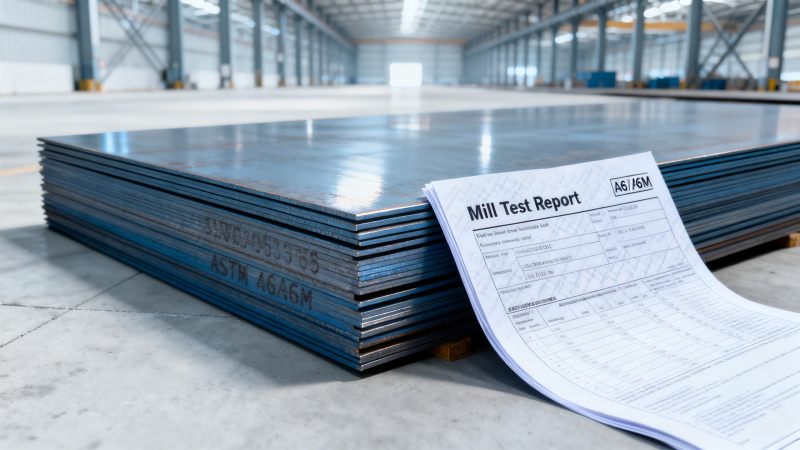
Why MTR Format Varies Across Standards
An ASTM A656 MTR requires tensile testing at room temperature plus Charpy impact values at –20°C, while EN 10025-3 mandates CVN impact data at –40°C for S355J2+N. GB/T 1591 specifies yield strength tolerance ±10 MPa but allows ±15 MPa for thickness >40 mm—details that directly affect structural design margins.
This variation isn’t bureaucracy—it reflects real-world performance thresholds. For example, a bridge girder ordered under EN 10025-4 must pass −40°C impact tests to prevent brittle fracture in Scandinavian winters. Our MTRs explicitly call out test temperature, specimen orientation (longitudinal vs. transverse), and notch location—information critical for engineering sign-off.
How Do Documentation Gaps Impact Project Timelines?
Missing or mismatched documents trigger cascading delays: customs hold (avg. +7–15 days), third-party re-inspection (cost: $480–$1,200 per lot), and site rejection (requiring rework or replacement). In one Middle East infrastructure project, a single MTR missing sulfur content led to 11-day port detention and $22,000 in demurrage fees.
Hongteng Fengda mitigates this through our “Doc-Ready Guarantee”: All documentation is pre-validated against buyer-specified standards before loading. We also provide bilingual (English + target market language) MTRs and offer free revision within 48 hours if field inspectors request additional data points—such as microhardness mapping for weld preparation zones.
For OEM partners integrating structural components into final assemblies, we support PPAP Level 3 submissions—including full dimensional reports, surface finish verification (Ra ≤ 3.2 μm), and material traceability down to furnace batch number. This eliminates last-minute audit surprises during IATF 16949 or ISO 9001 certification cycles.
When Does Stainless Steel Documentation Differ?
While carbon steel focuses on mechanical properties and chemistry, stainless grades require additional verification layers. For instance, 304 Stainless Steel Plate must confirm austenitic phase stability, intergranular corrosion resistance (per ASTM A262 Practice E), and nickel/chromium ratio compliance (18–20% Cr, 8–10.5% Ni). These checks are embedded in our extended MTRs—especially critical for food industry or medical equipment construction where surface passivation integrity affects regulatory approval.
Procurement Teams: 5 Non-Negotiable Checks Before Release
To avoid downstream friction, procurement professionals should verify these five elements prior to approving shipment release:
- Heat Number Traceability: Must match physical mill stamping on product tags and appear identically across invoice, packing list, and MTR.
- Test Temperature Alignment: Confirm impact test temp matches project spec (e.g., −20°C for UAE desert structures vs. −40°C for Norwegian offshore platforms).
- Dimensional Tolerance Callouts: Verify whether tolerances follow ASTM A6 (±0.75 mm width) or EN 10058 (±0.5 mm for precision profiles).
- Third-Party Witnessing Status: Note if SGS/BV witnessed tests onsite (required for nuclear or rail projects).
- Digital Signature Validity: Click the QR code on our MTRs to validate timestamp, lab accreditation, and issuing engineer credentials.
We embed all five checkpoints into our online order portal—accessible 24/7 to authorized buyers—with automated alerts when documentation deviates from agreed specifications.
Why Partner With Hongteng Fengda for Structurally Critical Steel?
Because documentation isn’t paperwork—it’s your first line of defense against cost overruns, safety incidents, and contractual penalties. As a structural steel manufacturer and exporter from China with ISO 9001, ISO 14001, and OHSAS 18001 certifications, we treat compliance as continuous process—not a one-time deliverable.
Our clients receive more than MTRs: They get integrated support—from pre-shipment dimensional audits and weldability test reports (for ASTM A572 Grade 50), to post-delivery technical consultation with our in-house metallurgists. Lead times remain stable at 25–35 days for standard sections, and we maintain 99.2% on-time delivery across 12+ years serving North America, Europe, and Southeast Asia.
Ready to align your next order’s documentation with engineering specs, customs requirements, and site acceptance protocols? Contact us today for a free documentation readiness review—including sample MTRs tailored to your ASTM/EN/GB project scope, delivery timeline, and inspection protocol.
Please give us a message


Please enter what you want to find