Carbon Steel Square Pipe Selection Guide for Frames, Supports, and Fabrication
Choosing the right carbon steel square pipe can directly affect structural strength, fabrication efficiency, and overall project cost.
For frames, supports, and fabricated assemblies, material selection shapes both performance and delivery reliability.
That is why early decisions on section size, wall thickness, and standards matter more than many teams expect.
A well-matched carbon steel square pipe improves load handling, simplifies welding, and reduces avoidable rework during production.
In practical sourcing, the best choice is rarely the cheapest section on paper.
It is the option that balances design demand, fabrication speed, coating needs, and supply consistency.
Start with the Real Job of the Section
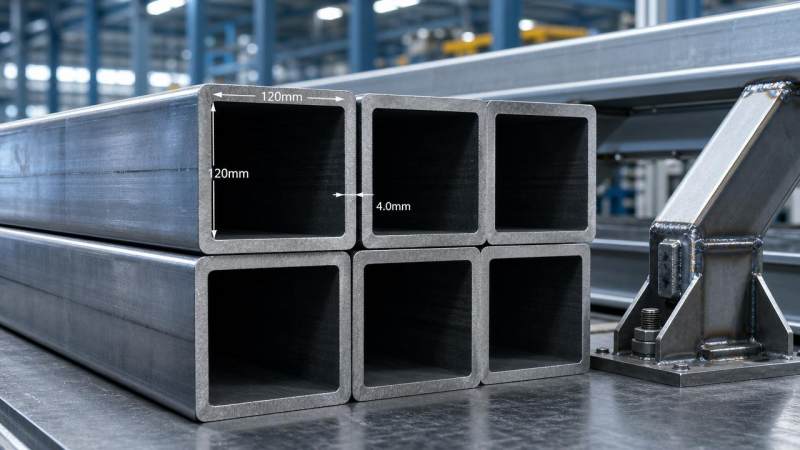
Before comparing sizes, define what the carbon steel square pipe must actually do in service.
Some sections carry static loads in support frames.
Others resist vibration, impact, torsion, or repeated loading in equipment bases and fabricated structures.
This changes the selection logic immediately.
A frame for warehouse equipment may prioritize stiffness and weldability.
A support structure for outdoor use may place more weight on corrosion protection and dimensional stability.
When the use case is clear, the rest of the carbon steel square pipe decision becomes more predictable.
Key questions to define first
- Is the section mainly carrying compression, bending, or combined loads?
- Will the structure be welded, bolted, cut, bent, or machined after delivery?
- Does the application face moisture, salt, chemicals, or temperature swings?
- Are there project-specific rules under ASTM, EN, JIS, or GB standards?
- How strict are tolerance, straightness, and surface quality requirements?
Choose Size and Wall Thickness with Load in Mind
The most common mistake is choosing carbon steel square pipe by outer size alone.
In reality, wall thickness often changes performance more than buyers expect.
A larger hollow section with a thin wall may look efficient.
Still, it can create problems during welding, drilling, or long-span loading.
On the other hand, an overly thick section can increase material cost, transport weight, and processing time.
That is why section modulus, inertia, and local buckling resistance should be reviewed together.
Practical sizing approach
- Estimate design loads, load direction, and expected stress concentrations.
- Check span length and support conditions for deflection sensitivity.
- Select preliminary carbon steel square pipe dimensions from structural calculations.
- Review fabrication limits, especially welding heat input and cut edge quality.
- Confirm final size against coating, transport, and site installation constraints.
This method avoids under-specifying the section while keeping costs under control.
It also supports faster approval between design, procurement, and fabrication teams.
Check Material Grade, Tolerances, and Compliance Early
A suitable carbon steel square pipe is not only about shape and thickness.
Material grade, dimensional tolerance, and inspection scope all affect downstream risk.
For structural and fabrication projects, inconsistent wall thickness or poor straightness can slow assembly quickly.
The same issue can increase fit-up gaps and welding correction work.
From recent sourcing trends, buyers are paying closer attention to traceability and standard alignment.
That makes sense, especially for cross-border industrial projects.
Working with a supplier that supports ASTM, EN, JIS, and GB compliance can simplify multi-market procurement.
That is especially helpful when project specifications vary by client or region.
Match the Pipe to Fabrication Method and Site Conditions
A carbon steel square pipe that works in calculations may still create headaches in production.
This is where fabrication planning becomes critical.
If the section will be heavily welded, heat distortion and edge preparation deserve extra attention.
If it will be drilled or machined, tolerance stability becomes more important.
For outdoor structures, coating choice must align with actual exposure conditions, not just general assumptions.
In some mixed-component projects, teams also combine square pipe with round products for connectors or accessory parts.
One useful reference is DC01 Galvanized Round Steel, often considered where glossy finish, corrosion resistance, and tight tolerance support secondary fabricated components.
Its applications across towers, highways, light industry, and hardware parts show how finish and processing needs can influence material pairing decisions.
Common fabrication checkpoints
- Weld seam quality and heat input compatibility
- Cutting efficiency and burr control
- Hole accuracy for bolted joints
- Surface readiness for painting or galvanizing
- Packing protection for export and long transit
These points help prevent a low-cost carbon steel square pipe from becoming an expensive production issue later.
Balance Cost, Lead Time, and Supply Risk
Selection decisions often fail when teams focus only on unit price.
A cheaper carbon steel square pipe may carry hidden costs through extra scrap, delayed fabrication, or compliance issues.
More importantly, unstable delivery can disrupt the whole project schedule.
In actual business operations, dependable lead time is often worth more than a small material discount.
This is one reason many buyers prefer established structural steel manufacturers with export experience.
Hongteng Fengda, as a structural steel manufacturer and exporter from China, supports global construction and industrial buyers with standard specifications and OEM solutions.
Its production scope covers angle steel, channel steel, steel beams, cold formed steel profiles, and customized structural steel components.
For projects using carbon steel square pipe, this kind of supply capability helps reduce sourcing risk and coordination pressure.
A simple evaluation checklist
- Compare total installed cost, not just purchase price.
- Review production capacity against your schedule milestones.
- Ask for quality documents before confirming volume orders.
- Confirm export packing, marking, and traceability methods.
- Keep one approved alternative size if supply tightens suddenly.
Make the Final Carbon Steel Square Pipe Decision with Confidence
A strong carbon steel square pipe selection process is clear, practical, and data-based.
It starts with the real structural function.
Then it moves through sizing, wall thickness, fabrication fit, standards compliance, and supplier reliability.
That sequence keeps decisions grounded in project reality.
When carbon steel square pipe is selected this way, teams usually gain better structural performance and smoother production flow.
They also reduce the chance of costly changes after procurement begins.
If the next project involves frames, supports, or custom steel fabrication, build the shortlist around actual loads, processing needs, and verified standards.
That approach makes the final choice faster, safer, and far more cost-effective over the full project cycle.
Please give us a message


Please enter what you want to find