Pressure service leaves little room for guesswork. The choice between welded pipe and carbon steel seamless pipe shapes burst resistance, inspection strategy, lifecycle cost, and code compliance. In steel-intensive projects, that decision also affects procurement timing, fabrication planning, and long-term operating confidence.
The comparison matters because both products are widely used, both can meet demanding standards, and neither is automatically better in every case. What matters is how pressure level, temperature, fluid type, wall thickness, and quality verification come together in the real service environment.
Why the distinction matters in pressure systems
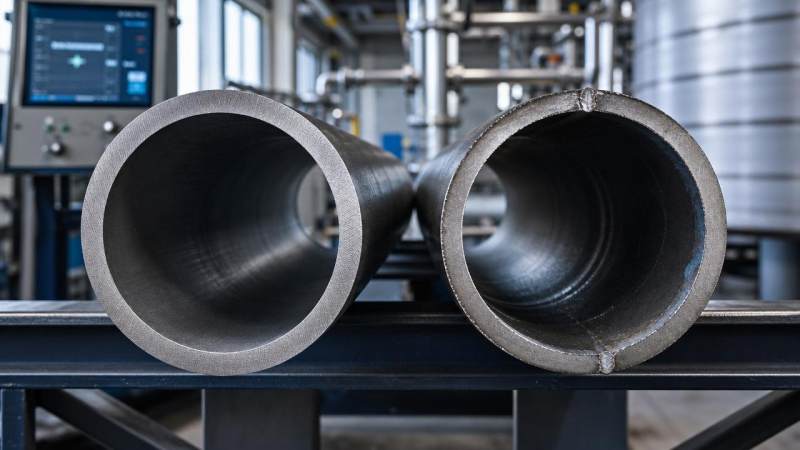
Pipes for pressure service are expected to contain internal force safely over time. That sounds simple, yet actual conditions often include pressure cycling, thermal shock, corrosive media, vibration, and weld-heavy installation environments.
In those conditions, buyers usually compare carbon steel seamless against welded alternatives because the manufacturing route changes the risk profile. Seamless pipe has no longitudinal weld seam. Welded pipe does, but modern production methods can deliver excellent consistency when properly controlled.
This is also why technical review rarely stops at price per ton. A lower material cost can be offset by extra testing, stricter acceptance checks, or shorter replacement intervals.
How seamless and welded pipe are actually different
Carbon steel seamless pipe is produced from a solid billet that is pierced, elongated, and rolled into a hollow section. Because there is no fused seam, the structure is continuous around the circumference.
Welded pipe is formed from steel plate or coil. The material is shaped into a tube and joined along a seam, often by ERW or other welding processes, followed by sizing and inspection.
That manufacturing difference influences several technical points:
- Seamless pipe avoids seam-related discontinuities.
- Welded pipe often offers tighter dimensional control in certain ranges.
- Seamless pipe is commonly preferred for higher pressure and severe service.
- Welded pipe can be more economical and easier to source in larger diameters.
Simple comparisons can be misleading, though. A poor seamless pipe is not safer than a well-made welded pipe that meets the right standard and passes full inspection.
Pressure performance and structural reliability
When pressure is the leading concern, carbon steel seamless usually has the advantage. The absence of a weld seam reduces one critical area for defect concentration, especially under fluctuating loads or elevated temperatures.
This does not mean welded pipe is weak. Many welded products perform reliably in pressure pipelines, fire protection lines, water transmission, and moderate industrial duty. The real question is how much design margin the application demands.
For steam, hydrocarbons, boiler feed, and other demanding systems, carbon steel seamless is frequently selected because conservative design practice values continuity of material and predictable pressure behavior.
Inspection, standards, and what buyers now watch closely
Industry attention has shifted from basic material supply to verification quality. Buyers now ask not only what the product is, but how it was inspected, traceable, and certified.
For pressure service, the review typically includes ASTM, EN, JIS, or GB alignment, hydrostatic testing, nondestructive examination, dimensional tolerance, chemistry, and mechanical properties. Heat treatment records and mill traceability also matter.
This is where experienced steel exporters add value. Hongteng Fengda, as a structural steel manufacturer and exporter from China, works with global projects that require consistent quality control, stable production capacity, and compliance with major international standards.
That background matters even when the project includes more than pipe alone. Pressure systems often connect to structural frames, support members, skids, and equipment bases that must be sourced with the same discipline.
Where welded pipe remains a practical choice
Welded pipe is often the rational option when service pressure is moderate, project budgets are tight, and large diameters are needed quickly. Many building services and utility lines fit that profile.
In actual project packages, pipe selection also sits beside broader steel supply decisions. Support systems may use sections such as Channel Steel Supplier products in Q195, Q235B, or Q345B, especially for wall beams, brackets, lightweight roofs, and mechanical support frames.
That kind of integration becomes useful when dimensional control, anti-corrosion finishing, and standard compliance need to stay aligned across both piping and structural components.
Typical use cases by service severity
A useful way to decide is to classify the line by consequence of failure, not only by nominal pressure. Some systems can tolerate maintenance interruption. Others cannot.
- High-pressure process lines: carbon steel seamless is commonly favored.
- Boiler and superheater service: seamless is often selected for safety margin.
- General utility piping: welded pipe may be sufficient and economical.
- Large-diameter transport lines: welded pipe often wins on scale and cost.
- Critical shutdown-sensitive systems: seamless often justifies its premium.
This is why “better” should always be read as “better for a defined service condition.” Without that context, the comparison loses practical value.
Cost should be measured beyond the purchase price
Seamless pipe usually costs more per unit. That is the most visible difference, but not always the most important one. Pressure failures, unplanned downtime, and conservative overdesign can cost far more than the material premium.
Welded pipe may reduce immediate expenditure and improve delivery flexibility. Yet if the application requires repeated seam inspection, additional documentation review, or thicker walls to build confidence, the cost gap can narrow.
In steel procurement, the strongest decisions usually balance five factors together: pressure demand, operating temperature, inspection burden, installation schedule, and total lifecycle risk.
A practical way to choose
A disciplined evaluation starts with service data and ends with supplier verification. That keeps the decision technical rather than habitual.
- Confirm design pressure, upset pressure, and temperature range.
- Check whether failure consequence is manageable or severe.
- Review applicable standards and client specifications.
- Compare inspection scope, including NDT and hydro test requirements.
- Assess supplier traceability, consistency, and delivery reliability.
If the line carries high pressure, cyclic loading, or hazardous media, carbon steel seamless is often the safer route. If service is moderate and well defined, welded pipe can be technically sound and commercially efficient.
The next step is to build a shortlist based on actual line conditions, then compare mill data, inspection plans, and standard compliance side by side. That approach usually reveals whether carbon steel seamless delivers necessary protection or whether welded pipe is already enough for the job.
Please give us a message


Please enter what you want to find