Before requesting pricing, buyers should know how to evaluate a carbon steel seamless pipe manufacturer beyond the quote itself. From production standards and quality control to export experience and delivery reliability, the right checklist helps procurement teams reduce sourcing risks, compare suppliers more accurately, and secure consistent pipe performance for industrial and construction projects.
For procurement teams, a low unit price can hide costly issues such as out-of-tolerance dimensions, incomplete material traceability, delayed shipment, or inconsistent performance under pressure and structural load. In steel sourcing, especially for industrial piping, construction support systems, and fabrication work, supplier capability matters as much as product cost.
A qualified carbon steel seamless pipe manufacturer should be assessed across at least 6 key areas: production scope, standards compliance, raw material control, inspection process, export execution, and delivery stability. Buyers who use a structured checklist often make faster comparisons and reduce rework, claims, and schedule disruptions during the purchasing cycle.
Core Supplier Evaluation Criteria Before RFQ
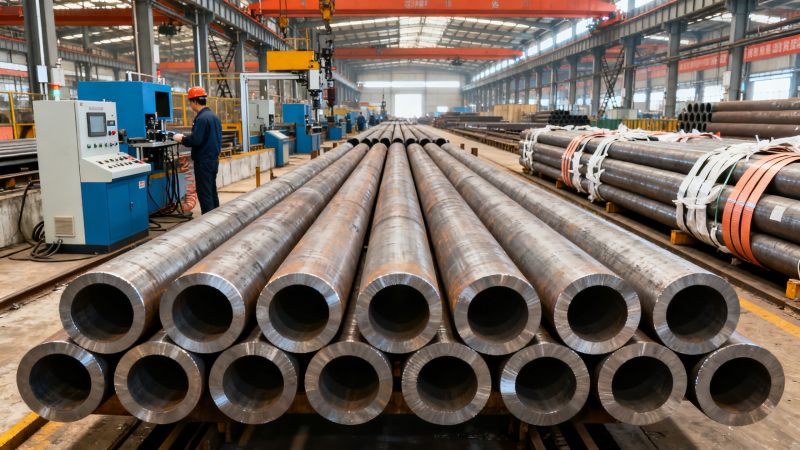
When evaluating a carbon steel seamless pipe manufacturer, the first step is to confirm whether the supplier can meet the exact operating and commercial requirements of the project. This includes not only pipe size and grade, but also heat treatment condition, testing scope, documentation package, and export readiness. A quote is only meaningful when these variables are clear.
1. Check Manufacturing Scope and Product Range
Not every manufacturer produces the same dimensional range or wall thickness capability. Some suppliers focus on small-diameter mechanical tubing, while others are better suited for structural or pressure-service pipe. Ask for the standard outer diameter range, common wall thickness range, and length options, such as 6 m, 9 m, or 12 m supply formats.
A capable supplier should also explain whether they support cut-to-length processing, beveling, end protection, black painting, bundling, and third-party inspection coordination. For projects with mixed steel demand, it is often useful to work with a company that understands both pipe products and structural steel applications, especially when procurement teams want fewer vendors and more consistent logistics planning.
2. Confirm Applicable Standards and Grade Matching
Standards are one of the biggest comparison points when selecting a carbon steel seamless pipe manufacturer. Buyers should confirm whether the pipe is supplied according to ASTM, EN, JIS, or GB standards, and whether the manufacturer can map local project specifications to equivalent steel grades when needed.
For example, a procurement team may require pressure-service material, structural use, or general engineering pipe. These applications can have different chemical composition limits, tensile requirements, hydrostatic testing rules, and NDT expectations. A serious supplier should clarify these differences before issuing a commercial offer.
What buyers should request at this stage
- Standard designation and steel grade
- Size tolerance and wall thickness tolerance
- Mechanical property range
- Heat treatment condition, if applicable
- MTC format and traceability method
- Testing list included in the quotation
The table below helps buyers compare supplier capability before they ask for a formal RFQ. It focuses on practical procurement checkpoints rather than broad marketing claims.
This comparison shows that supplier evaluation should be technical and operational at the same time. In most B2B steel purchases, the best-performing supplier is rarely the one with the lowest headline price alone. The better option is usually the manufacturer that can document quality, control delivery windows within 2 to 6 weeks, and respond clearly to technical queries.
3. Review Raw Material Control and Process Stability
A reliable carbon steel seamless pipe manufacturer should explain how billets or mother materials are sourced, identified, and traced through production. Buyers should ask whether the factory uses heat number control, in-process dimensional checks, and batch-based mechanical testing. These controls help reduce variation from lot to lot.
In practical terms, process stability affects roundness, wall uniformity, straightness, and weld-free structural integrity. Even a deviation of ±0.5 mm to ±1.0 mm can become a fabrication issue when the pipe must fit flanges, couplings, supports, or automated machining lines. Procurement teams should not assume all mills control these tolerances equally.
Quality Assurance, Documentation, and Delivery Risk Control
Once the manufacturing capability is confirmed, the next stage is to verify how the supplier manages quality records, inspection reporting, and shipment execution. For many buyers, this is where a strong carbon steel seamless pipe manufacturer stands apart from a trading-only source that has limited visibility into actual production and quality control.
4. Verify Inspection, Testing, and Mill Documentation
A good quotation should specify what is included in the test package. Common requirements may include chemical composition analysis, tensile testing, flattening or expanding test where applicable, hydrostatic testing, ultrasonic testing, dimensional inspection, and visual surface examination. Buyers should also ask whether inspection is conducted per heat, per lot, or per production batch.
Documentation is equally important. At minimum, many industrial buyers request a mill test certificate, packing list, commercial invoice, and origin-related export files. For projects in North America, Europe, or the Middle East, document accuracy can affect customs clearance and site acceptance as much as the material itself.
Common document checklist before order confirmation
- Product specification sheet with size, grade, and standard
- Inspection and test plan if required by the project
- MTC sample format for approval before production
- Packing method confirmation for container or bulk shipment
- Lead time breakdown from production to port loading
For procurement teams sourcing multiple steel products together, it is also efficient to work with suppliers that understand related flat and structural steel items. In mixed project purchasing, products such as DX52D Galvalume Steel Coil may be required for cladding, cold forming, or corrosion-resistant fabrication alongside pipe and structural sections.
That material uses low-carbon steel and is suited for cold forming, with yield strength not exceeding 260 MPa, tensile strength between 300 and 360 MPa, and elongation after fracture of at least 28%. Available dimensions include widths of 500–1500 mm, thickness from 0.12 mm to 4 mm, and lengths from 100 mm to 12000 mm, with common certifications such as ISO 9001, SGS, and BV. For buyers managing broader steel packages, this kind of product compatibility can simplify sourcing coordination and reduce supplier fragmentation.
The next table outlines the main delivery and quality risk points procurement teams should discuss before placing an order with any carbon steel seamless pipe manufacturer.
The key lesson is simple: risk is easier to prevent before the PO is issued than after cargo reaches the jobsite. A supplier that can provide specific answers, clear timelines, and consistent documents is usually easier to manage over 3, 6, or 12 months of repeat procurement.
5. Assess Export Experience and Communication Efficiency
For international sourcing, communication speed is not a soft factor. It directly affects order accuracy and schedule control. A dependable carbon steel seamless pipe manufacturer should respond to technical questions within 24 to 48 hours, clarify Incoterms, confirm port options, and provide realistic shipment planning rather than optimistic promises.
Suppliers with broader steel export experience, such as companies serving structural steel, beams, channels, angles, and customized components, often understand project documentation, container loading efficiency, and multi-item order coordination better. This is valuable for buyers that need one shipment to include several categories of steel products under consistent quality control.
6. Compare Total Procurement Value, Not Just Unit Price
A lower offer can become more expensive if it causes 2 weeks of delay, 3% rejection, extra machining, or replacement freight. Buyers should compare total landed value by looking at inspection inclusion, packing quality, dimensional consistency, claim handling process, and payment terms. This is especially important for projects with tight installation windows or penalty clauses.
In many cases, the most competitive carbon steel seamless pipe manufacturer is the one that offers stable quality over repeated batches, not just an attractive first order. Procurement teams should evaluate whether the supplier can support forecast-based purchasing, repeat dimensions, and documentation consistency across multiple shipments.
A Practical RFQ Checklist for Procurement Teams
To make supplier comparison more objective, buyers should send the same RFQ structure to each shortlisted carbon steel seamless pipe manufacturer. This reduces ambiguity and makes it easier to compare lead time, technical compliance, and commercial terms side by side.
Recommended RFQ fields
- Pipe standard and grade
- Outer diameter, wall thickness, and length
- Required quantity in tons or pieces
- End finish, coating, and packing requirements
- Inspection scope and third-party witness needs
- Delivery term such as FOB, CFR, or CIF
- Target delivery window, for example 20–35 days
- Destination port and document requirements
Questions worth asking before supplier approval
Ask whether the manufacturer can provide the same grade in future lots without major property variation, whether substitute grades need buyer approval, and whether non-standard lengths affect lead time or MOQ. Also confirm how claims are handled if dimensional nonconformity or transit damage is found upon receipt.
If your sourcing program includes structural steel in addition to pipe, working with an exporter such as Hongteng Fengda can bring practical coordination benefits. With experience in angle steel, channel steel, steel beams, cold formed steel profiles, and customized structural steel components, the company supports global buyers who want reliable steel supply, standards-based production, and more stable project execution across regions such as North America, Europe, the Middle East, and Southeast Asia.
A disciplined checklist helps procurement teams identify the right carbon steel seamless pipe manufacturer before commercial negotiations begin. By reviewing standards compliance, process control, inspection depth, document readiness, and delivery reliability, buyers can reduce sourcing risk and improve consistency across every shipment. If you are planning a new steel sourcing project or need support with pipe and structural steel supply from China, contact us now to get a tailored solution, discuss technical details, and receive a quotation built around your actual project requirements.
Please give us a message


Please enter what you want to find