Yes, galvanized sheet steel angles can withstand outdoor exposure, provided the coating system, fabrication method, and installation details suit the environment. For technical evaluators sourcing angulo de chapa galvanizada, the important question is not whether zinc resists corrosion—it does—but whether the finished angle has enough protection at its bends, edges, holes, and connections for the intended service conditions.
An angle supporting sheltered façade trim faces a different exposure from one installed beside the sea or inside a humid agricultural building. Both may be described as “galvanized,” yet their maintenance requirements can differ substantially. A reliable selection therefore starts with the exposure conditions and works backward to the steel grade, coating specification, and inspection requirements.
“Galvanized angle” can describe two different products
Before comparing quotations, establish how the angle is manufactured. This distinction affects coating coverage, dimensional tolerances, and the standards used to assess the product.
Angles formed from continuously galvanized sheet
These sections are bent or roll-formed from steel sheet that already carries a zinc coating. They are commonly used for framing, edge supports, brackets, and secondary components. The broad surfaces are protected before fabrication, but cutting and punching expose the steel substrate locally.
Zinc adjacent to a small exposed area can provide sacrificial protection. However, this protection has practical limits and depends on the exposed area, available zinc, and environment. It should not be treated as permission to leave every cut edge untreated, especially in coastal or persistently wet service.
Angles galvanized after fabrication
Alternatively, the angle is formed, cut, drilled, or welded before hot-dip galvanizing. This route can coat accessible edges and holes as well as the main surfaces, and often provides a heavier zinc layer than standard continuously galvanized sheet.
It is not automatically suitable for every thin section. Heat during galvanizing can cause distortion, and enclosed or overlapping details require suitable venting and drainage. Buyers should agree dimensional tolerances and confirm that the geometry can be galvanized safely and consistently.
The purchasing implication: “galvanized sheet angle” and “fabricated angle, hot-dip galvanized” should not be accepted as interchangeable descriptions without reviewing their coating and dimensional requirements.
Outdoor exposure is more than rain
Zinc protects steel through both a barrier effect and sacrificial action. In suitable atmospheric conditions, its surface develops corrosion products that help slow further attack. The rate at which zinc is consumed nevertheless changes with salt deposition, pollutants, temperature, and time of wetness.
Rain can wash contaminants away from an exposed surface. A sheltered connection may retain them instead. This is why a bracket under an overhang can sometimes corrode more aggressively than a nearby surface that receives regular rainwashing.
ISO 9223 can help classify atmospheric corrosivity, while ISO 14713 provides guidance relevant to zinc coatings. Where an additional paint system is specified, ISO 12944 may inform coating selection. These references support engineering judgment; they do not turn an unspecified galvanized angle into a product with a guaranteed lifespan.
Read the coating designation—not just the word “galvanized”
Coating mass and coating thickness are related, but they are not identical purchasing terms. Continuous galvanized sheet is often specified by a coating-mass designation, whereas articles galvanized after fabrication are typically assessed using coating thickness requirements associated with the relevant standard.
For example, Z275 under EN 10346 denotes a zinc coating-mass level of 275 g/m² across both surfaces, subject to the standard’s test requirements. If distributed equally, that corresponds approximately to 19 μm of zinc per side. It does not mean 275 μm of coating, nor does it establish the minimum thickness at every bend or cut edge.
Specifications under ASTM A653/A653M use their own coating designations and requirements. ASTM A123/A123M and ISO 1461 address hot-dip galvanized fabricated articles within their respective scopes. Confirm which standard applies to the actual manufacturing route rather than attaching a familiar standard to the quotation.
For an angulo de chapa galvanizada evaluation, ask the supplier to identify:
- The steel grade and whether its mechanical properties are suitable for the design.
- The nominal base-metal thickness, coating designation, and applicable tolerances.
- The galvanizing route: before forming or after fabrication.
- The method used to assess coating mass or local coating thickness.
- The treatment of cut edges, drilled holes, welds, and handling damage.
- The inspection documentation supplied with the order.
A thicker zinc layer generally provides more protection in the same environment, but coating quantity alone is not the complete specification. A poorly drained joint can consume that protection faster than anticipated.
The failure points are usually in the details
During evaluation, look beyond the flat faces. The locations most likely to cause trouble are often small enough to escape notice in a catalogue photograph.
Bends: Tight bending can strain the coating and produce cracking, depending on the substrate, coating, forming process, and bend radius. Request suitable bend geometry and inspect representative finished sections. A sound-looking flat sheet does not prove that the formed angle has an intact coating.
Cut edges and holes: Clean, burr-free cuts reduce local defects and improve the effectiveness of any repair coating. Specify edge protection where the exposure warrants it, particularly around fasteners and connections that remain damp.
Welded areas: Welding damages nearby zinc protection. Where pre-galvanized components are welded, the affected region needs appropriate preparation and an agreed repair system. ASTM A780/A780M describes repair methods for damaged hot-dip galvanized coatings where applicable. Welding galvanized steel also requires suitable fume controls.
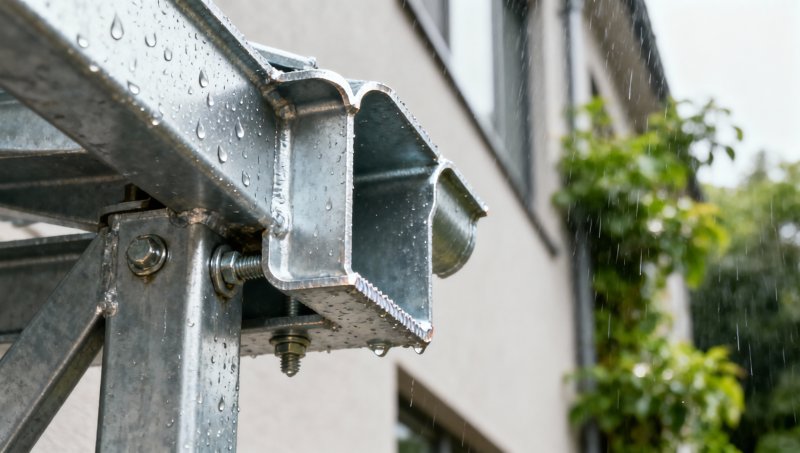
Water traps: Upward-facing angle legs, overlapping plates, and tight crevices can retain water and debris. Where possible, orient sections to drain, avoid unnecessary pockets, and provide access for cleaning. A small detailing change can be more valuable than a vague request for “better corrosion resistance.”
Dissimilar-metal contacts: Direct contact with copper or certain other metals in a wet environment can accelerate zinc loss. Stainless steel fasteners also require assessment of contact area, exposure, and isolation needs. Use compatible fasteners and suitable separating materials where the design calls for them.
Storage matters too. Tightly stacked galvanized sections can develop white corrosion products when moisture becomes trapped between surfaces. Store bundles dry, ventilated, and off the ground. Light staining is not automatically a structural rejection, but significant wet-storage corrosion should be assessed for coating loss rather than dismissed as cosmetic.
Corrosion resistance does not establish structural capacity
A galvanized sheet angle can retain a clean appearance yet still be unsuitable for its assigned load. Thin cold-formed sections require checks for local buckling, connection bearing, fastener pull-through, deflection, and any other failure modes relevant to the application.
Do not substitute a thin formed angle for a hot-rolled structural angle merely because the leg dimensions match. Steel grade, thickness, corner geometry, and section properties all affect performance. The evaluator should also distinguish base-metal thickness from total coated thickness, particularly when comparing thin-sheet products.
Where a component is safety-critical or difficult to replace, corrosion assessment and structural verification should be coordinated. The acceptable coating deterioration and any allowance for section loss depend on the design basis—not on appearance alone.
When a painted sheet-based solution deserves consideration
For visible trims, enclosure supports, and coordinated roofing or wall systems, a metallic coating plus an organic finish may be worth evaluating. The additional barrier can improve protection and appearance, provided its chemistry, thickness, adhesion, and fabrication limits suit the exposure.
Hongteng Fengda’s Color Coated Galvanized Steel Sheet PPGI range includes listed aluminum-zinc substrate options and finishes such as PE, SMP, HDP, and PVDF. Published dimensions include thicknesses of 0.2–1.2 mm and widths of 600–1250 mm, with listed top organic coating thicknesses of 11–35 μm and back coatings of 5–14 μm.
For procurement, resolve the naming distinction: PPGI normally refers to prepainted galvanized steel, while PPGL normally refers to prepainted aluminum-zinc-coated steel. Confirm the actual metallic substrate and coating designation on the order. Organic paint thickness is not a substitute for metallic coating mass.
If this sheet is to be formed into angles, verify bendability, edge protection, coating damage limits, and mechanical suitability. PE, SMP, HDP, and PVDF labels alone do not establish suitability for a particular coastal or chemical exposure. Nor should roofing-panel service-life statements be transferred directly to cut and formed angle components.
A practical approval checklist for technical buyers
The strongest purchasing specification connects the installation environment with measurable product requirements. It should give both the manufacturer and the receiving inspector a clear basis for acceptance.
- Define the exposure. Record salt sources, pollutants, condensation, splash, shelter, and cleaning conditions.
- Define the service expectation. State the intended service period, access for inspection, and whether maintenance or recoating is realistic.
- Fix the section design. Specify leg dimensions, base-metal thickness, grade, bend radius, holes, and structural requirements.
- Choose the coating route. Compare continuously galvanized sheet with galvanizing after fabrication and, where necessary, an additional coating system.
- Agree fabrication protection. Document requirements for edges, welds, damaged coating, drainage, and compatible connections.
- Set inspection requirements. Include dimensional checks, appropriate coating tests, visual acceptance criteria, traceability, and packaging controls.
For export sourcing, these details should be settled before production. Hongteng Fengda supplies structural steel sections and customized components; buyers can use the inquiry stage to clarify forming, coating, and documentation requirements. A general reference to ASTM, EN, JIS, or GB compliance should always be narrowed to the specific product standard, grade, and coating requirement.
The selection decision is therefore conditional, not uncertain: galvanized sheet steel angles are a viable outdoor option when their coating, fabrication, and installation match the exposure. In aggressive environments, heavier protection or a compatible additional coating may be necessary. Approve the finished angle as a complete system—not simply a piece of steel carrying the word “galvanized.”
Please give us a message


Please enter what you want to find