For procurement and project evaluation teams, material choice directly affects warehouse budgets, timelines, and long-term performance. Using cold rolled steel for warehouse construction can help reduce waste, improve dimensional accuracy, and support efficient fabrication in suitable applications. As a structural steel manufacturer and exporter from China, Hongteng Fengda provides reliable steel products and customized solutions that help global buyers control costs while meeting quality and project requirements.
Can cold rolled steel really lower warehouse construction costs?
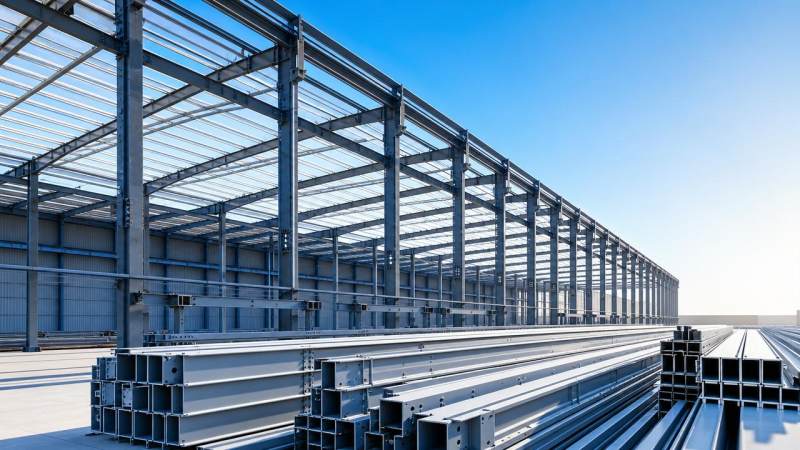
Yes, but not in every part of a warehouse and not in every project scenario. That is the most useful answer for business evaluation teams.
Cold rolled steel can reduce total warehouse build costs when its precision, lighter section design, and fabrication efficiency create measurable savings across procurement, processing, installation, and lifecycle maintenance.
However, cost reduction does not come simply from choosing a material label. It depends on where cold rolled sections are used, structural requirements, corrosion environment, fabrication capacity, and supply consistency.
For most warehouse projects, the best financial outcome comes from using cold rolled steel for warehouse construction in selected components rather than forcing it into every structural application.
Evaluation teams should therefore compare total installed cost, not just price per ton. A slightly higher unit material cost may still produce a lower project budget.
What is the real search intent behind this question?
People searching this topic usually are not asking for a textbook definition of cold rolled steel. They want to know whether it improves project economics in a practical way.
For procurement managers, estimators, and commercial reviewers, the key concern is whether cold rolled steel can reduce capex without creating quality, compliance, or supply chain risks.
They also want to know where savings come from, which warehouse components are suitable, how to compare with hot rolled alternatives, and what risks could erase expected savings.
That means the most valuable discussion is commercial and technical at the same time: use cases, cost drivers, fabrication impact, and sourcing reliability.
Where cold rolled steel creates cost savings in warehouse projects
The main value of cold rolled steel comes from manufacturing precision. Because sections are formed with tighter dimensional control, downstream cutting, punching, and assembly can be more efficient.
In warehouse construction, this often reduces rework, fit-up problems, and material waste. Small improvements across many repeated members can translate into meaningful budget savings.
Cold rolled profiles are especially attractive in secondary framing systems, wall members, purlins, girts, bracing elements, and lightweight support components where optimized shapes improve material efficiency.
Another advantage is weight control. In suitable designs, cold formed profiles can achieve required performance with less steel mass than less optimized alternatives, lowering transport and handling costs.
Faster site installation is another indirect saving. Lighter, more uniform members are easier to move, position, and connect, which can shorten labor hours and crane dependency.
When coated properly, cold rolled steel can also support lower maintenance exposure in some warehouse environments, particularly where galvanized finishes are used for durability.
Why total installed cost matters more than steel price per ton
Many project teams make the mistake of comparing materials only by ex-works or landed tonnage price. That approach can hide larger financial effects.
A more reliable evaluation should include raw material cost, fabrication efficiency, transport, installation labor, wastage, protective coating, maintenance, and the cost of delays or corrections.
For example, if a cold rolled section costs more per ton but reduces member weight, cuts installation time, and lowers scrap rates, the final project economics may still be better.
This is particularly relevant for warehouse programs with standardized layouts or repeat builds. Repetition amplifies the benefit of dimensional consistency and prefabrication accuracy.
Commercial teams should ask suppliers for a component-level comparison, not just a product quotation. That is how hidden savings become visible.
Which warehouse components are the best candidates for cold rolled steel?
Not every structural member should automatically be cold rolled. Primary heavy-load frames may still favor hot rolled sections depending on span, loading, and local code requirements.
Cold rolled steel for warehouse construction is usually most effective in secondary structural systems and light-to-medium load applications that benefit from formed shapes and efficient mass production.
Common examples include roof purlins, wall girts, eave struts, bracing members, partition framing, mezzanine accessories, and support systems for cladding or utilities.
One practical option is the C-beam, often used in purlins and wall beams of steel structure buildings.
It can also be combined into lightweight roof trusses, brackets, and other building components, making it useful where design efficiency and installation speed matter.
Available in materials such as Q195, Q235, Q345, A36, SS400, and S235JR, these sections can be supplied with galvanized, powder coated, or black varnish surfaces depending on exposure conditions.
How cold rolled sections support procurement efficiency
For business evaluation personnel, the material decision is not only about engineering. It also affects supplier management, quality predictability, and project coordination.
Cold rolled products often support better procurement planning because specifications are highly repeatable and suitable for batch production. That helps stabilize supply and reduce variation between deliveries.
Processing services also matter. Suppliers that can provide bending, welding, punching, decoiling, and cutting reduce the need for multiple subcontractors and simplify the purchasing chain.
In export-driven projects, quality control and standards compliance are equally important. Products aligned with ASTM, EN, JIS, and GB standards are easier to evaluate for international use.
For warehouse programs across multiple countries, standardized components also improve internal review because commercial and technical teams can compare offers on a like-for-like basis.
What risks should evaluation teams check before expecting savings?
Cold rolled steel is not a universal cost-saving answer. If the structural design is unsuitable, expected savings can disappear quickly.
The first risk is misuse in heavily loaded primary members without proper engineering review. In those cases, material efficiency may be outweighed by strength or stiffness requirements.
The second risk is underestimating corrosion exposure. Warehouses in coastal, humid, chemical, or high-condensation environments may need stronger protective systems, which affect lifecycle cost.
The third risk is poor fabrication coordination. Precision products only create savings when shop drawings, hole locations, tolerances, and installation sequencing are managed well.
The fourth risk is inconsistent supply quality. If dimensional tolerances are unstable, site rework can eliminate any benefit originally expected from cold rolled manufacturing.
That is why supplier capability, certification, and inspection systems are as important as the section profile itself.
How to evaluate supplier capability for cold rolled warehouse components
Commercial buyers should go beyond catalog data. The right supplier should demonstrate production consistency, standard compliance, export experience, and the ability to customize based on project drawings.
Ask whether the manufacturer supports common standards such as ASTM, EN, JIS, and GB. This reduces technical ambiguity during project review and international approval processes.
Check processing tolerance, coating options, and whether perforation, punching, or custom lengths are available. These details directly affect fabrication productivity on site.
It is also useful to confirm available lengths such as 6m, 9m, and 12m, plus customization for large quantity orders. Matching supply length to design reduces cutting waste.
Manufacturers with modern production lines and strict quality control can help buyers reduce sourcing risk, especially when the project depends on dependable lead times.
Hongteng Fengda, as a structural steel manufacturer and exporter from China, supports global construction and industrial buyers with stable capacity and customized structural steel solutions.
When does cold rolled steel deliver the strongest business case?
The strongest business case usually appears when the warehouse design includes a high number of repeated secondary members and when installation speed has direct cost value.
Projects in remote locations can also benefit because lighter optimized sections may reduce freight and handling burdens compared with heavier alternatives.
Another good scenario is when the buyer wants prefabricated or semi-finished components. The more work completed before shipment, the more predictable the site budget becomes.
If the warehouse is part of a larger roll-out program, the value becomes even clearer. Standardized cold rolled components can support repeatability across multiple buildings.
In such cases, the right section design, coating system, and supplier coordination can improve both first-cost control and schedule reliability.
Practical checklist for procurement and project evaluation teams
Start with component segmentation. Identify which parts of the warehouse are primary heavy structural elements and which are secondary framing or light support members.
Then compare alternatives based on installed cost, not just steel price. Include fabrication, waste, transport, labor, coating, maintenance, and schedule impact.
Ask suppliers for section optimization proposals. Formed profiles may offer better material efficiency than conventional choices in selected applications.
Review coatings based on environment. Galvanized finishes are often a strong option for durability and lower maintenance in many warehouse conditions.
Confirm certifications and quality systems such as CE, SGS, BV, and ISO where relevant to the project and buyer compliance process.
Finally, verify that the supplier can handle custom punching, cutting, and tolerance control so the commercial savings are achievable in practice, not only in theory.
Conclusion: Is cold rolled steel a smart way to cut warehouse costs?
For procurement and evaluation teams, the answer is yes in the right applications. Cold rolled steel can reduce warehouse build costs when used where precision, lighter design, and fabrication efficiency matter most.
It is especially effective for secondary framing systems and repeatable building components rather than as a blanket substitute for every structural member.
The best decisions come from comparing total installed cost, checking application suitability, and choosing a supplier with dependable quality and customization capability.
In other words, cold rolled steel for warehouse construction is not simply a cheaper material choice. It is a smarter cost-control strategy when matched to the right design scope.
For global buyers seeking reliable structural steel supply, clear specifications, and project-focused support, that combination can make a meaningful difference to warehouse project outcomes.
Please give us a message


Please enter what you want to find