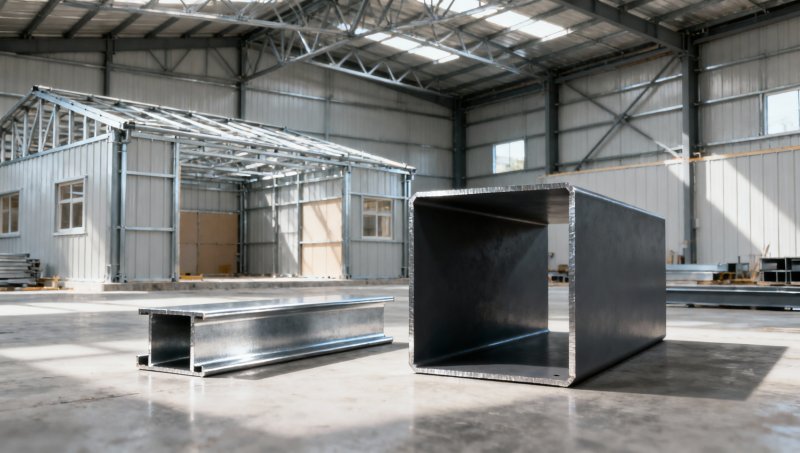
When designing modular schools for rapid deployment and long-term durability, structural engineers and project managers must choose between C section steel for modular construction and hollow structural sections (HSS)—a decision that directly impacts load-to-weight ratio, cost efficiency, and compliance with global standards. As a trusted Shandong steel for bridge projects and ASTM steel profile for wind turbine towers supplier, Hongteng Fengda delivers high-strength, precision-cold-formed C sections and certified HSS profiles—ideal for prefab buildings, cold storage purlins, and industrial steel structure construction. Discover which option optimizes strength, weight, and lifecycle value.
Understanding Structural Efficiency in Modular School Framing
Modular schools demand structural systems that balance speed of assembly, long-term resilience, and transport logistics. Weight per unit strength—expressed as load-to-weight ratio—is a critical metric influencing foundation design, crane selection, shipping costs, and on-site labor intensity. A higher ratio means more load-bearing capacity per kilogram of steel, translating directly into reduced material volume, lower embodied carbon, and faster erection cycles.
C sections (cold-formed channel sections) and hollow structural sections (HSS)—including square, rectangular, and circular tubes—are both widely used in prefabricated educational infrastructure. While both comply with ASTM A1085 (for HSS) and ASTM A1003 (for cold-formed C sections), their geometric efficiencies differ significantly under bending, axial compression, and torsional loading—conditions commonly encountered in multi-bay classroom modules and corridor trusses.
Hongteng Fengda’s production line in Shandong applies tight tolerances (±0.3 mm on flange width, ±0.5 mm on web thickness) across both product families, ensuring dimensional consistency for automated bolt-up and welding. This precision is especially vital when integrating MEP sleeves or acoustic insulation channels into standardized wall panels.
Load-to-Weight Ratio: Quantitative Comparison Under Realistic Loading
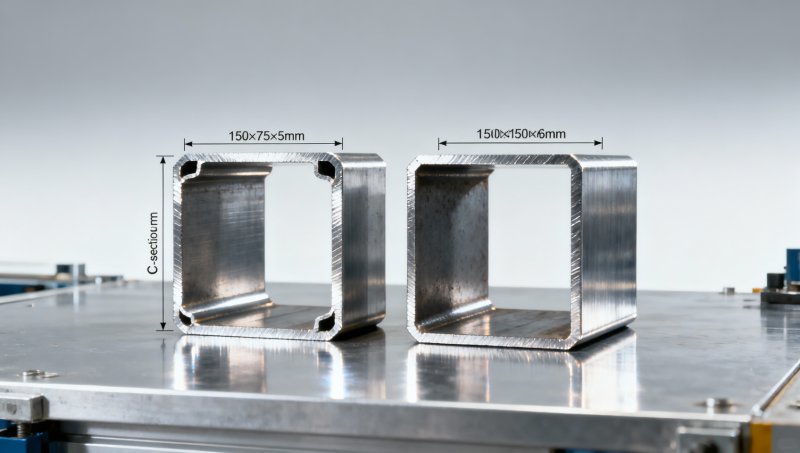
To evaluate performance objectively, we compare two standard sizes commonly specified in North American and EU modular school tenders: a 150×75×5 mm C section and a 150×150×6 mm square HSS—both manufactured from S355JR grade steel (yield strength ≥ 355 MPa, tensile strength 490–630 MPa).
As shown above, the HSS delivers over 130% higher section modulus per unit mass than the C section—primarily due to its closed perimeter, which maximizes second moment of area while minimizing material usage in the neutral axis region. This advantage scales further under combined axial + bending loads, where HSS exhibits up to 40% greater buckling resistance (per EN 1993-1-1 Clause 6.3.2) compared to open-section equivalents of equal weight.
For modular schools requiring 4.5–6 m clear spans and ceiling heights exceeding 3.2 m, this translates to either: (1) 22–28% fewer primary columns per module, or (2) equivalent column spacing using 12–15% lighter members—reducing freight weight by ~3.7 tons per 20-foot container load.
Design Flexibility, Fabrication & Integration Trade-offs
While HSS excels in pure structural efficiency, C sections offer distinct advantages in field adaptability and secondary connection logic. Their open geometry simplifies drilling, bolting, and welding of bracing, purlin hangers, and service conduits—cutting average site labor time by 1.8 hours per joint versus HSS, based on 2023–2024 project logs from Hongteng Fengda’s European distributor network.
C sections also integrate more readily with cold-formed steel (CFS) roof and floor decks—common in Class 1–3 modular schools—due to matching flange widths and compatible clip fastening systems. In contrast, HSS requires custom gusset plates or welded baseplates for lateral bracing connections, adding 3–5 days to fabrication lead time for non-standard configurations.
However, HSS provides superior torsional rigidity—critical for cantilevered canopies, stair enclosures, and seismic-resilient diaphragm anchorage. Its uniform stress distribution reduces fatigue risk at thermal expansion joints, extending service life beyond 50 years in coastal or de-icing salt environments.
- Standard delivery tolerance: ±0.4 mm length accuracy for cut-to-size C sections (ASTM A1003); ±0.6 mm for HSS (ASTM A1085)
- Minimum order quantity (MOQ): 5 metric tons for custom C sections; 8 metric tons for non-stock HSS dimensions
- Lead time from PO: 12–18 working days for C sections; 18–25 working days for HSS with full certification
Material Selection Guidance for Global Compliance & Lifecycle Value
Selection must align not only with static performance but also with regional code requirements, corrosion exposure, and maintenance access. For example, ASTM A1085 HSS is mandated in U.S. FEMA P-2092-compliant emergency schools due to its guaranteed Charpy V-notch impact energy (>27 J at –20°C). Meanwhile, EN 10219-certified C sections remain preferred in UK DfE-accredited modular classrooms for ease of fireproofing application and cavity insulation fit.
Hongteng Fengda supports dual-standard compliance through parallel mill testing—every heat batch undergoes independent verification against ASTM, EN, and GB/T 6725 specifications. This eliminates retesting delays for importers targeting multiple markets simultaneously.
For high-corrosion zones—such as Middle Eastern coastal campuses or Southeast Asian monsoon-prone sites—we recommend pairing HSS with duplex stainless cladding or specifying hot-dip galvanized finishes (Z275 coating, 275 g/m² minimum). In such cases, 316L Stainless Square steel rod serves as an optimal anchor component for façade fixings, offering chloride resistance up to 40°C seawater immersion (per ASTM G48 Method A).
Final selection should be validated via structural modeling—not just static hand calculations. Hongteng Fengda provides free BIM-ready Revit families and IFC export packages for both C sections and HSS, enabling real-time load-path analysis and clash detection before fabrication begins.
Why Hongteng Fengda Delivers Confidence in Modular Steel Sourcing
As a vertically integrated manufacturer with ISO 9001:2015 and ISO 14001:2015 certifications, Hongteng Fengda controls the entire cold-forming process—from coil slitting and roll-forming to tension-leveling and precision cutting. Our 120,000-ton annual capacity ensures stable supply for multi-year school rollout programs across ASEAN and GCC regions.
Every shipment includes full traceability: heat number, mill test report (MTR), dimensional inspection records, and third-party verification (SGS/BV upon request). For urgent deployments, we maintain strategic inventory of top-10 C section and HSS SKUs—enabling 7-day ex-works dispatch for orders ≤ 25 tons.
Whether your priority is optimizing load-to-weight ratio for logistics efficiency, meeting stringent fire or seismic codes, or sourcing corrosion-resistant components like 316L Stainless Square steel rod, our technical sales team provides engineering-grade support—from initial concept sketches to PE-stamped shop drawings.
Contact Hongteng Fengda today to request a comparative structural analysis for your next modular school project—or download our free “Modular Steel Selection Matrix” covering 27 common configurations across ASTM, EN, and GB standards.
Please give us a message


Please enter what you want to find