Before accepting ASTM A36 structural steel plate, check whether the mill test report can be connected to the physical plate and whether its results satisfy the specification and purchase order that govern the shipment. A report showing a passing tensile test is useful, but it does not resolve a missing heat number, an incorrect thickness, or a project requirement that was never included in the order.
For procurement teams, the most effective review follows the material: identify the plate, verify the applicable requirements, then compare the reported chemistry and mechanical properties with those requirements. Any gap should be resolved before the plate is cut or released for fabrication, when sorting and replacement become more expensive.
Start with identity: does the report belong to the plate?
The heat number is the starting point for traceability. Compare the heat number on the MTR with the marking on the plate and the numbers on the packing list, delivery note, and any supplier traceability records. The report should identify the producing mill, the material specification and grade, and the relevant test results. Check that the purchase order or project reference on the document trail connects the material to the correct order.
A heat number identifies a batch of steel, not necessarily an individual plate. A shipment may contain several plates from one heat, several heats, or plates processed from larger parent plates. Where a distributor or processor has cut the material, ask how the original identification was transferred to the pieces. A cutting list or inventory record can help connect each piece to its source, but a handwritten mark alone may not satisfy a project’s traceability rules.
Do not assume that an MTR attached to a shipment covers every plate in it. Match each heat in the delivery to the corresponding report, and check that all required pages and referenced attachments are present. If a plate arrives without a readable mark, hold it for identification under the agreed procedure. An MTR from the same supplier, or a report for a heat that looks similar, does not establish that the unidentified plate belongs to that heat.
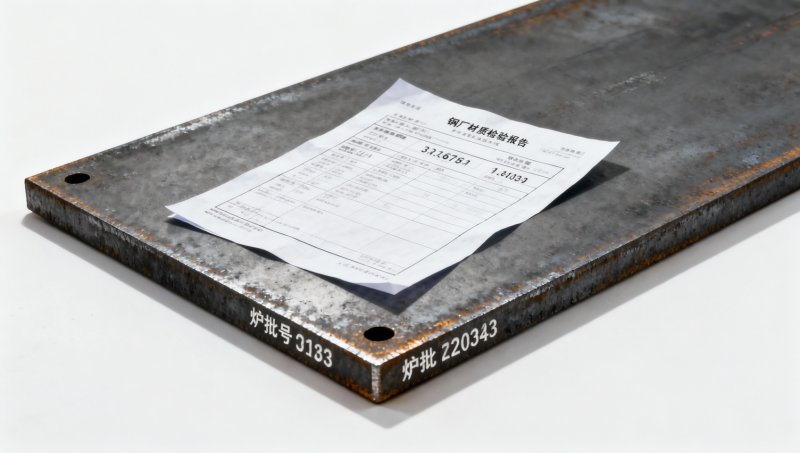
For a multi-heat order, a simple receiving register is often more useful than a folder of certificates alone. Record the plate or bundle identifier, heat number, dimensions, MTR reference, and any discrepancy. This gives the fabricator a practical way to maintain traceability after material moves into stock.
Read the specification line against the order
The MTR should identify ASTM A36/A36M and the grade or designation applicable to the material. Compare the stated specification and edition with the purchase order and project documents. The governing contract may identify a particular edition or incorporate additional requirements; the presence of “A36” on the report does not automatically demonstrate compliance with every project condition.
Also check the product form and reported dimensions. Plate thickness matters because applicable mechanical-property and testing requirements can depend on thickness and other conditions in the specification. The thickness on the MTR should correspond to the material supplied or be clearly linked to the tested product. Separately, verify the ordered dimensions and tolerances against the applicable requirements and the receiving measurements. A satisfactory test certificate is not a substitute for measuring the plate.
Review any additional requirements agreed at purchase, such as impact testing, ultrasonic examination, specific marking, inspection access, or particular certification language. These are not automatically supplied merely because the order calls for A36. The report or accompanying records should show the required examination and results, where applicable. A supplier’s statement that material is “suitable for structural use” is not equivalent to evidence of a specified supplementary test.
When several documents appear to conflict, establish the governing order of precedence before accepting the material. For example, a supplier’s quotation may describe standard A36 plate while the purchase order calls for an additional examination. The buyer needs a documented resolution of that difference, not an assumption that the examination was included in the quoted price.
Compare test results with the right requirements
An MTR normally reports chemical analysis and mechanical test results. Read the values alongside the applicable specification edition, the plate thickness, and the purchase order. Check the units as well: a value reported in MPa must be compared with requirements expressed in the same unit system, using the rules of the governing specification.
Chemical composition
Review the reported elements against the limits that apply to the ordered plate. Carbon, manganese, phosphorus, and sulfur are among the values a buyer may encounter, but applicable limits and reporting requirements should be checked against the actual standard and product conditions rather than a generic online table.
Pay attention to the type of analysis. A heat analysis describes the steel heat; a product analysis concerns a sample taken from the finished product. The applicable requirements and permissible variations are not necessarily identical. If the order specifies a product analysis or a tighter limit for fabrication purposes, a heat analysis alone may not satisfy that additional requirement.
Chemistry also matters beyond a simple pass-or-fail review. For a heavily welded assembly, the fabricator may need composition information to assess welding procedures and any specified carbon-equivalent limit. Do not infer a carbon-equivalent value or a weldability guarantee from the grade name alone. If a calculation or particular elements are required, agree on the reporting method and limits before the order is placed.
Mechanical properties
Look for the reported yield strength, tensile strength, and elongation, then compare them with the requirements applicable to the plate. For example, a report for plate within the applicable thickness range may show a yield result in ksi or MPa; the reviewer must use the corresponding A36/A36M requirement for that product and thickness. A result that exceeds a familiar minimum is not enough if another required property is absent or outside its permitted range.
Elongation deserves the same care as strength. Its acceptance requirement can depend on factors such as specimen type, gauge length, thickness, and applicable adjustments. A percentage copied into a spreadsheet without those details can lead to an incorrect rejection or acceptance. Where the report does not provide enough information to interpret a result, ask the supplier for the relevant test details.
Check the test basis and traceability as well. An MTR may report results for the applicable heat, lot, or test unit under the governing rules; it does not necessarily mean that every individual plate was mechanically tested. If the project requires a different testing frequency or plate-specific evidence, that requirement needs to be part of the purchase agreement.
Finally, distinguish a reported result from a claim on a cover sheet. “Meets ASTM A36” can be a useful certification statement, but the buyer should still be able to locate the results and connect them to the material. Conversely, a set of numbers without an identifiable mill, specification, and traceability trail is a weak basis for release.
Know what the MTR does not prove
A mill report is evidence about the material and tests it identifies. It does not, by itself, prove that the delivered plates have the correct quantity, dimensions, flatness, surface condition, or edge condition. Those checks belong in receiving inspection and should be measured or assessed against the requirements in the order and applicable standards.
Nor does a passing MTR establish that a plate meets every fabrication or service requirement. If the design calls for impact properties at a specified temperature, through-thickness performance, or another special condition, request the relevant evidence explicitly. Do not treat the absence of an adverse result as proof that an unreported test was performed.
The same distinction applies when a building package includes different steel products. Structural plate and a roofing product such as Color Coated Galvanized Roof Sheet PPGI have different functions and purchase requirements. A roof sheet’s coating and finish information does not establish compliance for an A36 structural plate, and an A36 plate MTR does not certify the roof sheet.
Resolve discrepancies before fabrication
Not every document error means the steel is unsuitable. A missing purchase order number, an unclear scan, or a mismatch caused by a processing record may be correctable through the supplier’s documented traceability system. A reported property outside the applicable limit, an untraceable plate, or a missing required test is a different matter. Procurement should avoid treating all discrepancies as paperwork corrections.
Place affected material on hold and describe the discrepancy precisely. Identify the plate, heat, purchase order, report number, and requirement in question. Request an explanation and supporting records from the supplier or mill as appropriate. If a corrected certificate is issued, check that it is authorized, identifiable, and connected to the original material; a changed number without an explanation or supporting evidence does not resolve the underlying issue.
Where additional testing is proposed, establish who will select the samples, what will be tested, which acceptance criteria apply, and whether the contract and project owner permit that route. Testing can answer some questions about properties, but it cannot automatically reconstruct lost identity or demonstrate that an omitted examination was performed at the required stage. Any concession or substitution should be approved by the party authorized under the project documents, in writing.
Cost decisions are easier before material is committed to cutting. A low plate price can be outweighed by sorting, retesting, replacement freight, fabrication delays, or rejected work. Specify the required MTR, traceability, supplementary tests, and document timing in the purchase order, and review the certificates early enough to resolve questions before delivery or production. That gives the buyer a practical basis for comparing offers as well as accepting the eventual shipment.
Please give us a message


Please enter what you want to find