If you're looking to buy stainless steel pipe online, the first red flag isn’t price—it’s silence on certifications and traceability. Procurement professionals managing construction, industrial, or OEM projects often discover too late that missing or incomplete documentation triggers delays at customs, fails third-party QA audits, or worse—leads to field rejection of installed piping systems. Unlike commodity-grade carbon steel, stainless steel pipe performance hinges on precise alloy composition, heat treatment history, and cold-working parameters—all verified only through standardized test reports and unbroken batch-level tracking.
Hongteng Fengda, as a structural steel manufacturer and exporter from China, treats certification and traceability not as paperwork but as non-negotiable operational infrastructure. Every stainless steel pipe we supply carries full mill test reports (MTRs), heat numbers, and batch identifiers aligned with ASTM A312, EN 10217-7, JIS G3459, or GB/T 12771—depending on your project’s jurisdiction and end-use requirements. Here’s what you must demand—and why each element matters in real-world procurement.
Why Certifications Are Your First Line of Defense
Certifications aren’t just stamps on paper; they’re contractual evidence of material fitness for purpose. When you buy stainless steel pipe, the applicable standard defines everything: permissible chemical ranges (e.g., Cr ≥18.0%, Ni ≥8.0% for 304), mechanical properties (minimum tensile strength, yield strength, elongation), surface finish tolerances, and hydrostatic test pressure. Without certified compliance, you have no enforceable basis to reject substandard material—even if it fails in service.
ASTM A312 is the most widely referenced specification for seamless and welded austenitic stainless steel pipe. But its scope doesn’t cover all use cases. For high-pressure boiler applications, ASTM A213 applies. For sanitary process lines, ASTM A270 is mandatory. If your project falls under EU Pressure Equipment Directive (PED), EN 10217-7—not ASTM—is the binding requirement. Confusing or mixing standards risks non-compliance during regulatory review or insurance claim validation.
Look beyond the standard label. A valid MTR must include: the heat number (not just lot number), actual chemical analysis (not just “meets spec”), tensile and yield test results with units and test method references (e.g., ASTM E8), and signature/stamp from an independent lab or accredited mill QA department. Generic “certificates of conformance” without heat-specific data hold no technical weight.
Traceability Data: More Than Just a Heat Number
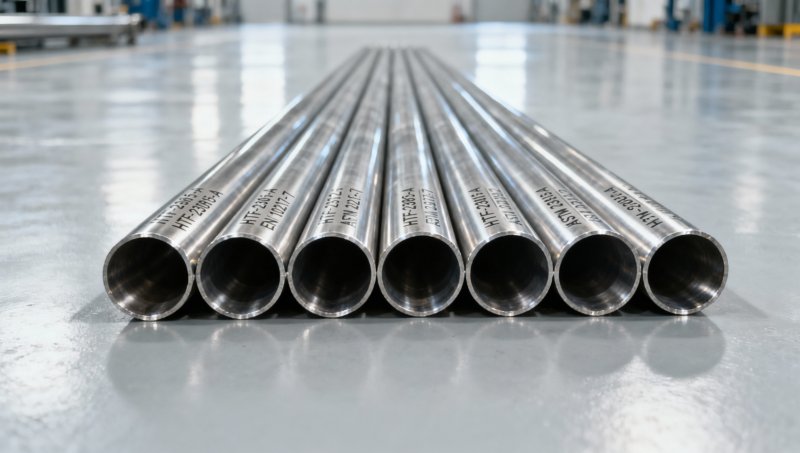
A heat number is necessary—but insufficient. True traceability means linking that number to every physical unit shipped: individual pipes, bundles, or coils. In practice, this requires consistent marking—either stamped, etched, or applied via durable label—on each pipe or bundle, matching exactly what appears on the MTR and packing list. Discrepancies here are common when suppliers outsource finishing or repack in transit.
For procurement teams managing multi-tier supply chains, batch-level traceability becomes critical during root cause analysis. If corrosion initiates in-field, can you isolate whether it affected one heat batch or crossed multiple heats? Without synchronized heat numbers across MTRs, shipping documents, and physical markings, failure investigation stalls before it begins. Hongteng Fengda maintains digital traceability logs tied to production batches, enabling rapid retrieval of thermal history, rolling parameters, and final inspection records upon request.
What to Verify Before Release
- Heat number consistency: Must appear identically on MTR, packing list, shipping mark, and physical pipe/bundle.
- Test report completeness: Includes raw test values (not pass/fail only), test method citations, and sign-off by qualified personnel.
- Dimensional verification: Actual OD, wall thickness, and length measured per ASTM A450/A450M—not assumed from nominal size.
- Surface condition notes: Any grinding, pickling, or passivation treatments performed, with supporting process records.
When Stainless Steel Pipe Isn’t the Right Fit—And What Is
Not every application demanding corrosion resistance requires stainless steel pipe. In environments dominated by atmospheric exposure, chloride-free industrial atmospheres, or mild indoor conditions, alternatives like Coil Coated Galvanized Steel offer comparable lifecycle cost advantages with lower upfront material cost and faster lead times. Galvanized steel with Z275 coating (275 g/m² zinc) provides robust barrier protection where aggressive acids, high-temperature steam, or continuous immersion aren’t present.
This isn’t about substitution—it’s about alignment. If your project involves HVAC ductwork, cable trays, or light structural framing, specifying 304 stainless pipe adds unnecessary cost without functional benefit. Meanwhile, Coil Coated Galvanized Steel delivers proven corrosion resistance, consistent yield strength (≥240–380 MPa), and dimensional stability across widths up to 1500 mm—ideal for high-volume fabrication where weldability and paint adhesion matter more than high-temperature oxidation resistance.
How to Validate Supplier Claims—Without Relying on Promises
Ask for sample MTRs *before* placing an order—not after. Reputable suppliers will share anonymized, redacted reports showing structure, test methods, and sign-off format. Compare them against ASTM or EN templates. Watch for inconsistencies: missing test temperatures, undefined sampling frequency, or vague references like “per applicable standard” instead of citing the exact clause.
Request third-party lab reports—not just internal mill tests—for critical applications. SGS, Bureau Veritas, or TÜV-certified labs provide independent verification. Also confirm whether the supplier controls the entire chain: melting, hot working, cold drawing, heat treatment, and final testing. Fragmented sourcing increases risk of documentation gaps between stages.
Finally, verify the supplier’s audit history. ISO 9001 certification alone doesn’t guarantee stainless steel pipe quality. Look for ISO/IEC 17025 accreditation for their in-house lab, or evidence of annual audits against ASTM A312 Annex A requirements. Hongteng Fengda undergoes biannual external audits covering raw material traceability, process control, and MTR generation—reports available under NDA upon request.
What Happens If You Skip Verification
The consequences escalate quickly. At port, customs may detain shipments lacking EN 10204 3.1 or 3.2 certificates. On-site, third-party inspectors may reject entire pipe lots during pre-installation checks—halting progress while replacement orders burn through contingency budgets. Worse, undetected compositional deviations (e.g., low molybdenum in 316 grade) can lead to premature pitting in cooling water systems, triggering unplanned shutdowns months after commissioning.
Procurement isn’t just about lowest landed cost—it’s about lowest total risk-adjusted cost. Each omitted certification or undocumented heat number compounds uncertainty. That uncertainty translates directly into schedule buffers, inspection overhead, and warranty exposure.
When you buy stainless steel pipe online, treat documentation as part of the product specification—not an afterthought. Demand heat-specific MTRs, cross-verified traceability, and clear alignment with your project’s governing standard. Anything less shifts risk from supplier to buyer—and that shift rarely appears on the purchase order.
Please give us a message


Please enter what you want to find