If you plan to buy stainless steel coil online, small specification gaps can lead to costly delays, quality disputes, and sourcing risks.
For steel sourcing, grade, finish, tolerance, and standard alignment matter as much as price.
A listing may look complete, yet critical details are often missing or described differently across suppliers.
This article explains what to verify before you buy stainless steel coil online for industrial, fabrication, and construction use.
Understanding stainless steel coil specifications
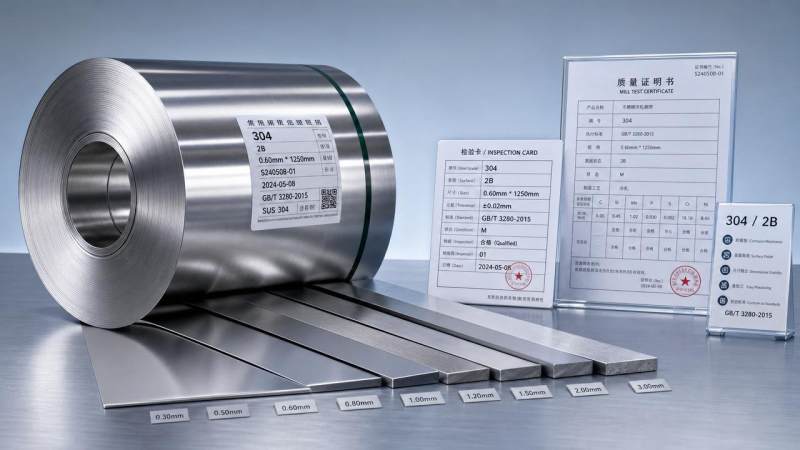
To buy stainless steel coil safely, start with the basic specification structure.
A complete offer should define material grade, thickness, width, finish, coil weight, edge condition, standard, and mechanical properties.
If one item is unclear, comparison becomes unreliable and project risk increases.
Many online quotations only show grade and size.
That is not enough for technical approval or for judging long-term value.
- Grade designation: 201, 304, 316, or equivalent.
- Standard reference: ASTM, EN, JIS, or GB.
- Thickness tolerance and width tolerance.
- Surface finish such as 2B, BA, No.1, or HL.
- Annealed, cold rolled, or hot rolled condition.
- Chemical composition and test certificate availability.
When you buy stainless steel coil, these points must be confirmed in writing before production starts.
Where online quotations often hide specification gaps
The biggest issue is not always wrong material.
More often, the issue is incomplete wording that creates different interpretations between buyer and supplier.
Grade naming is not enough
A quote that says only “stainless steel coil 201” still leaves several open questions.
You still need the standard, chemistry range, and processing condition.
Finish descriptions may differ
A bright-looking image does not confirm BA finish.
Likewise, decorative finishes such as 4K, HL, and 8K require visual definition and sample confirmation.
Tolerance can change usability
If thickness tolerance is too wide, forming, welding, and assembly results can vary.
This matters in parts production, cladding systems, and fabrication lines.
Edge condition affects processing
Mill edge and slit edge are not interchangeable in every application.
Wrong edge condition can increase burr issues or downstream trimming cost.
Key technical checks before you buy stainless steel coil
Before you buy stainless steel coil, review a technical checklist rather than relying on product photos or headline pricing.
For projects needing economical stainless material, 201 Stainless Steel Coil can fit many fabrication and decorative uses.
It is a high manganese, low nickel stainless grade with good formability and useful strength under pressure.
Typical finishes include BA, 2B, NO.1, NO.4, 4K, HL, and 8K.
Common size ranges include thickness 2.5mm to 10.0mm and width 610mm to 2000mm.
Industry concerns shaping stainless steel coil sourcing
The online steel market is more transparent than before, but specification control remains uneven.
Several industry signals explain why buyers must review details carefully.
- Global price volatility increases substitution risk between grades.
- Decorative applications demand tighter finish consistency.
- Export shipments need stronger traceability and document accuracy.
- Fabrication lines require stable coil dimensions for efficiency.
- International projects often need ASTM, EN, JIS, or GB compliance alignment.
A reliable structural steel manufacturer and exporter should translate these requirements into clear offer sheets and controlled production records.
That support reduces sourcing risk, especially in multi-country procurement and custom supply situations.
Application value and fit-for-use evaluation
When you buy stainless steel coil, the best choice depends on the real use environment rather than a generic material label.
A proper fit-for-use review should combine corrosion needs, forming needs, surface expectations, and budget limits.
A material such as 201 can serve tabletops, kitchen supplies, bolts, springs, screens, vehicles, and decorative projects when the performance target is correctly defined.
Its tensile strength can reach at least 520MPa, with yield strength at least 275MPa and elongation around 55% to 60%.
Practical steps for comparing suppliers accurately
To buy stainless steel coil with confidence, use the same request format for every supplier.
That avoids misleading price comparisons based on hidden specification differences.
- Send a written spec sheet with grade, finish, dimensions, tolerance, standard, and application.
- Ask for MTC samples and recent production references.
- Confirm coil inner diameter, outer diameter, and maximum coil weight.
- Request packaging details for export protection.
- Check whether slitting, cut-to-length, or custom processing is available.
- Review lead time together with production capacity, not promise alone.
- Verify third-party inspection options when project sensitivity is high.
It is also useful to confirm whether the supplier supports ASTM, EN, JIS, and GB based orders.
This is especially important in export projects involving multiple technical review teams.
Specification control as the next sourcing step
To buy stainless steel coil online successfully, treat specification control as the core of purchasing, not a final check.
A clear RFQ, matched standard, verified finish, and documented tolerance can prevent most avoidable disputes.
If a project needs dependable steel supply, stable production, and custom structural support, it helps to work with an exporter experienced in international standards and practical application needs.
Before placing the next order, prepare a complete technical checklist and compare offers line by line.
That is the most effective way to buy stainless steel coil with lower risk, better value, and more predictable project results.
Please give us a message


Please enter what you want to find