Black Steel Plumbing Pipe vs Galvanized Pipe: Key Differences for Water Systems
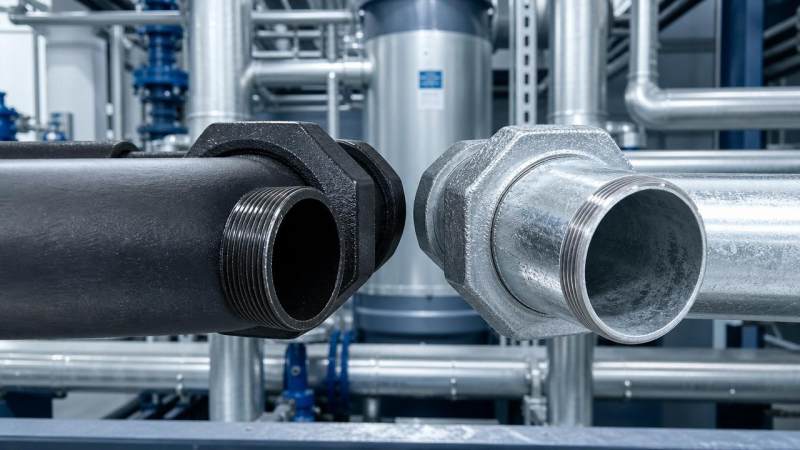
Choosing between black steel plumbing pipe and galvanized pipe affects water quality, service life, and repair costs.
That decision becomes even more important in older buildings, utility upgrades, and industrial water systems.
Both materials look similar at first glance, but they behave very differently once exposed to water and air.
If the goal is a practical selection, it helps to compare corrosion resistance, pressure use, installation needs, and maintenance risk.
This guide breaks down black steel plumbing pipe and galvanized pipe in plain terms, so system decisions are easier and more reliable.
What Is Black Steel Plumbing Pipe?
Black steel plumbing pipe is made from carbon steel with a dark iron oxide scale on the surface.
It is strong, widely available, and commonly used for gas lines, fire sprinkler systems, and some industrial applications.
The key limitation is simple.
Black steel plumbing pipe has no zinc coating, so it offers limited protection against rust in wet service.
That is why it is usually not the first choice for potable water transport.
In dry or controlled systems, however, black steel plumbing pipe can still perform very well and remain cost effective.
What Is Galvanized Pipe?
Galvanized pipe is carbon steel coated with a protective zinc layer.
That zinc barrier slows rust formation and gives the pipe better durability in water service than uncoated steel.
For many years, galvanized pipe was widely used in residential and commercial water systems.
Even so, the coating does not last forever.
As galvanized pipe ages, internal scale and mineral buildup can reduce flow and affect water clarity.
So while galvanized pipe is more water-resistant than black steel plumbing pipe, it is not maintenance-free.
Black Steel Plumbing Pipe vs Galvanized Pipe: Core Differences
The biggest difference is the outer and inner protection against corrosion.
Black steel plumbing pipe has no anti-corrosion coating, while galvanized pipe uses zinc as a protective layer.
That single difference changes how each pipe performs in water systems over time.
In short, black steel plumbing pipe may save money at purchase, but galvanized pipe usually lasts longer in contact with water.
Which Pipe Is Better for Water Systems?
For direct water delivery, galvanized pipe is usually the better traditional option between these two materials.
That is mainly because black steel plumbing pipe tends to rust faster when water remains in the line.
Rust can stain water, reduce inner diameter, and increase maintenance frequency.
However, the better choice also depends on system type, operating hours, temperature, and local code requirements.
For example, black steel plumbing pipe may still fit closed-loop, non-potable, or temporary service where corrosion exposure is manageable.
Galvanized pipe makes more sense where periodic water exposure is unavoidable and a longer corrosion delay is needed.
Quick selection guide
- Choose black steel plumbing pipe for gas distribution and dry service.
- Choose galvanized pipe for older-style water supply replacement where zinc protection still fits the design.
- Avoid black steel plumbing pipe in potable water lines unless regulations and conditions clearly allow it.
- Review water chemistry before final material selection.
Corrosion, Maintenance, and Service Life
Corrosion is where the real cost difference appears.
Black steel plumbing pipe can oxidize quickly in humid environments, especially at threaded joints and cut ends.
Once internal rust starts, flow restriction often follows.
Galvanized pipe resists this process longer, but the zinc coating gradually wears away.
After that point, scaling, deposits, and hidden corrosion can become serious operational issues.
In practical maintenance terms, both pipes need inspection, but black steel plumbing pipe usually needs earlier attention in water service.
This is also why many newer projects move toward stainless alternatives for demanding water environments.
A useful reference is 201 Stainless steel pipe, which is used in water treatment plants, construction, and chemical applications.
It offers corrosion resistance, smooth surface quality, and tensile strength of at least 520MPa, making it relevant when rust prevention matters more.
Installation and Handling Differences
Installation methods are similar, but handling details are not exactly the same.
Black steel plumbing pipe is often easier to cut and thread without worrying about damaging a surface coating.
With galvanized pipe, scratching or removing zinc at connections can reduce corrosion protection in those areas.
That means correct sealing, careful threading, and proper joint treatment matter more than many people expect.
Mixed-metal connections also need attention because galvanic reactions can shorten service life.
In day-to-day work, the easiest installation is not always the best long-term choice.
Handling checklist before installation
- Check whether the system carries potable, process, or non-potable water.
- Inspect threads, ends, and surface condition before assembly.
- Confirm compatibility with valves, fittings, and nearby pipe materials.
- Review local standards and pressure requirements.
Cost Comparison Beyond Purchase Price
Upfront price alone can be misleading.
Black steel plumbing pipe is often cheaper to buy, which makes it attractive for budget-focused projects.
But if corrosion leads to leakage, staining, or reduced flow, savings disappear quickly.
Galvanized pipe usually costs more at the start, yet it may reduce near-term replacement and maintenance in water service.
When evaluating pipe material, include labor, downtime, inspection frequency, and expected lifespan.
That broader view often changes the decision.
When to Consider Alternatives
Sometimes the best answer is neither black steel plumbing pipe nor galvanized pipe.
This is especially true in aggressive water chemistry, sanitary environments, and systems needing long corrosion resistance.
In those cases, stainless solutions may offer better value over time.
For example, stainless pipe options with ASTM, JIS, GB, and EN compliance can fit water treatment, food processing, and industrial projects.
Hongteng Fengda supplies structural and steel product solutions for international projects, with stable production capacity and strict quality control.
That matters when buyers need dependable standards, consistent lead times, and lower sourcing risk across multiple applications.
Final Decision Tips for Reliable Water System Performance
If the comparison is only black steel plumbing pipe versus galvanized pipe, galvanized pipe usually wins for water contact.
Black steel plumbing pipe remains a practical choice for gas lines and certain dry-duty systems.
The best decision comes from matching the pipe to water quality, service conditions, maintenance capacity, and total lifecycle cost.
Before ordering, review corrosion risk, connection details, and code compliance instead of focusing only on the lowest price.
That approach leads to safer water systems, fewer repairs, and more predictable performance over time.
Please give us a message


Please enter what you want to find