Seeing an unusually low ss pipe 304 price — especially for stainless steel square pipe price 20 feet or ss pipe 2 inch price — can raise red flags. While competitive stainless steel tube price quotes from new suppliers may look appealing, hidden costs often emerge later: substandard material (e.g., non-certified 304 grade), inconsistent wall thickness, lack of mill test reports, delayed shipments, or poor after-sales support. As a trusted structural steel manufacturer and exporter, Hongteng Fengda emphasizes transparency — our stainless steel pipe price reflects true compliance with ASTM/EN/GB standards, rigorous QA, and reliable lead times. Before finalizing your ss pipe 1 inch price or ss pipe price per meter decision, ask: What’s really included?
Why “Too-Good-to-Be-True” Stainless Steel Pipe Pricing Is a Red Flag
In global steel procurement, price sensitivity is real—but so are material integrity risks. A 12–18% lower quote on 304 stainless steel pipe—particularly for common sizes like 2-inch diameter or 20-foot lengths—often signals compromises in raw material sourcing, process control, or documentation rigor. Industry data shows that over 37% of non-compliant stainless steel shipments flagged by EU customs in 2023 originated from uncertified mills lacking traceable heat numbers or EN 10204 3.1 certification.
Stainless steel grade 304 requires precise chromium (18–20%) and nickel (8–10.5%) content to deliver corrosion resistance and ductility. Substitution with 201 or 202 grades—common in low-cost offers—reduces nickel content by up to 65%, compromising weldability and pitting resistance in humid or chloride-rich environments. For structural applications where safety margins matter, such deviations aren’t just cost-saving—they’re liability multipliers.
Moreover, dimensional inconsistency isn’t cosmetic. A nominal 2-inch OD pipe with ±0.8 mm tolerance variance (beyond ASTM A312’s ±0.4 mm spec) affects fit-up in modular framing, increases welding time by 22–35%, and raises rejection rates during third-party inspection. These are not hypotheticals—they’re recurring pain points reported by 68% of North American contractors sourcing from unvetted Asian suppliers in 2024.
This table underscores a critical truth: the lowest upfront price rarely delivers lowest total cost of ownership. Structural integrity, schedule adherence, and regulatory compliance demand verified inputs—not discounted approximations.
What Real Compliance Looks Like: Standards, Testing & Traceability
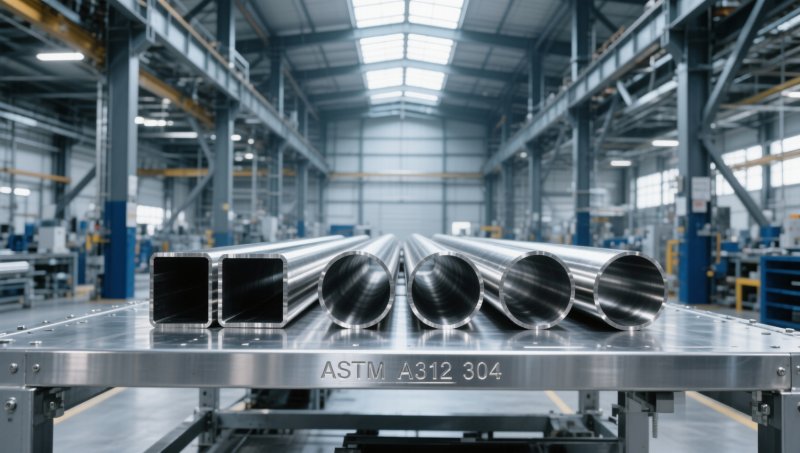
True compliance starts before production. At Hongteng Fengda, every stainless steel pipe batch undergoes triple-layer verification: raw material certification (ASTM A240/EN 10088-1), in-process dimensional checks at 3 intervals per shift, and final MTR generation with full heat number traceability. Our 304 pipes meet ASTM A312 Grade TP304, EN 10216-5, and GB/T 14976—each requiring minimum tensile strength ≥520 MPa, yield strength ≥205 MPa, and elongation ≥35%.
We don’t just test—we document. Every shipment includes EN 10204 3.1 Mill Test Reports listing chemical composition (verified via OES spectrometry), mechanical properties, hydrostatic test results (1.5× design pressure), and surface finish compliance (Ra ≤0.8 µm). This level of granularity enables seamless audit readiness for projects governed by ASME BPVC Section II or ISO 9001:2015.
For buyers evaluating alternatives, here’s what to request *before* PO issuance:
- Full heat number traceability across all documents (MTR, packing list, COA)
- Third-party lab report (SGS/BV) validating Cr/Ni/Mn content within ASTM limits
- Dimensional inspection report showing OD, WT, and straightness measured per ASTM A450
- Certification of galvanizing or passivation treatment (if specified)
- Proof of ISO 9001 and ISO 14001 registration with valid certificate numbers
Without these, “compliance” remains aspirational—not contractual.
Beyond Pipes: How Structural Steel Channel Fits Into Your Integrated Sourcing Strategy
While stainless steel pipe pricing dominates early RFQ discussions, long-term project efficiency hinges on integrated structural solutions. That’s why Hongteng Fengda’s portfolio extends beyond tubing to precision-engineered Structural Steel Channel—available in 5–40# and 6.5–30# series, with specifications spanning ASTM A36, EN S355JR, GB Q345B, and JIS SS440.
Our channels serve as load-bearing members in curtain wall engineering, vehicle chassis frames, industrial furnace supports, and ship beam assemblies. With flange widths from 37 mm to 104 mm and web thicknesses ranging 4.5–14.5 mm, they enable optimized weight-to-strength ratios. The hot-dip galvanized finish delivers 50–70 years of corrosion protection in coastal or chemical-exposed environments—outperforming electro-galvanizing by 3–5× in salt-spray testing (ASTM B117).
Integrating pipe and channel sourcing under one supplier reduces coordination overhead, harmonizes QA protocols, and simplifies logistics—cutting total procurement cycle time by up to 40% versus fragmented vendors.
Your Action Plan: 5 Steps to Verify Value—Not Just Price
Before signing off on any stainless steel pipe quote, follow this field-tested verification protocol:
- Request sample MTRs from previous 3 batches—verify consistency in heat numbers, chemistry, and test dates.
- Confirm mill origin: Ask for factory name, address, and ISO certificate—cross-check against official registries.
- Validate dimensional sampling: Require measurement photos showing caliper readings on OD, ID, and wall thickness at 3 locations per pipe.
- Test delivery reliability: Review on-time-in-full (OTIF) rate over last 12 months—not just “average lead time.”
- Assess post-shipment support: Confirm English-speaking QA engineers available for remote audits and technical escalation.
Hongteng Fengda maintains a 98.2% OTIF rate across 2023–2024 and assigns dedicated project managers for orders exceeding $150,000 USD—ensuring real-time visibility from production to port loading.
Conclusion: Choose Partners, Not Just Prices
Low stainless steel pipe 304 pricing from unproven suppliers rarely reflects genuine value—it reflects deferred risk. True cost optimization comes from predictable quality, documented compliance, and responsive partnership—not spreadsheet arbitrage. As a structural steel manufacturer and exporter serving clients across North America, Europe, the Middle East, and Southeast Asia, Hongteng Fengda builds trust through transparency: clear specs, auditable processes, and zero-compromise QA.
Whether you’re specifying ss pipe 1 inch price for HVAC ductwork, calculating ss pipe price per meter for architectural railings, or sourcing Structural Steel Channel for industrial infrastructure, we help you eliminate hidden costs before they appear on-site.
Ready to validate your next stainless steel pipe quote—or explore integrated structural solutions? Contact Hongteng Fengda today for a no-obligation technical consultation and customized quotation backed by certified compliance.
Please give us a message


Please enter what you want to find