Angle Stainless Steel Supplier: Quality Checks Before Ordering
Choosing the right angle stainless steel supplier is critical for stable quality, lower sourcing risk, and smoother project delivery.
Before placing an order, review grade consistency, dimensions, finish, testing documents, and production control.
A careful process helps avoid claims, delays, rework, and hidden costs across global steel sourcing.
Why a structured review matters
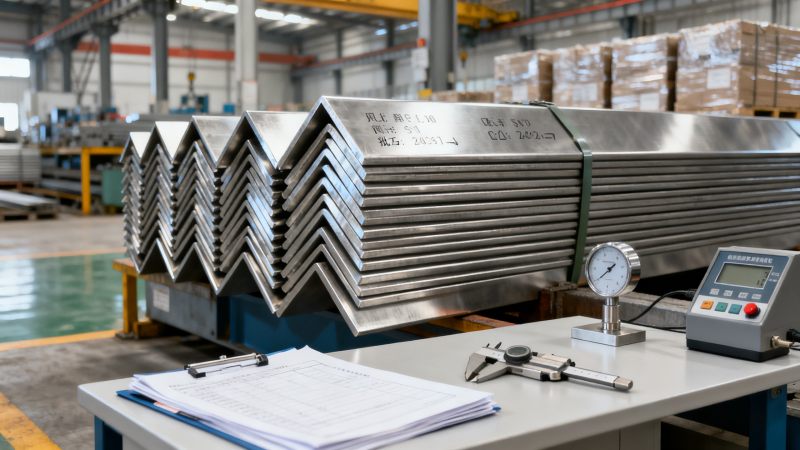
An angle stainless steel supplier may offer attractive prices, but quality variation can damage long-term purchasing performance.
Small deviations in chemistry, leg size, straightness, or packaging can create fitting issues and corrosion risks later.
A structured review makes supplier comparison easier and supports better decisions on compliance, lead time, and total value.
Key quality checks before ordering
- Confirm the stainless steel grade, standard, and intended environment, including ASTM, EN, JIS, or GB requirements for corrosion resistance and fabrication performance.
- Check chemical composition and request mill test certificates to verify chromium, nickel, and other elements match the ordered stainless specification.
- Review dimensional tolerances for leg length, thickness, angle accuracy, and length to ensure compatibility with fabrication and installation drawings.
- Inspect straightness, twist, and edge condition, because poor profile stability can increase cutting waste and assembly difficulty on site.
- Evaluate surface finish for scratches, scale, oil, staining, and passivation quality, especially when appearance or corrosion exposure matters.
- Ask about production methods, including hot rolled or laser fused options, because process selection affects tolerance, finish, and application suitability.
- Verify mechanical properties such as yield strength, tensile strength, and elongation when structural use or forming work is involved.
- Review traceability systems, heat numbers, and batch identification so each shipment can be matched to documents and inspection records.
- Confirm packaging, labeling, and protection methods to reduce transit damage, moisture exposure, and mixed-batch delivery problems.
- Assess production consistency and export experience by checking sample quality, repeat orders, and documented delivery performance.
Material grade verification
Grade selection is the first checkpoint when choosing an angle stainless steel supplier.
304 is common for general environments, while 316 is often preferred for marine or chloride exposure.
If welding is required, ask whether low-carbon grades such as 304L or 316L are available.
Tolerance and profile accuracy
Dimensional problems are among the most frequent causes of installation delays and customer complaints.
Ask the angle stainless steel supplier for tolerance tables and actual inspection records from recent production lots.
Samples should be measured for leg equality, corner shape, thickness range, and cut-length precision.
Surface and finishing checks
Surface condition matters for both appearance and corrosion behavior.
Specify whether you need pickled, polished, brushed, or mill finish material before quotation and production.
The angle stainless steel supplier should explain inspection criteria for defects, cleaning, and protective film if needed.
A useful comparison point for broader steel sourcing
Many buyers source multiple steel categories from one exporter, so quality discipline should be checked across product lines.
For example, Color Coated Galvalume Steel Coil PPGL requires strict control of coating, color, and paint systems.
Its thickness range is 0.13mm to 0.8mm, width is 600mm to 1250mm, and custom length is supported.
Paint options include PE, SMP, HDP, and PVDF, with top coat thickness from 10 to 30 microns.
Applications cover roofing, wall panels, appliances, transport panels, furniture, shutters, and signs.
A supplier that manages coating performance, corrosion resistance, processing quality, and appearance well often shows stronger overall quality systems.
Checks for different application situations
Construction and structural use
When angle stainless steel is used in frames, supports, or exposed building details, strength and tolerance are priorities.
Confirm standard compliance, weldability, straightness, and corrosion resistance for the actual service environment.
Industrial fabrication
For machinery, tanks, brackets, or equipment housings, dimensional repeatability affects production efficiency.
Ask the angle stainless steel supplier about cut-to-length service, deburring, and batch consistency across repeat orders.
Marine or corrosive environments
Salt, humidity, and chemicals accelerate surface damage when grade selection is wrong.
Review pitting resistance expectations, passivation practices, and whether 316 or equivalent material is more appropriate.
Distribution and stock supply
For stock orders, packaging and labeling become as important as mill quality.
Mixed sizes, unclear tags, or weak bundle protection can cause costly warehouse confusion and resale issues.
Commonly overlooked risks
- Approving based only on photos instead of real samples or detailed inspection reports can hide finish and tolerance problems.
- Ignoring country-specific standards may lead to customs delays, failed compliance review, or project rejection after arrival.
- Comparing price without checking included services may overlook testing, packaging, marking, and documentation differences.
- Ordering trial quantities without confirming repeatability can create quality gaps between sample batches and mass production.
- Accepting incomplete mill certificates weakens traceability and makes later claims harder to support with evidence.
Practical execution steps before confirming the order
- Send a technical sheet listing grade, size, finish, standard, tolerances, quantity, and destination market requirements.
- Request mill test certificates, inspection photos, and sample measurements from the exact product category being quoted.
- Compare at least two production batches if stable long-term sourcing is required from the angle stainless steel supplier.
- Confirm packing details, shipping marks, pallet method, and moisture protection before mass production starts.
- Write quality claims, tolerance limits, and document requirements clearly into the purchase agreement.
How to assess supplier reliability beyond the quotation
A reliable angle stainless steel supplier should offer more than a low unit price.
Look for modern production facilities, clear quality procedures, export documentation experience, and consistent communication.
Hongteng Fengda, a structural steel manufacturer and exporter from China, supplies angle steel, channel steel, beams, cold formed profiles, and customized steel components.
With compliance to ASTM, EN, JIS, and GB standards, the company supports global projects with stable capacity and dependable lead times.
Final thoughts and next steps
Selecting the right angle stainless steel supplier starts with disciplined quality review, not price alone.
Check grade, dimensions, finish, certificates, traceability, and production consistency before approving any order.
Use a written specification sheet, request evidence, and validate repeatability through samples or prior batch records.
That approach reduces sourcing risk, improves resale confidence, and supports better long-term steel supply decisions.
Please give us a message


Please enter what you want to find