When 304 Isn’t Enough: Why Coastal, Chemical & Food Facilities in Europe Are Reassessing Angle Stainless Steel Selection
For technical evaluators specifying structural stainless angles in EU-based coastal infrastructure, chemical processing plants, or high-sanitation food facilities, the default choice—304 stainless steel—is increasingly failing under real-world conditions. Not because it’s “bad”, but because its corrosion resistance has hard limits that align poorly with three specific operational realities: chloride-laden marine atmospheres, aggressive process chemicals (especially oxidising acids and chlorinated cleaning agents), and prolonged exposure to organic acids combined with thermal cycling and surface contamination. The question isn’t whether 304 works—it often does—but whether its lower upfront cost justifies higher lifecycle risk in these settings. That’s where 316L enters not as a premium upgrade, but as a functional necessity rooted in metallurgy, not marketing.
Chloride Exposure: Where 304’s Passive Layer Breaks Down
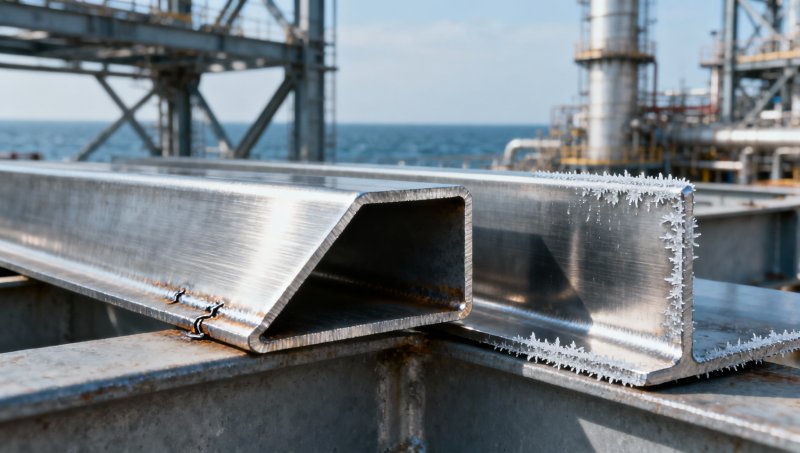
In coastal environments across Southern and Western Europe—think port-side processing halls, offshore support structures, or desalination plant framing—the dominant threat is chloride-induced pitting and crevice corrosion. 304 stainless contains ~18% chromium and 8% nickel, forming a passive oxide layer that resists general corrosion. But chloride ions (Cl⁻) from sea spray or de-icing salts aggressively localise at micro-defects—weld heat-affected zones, mill scale residues, or even dust-trapped surfaces—and penetrate that layer. Once initiated, pits propagate rapidly beneath the surface, remaining invisible until structural integrity is compromised. Field inspections in Mediterranean harbours consistently show 304 angle sections developing sub-surface pitting within 3–5 years of installation—even when surface appearance remains intact.
316L adds ~2–3% molybdenum (Mo), which dramatically increases resistance to chloride attack by stabilising the passive film and slowing pit nucleation. Crucially, the “L” grade denotes low carbon (<0.03%), minimising carbide precipitation during welding—a common failure point for 304 angles in field-assembled structures. For welded angle joints exposed to splash zones or humid salt air, 316L isn’t over-engineering; it’s preventing premature weld decay that forces costly rework or unplanned shutdowns.
Chemical Processing: It’s Not Just About Acid Strength
Many specifiers assume that if a chemical solution isn’t strongly acidic (pH < 2), 304 suffices. That’s dangerously misleading in practice. In chemical plants handling sodium hypochlorite, ferric chloride, or nitric acid blends—even at moderate concentrations—corrosion depends less on bulk pH and more on oxidising potential, halide content, and temperature. 304 performs adequately in dilute, non-halogenated acids like acetic or citric. But introduce trace chlorides (common in recycled process water or cleaning rinses) and elevated temperatures (>40°C), and its corrosion rate spikes unpredictably.
316L’s molybdenum content raises the critical pitting temperature (CPT) by 15–25°C over 304—meaning it remains stable where 304 begins active pitting. More importantly, its improved resistance to stress corrosion cracking (SCC) under tensile load in chloride/oxidiser environments makes it the de facto standard for structural supports in scrubber towers, reactor platforms, and piping racks. This isn’t theoretical: EN 10088-2 explicitly recommends 316/316L for “environments containing chlorides or other halides, especially at elevated temperatures.”
Food Processing: Sanitation Demands More Than Cleanability
Here, the misconception is that “food-grade” means 304 is sufficient. While 304 meets basic hygiene requirements for equipment surfaces, structural angles play a different role—they bear load, anchor conveyors, support hoods, and form frames for washdown zones. Repeated exposure to hot caustic (NaOH) and acidic (nitric/phosphoric) cleaning cycles, combined with steam sterilisation and condensate pooling in corners, creates ideal conditions for microbiologically influenced corrosion (MIC). Biofilms trap chlorides and organic acids against the metal surface, accelerating localised attack. 304 angles in dairy processing plants in Northern Germany have shown accelerated crevice corrosion at bolted connections after only 2–3 years—despite rigorous cleaning protocols.
316L’s superior resistance to both acidic and alkaline cleaners, plus its ability to maintain passivity in wet-dry cycling zones, directly extends service life and reduces contamination risk. EN 14159 (stainless steels for food contact) doesn’t mandate 316L—but it acknowledges that “in aggressive cleaning regimes, higher alloyed grades may be necessary to ensure long-term performance.” For technical evaluators, this translates to fewer unscheduled inspections, lower maintenance labour costs, and demonstrable compliance with HACCP and BRCGS audit requirements.
The Real Cost Difference: Lifecycle, Not Line Item
Yes, 316L angle stainless steel Europe typically costs 20–35% more than 304 on a per-tonne basis. But lifecycle costing reveals a different picture. Consider a coastal wastewater treatment facility in Portugal installing 304 angles for pump station framing: €120,000 material cost. Within six years, 30% of welded joints require grinding, re-passivation, and recoating due to pitting—adding €45,000 in labour and downtime. By year 12, full replacement is needed. Switching to 316L increases initial cost to €155,000—but eliminates those interventions. Over 20 years, the total cost of ownership (TCO) favours 316L by €72,000. The break-even point? Often under 5 years in high-chloride or chemically aggressive settings.
This calculation assumes consistent quality. Substandard 316L—low Mo content, inconsistent heat treatment, or poor surface finish—erodes that advantage. That’s why traceability matters: EN 10219-compliant angles must carry mill test reports verifying actual Mo content (not just nominal), intergranular corrosion test results (ASTM A262 Practice E), and surface roughness (Ra ≤ 0.8 µm for hygienic applications). Suppliers claiming “316L equivalent” without certified documentation are introducing unquantifiable risk.
Where 304 Still Holds Ground—And When to Look Beyond Both
304 remains appropriate for dry, indoor, low-contamination environments: interior structural bracing in pharmaceutical cleanrooms (away from washdown zones), non-critical support frames in ambient-temperature food packaging lines, or architectural façade angles in inland urban settings. Its formability and weldability also make it preferable for complex custom bends where 316L’s higher strength requires more force and post-forming stress relief.
But for highly aggressive scenarios—seawater immersion, concentrated hydrochloric acid vapour, or continuous exposure to chlorine dioxide sanitising systems—neither 304 nor 316L suffices. Duplex grades (e.g., EN 1.4462) or super-austenitics (e.g., 254 SMO) become necessary. And for filtration components within these same facilities—like sieve plates, filter baskets, or screen panels—material selection follows different rules. Here, fine-mesh integrity, micron retention consistency, and resistance to abrasive flow matter more than structural yield strength. 306 Stainless Steel Welded Mesh, for example, leverages the same 316L chemistry in wire form to deliver precise particle separation while maintaining corrosion resistance in chemical and food-grade sieving applications—proving that alloy choice must match function, not just location.
Next Steps for Technical Evaluators
Don’t default to 304. Don’t automatically specify 316L without validating the environment. Start with a chloride budget: estimate airborne Cl⁻ deposition (g/m²/year) using ISO 9223 maps for your site, then overlay process chemical exposure duration and temperature. Cross-reference with EN 10088-1’s corrosion resistance tables—not as absolute thresholds, but as relative guidance. Prioritise weldability and post-weld treatment: request certified welding procedure specifications (WPS) for the chosen grade, and insist on pickling/passivation validation reports—not just “as supplied” certificates. Finally, verify supplier capability: can they provide full traceability from melt analysis to final dimensional inspection? If not, the material cost saving is illusory.
Please give us a message


Please enter what you want to find