What is angle iron shelving and why is thickness important?
Angle iron shelving refers to storage systems constructed using L-shaped steel profiles, where thickness directly determines load capacity and structural integrity. As a fundamental parameter, thickness affects:
- Weight capacity: Thicker angles (3-6mm) support 150-500kg per shelf
- Deflection resistance: 1/4" (6.35mm) thickness reduces sag by 40% vs 1/8" (3.175mm) at 4ft spans
- Durability: 5mm+ thickness withstands industrial environments for 10-15 years
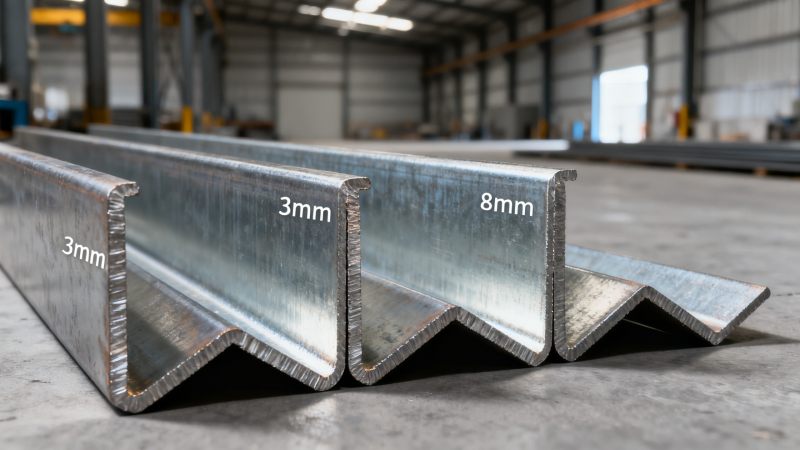
At Hongteng Fengda, we manufacture angle irons from Q235B to S355JR grades with thicknesses ranging 2-25mm, allowing precise matching to shelving requirements. The right thickness prevents over-engineering (wasting material) or under-designing (safety risks).
How do I calculate required angle iron thickness for my shelves?
Key calculation factors
Three primary variables determine optimal thickness:
For DIY projects, use this simplified formula: Minimum thickness (mm) = (Total load in kg × Span in meters) ÷ 120. Always add 1-2mm safety margin for dynamic loads.
When to consider H-beams instead
For shelving exceeding 8ft spans or 500kg loads, H-beam structures often prove more efficient. With flange widths of 50-400mm and web heights up to 900mm, these I-shaped sections provide superior load distribution for industrial storage systems. Key advantages include:
- 30-50% higher strength-to-weight ratio than angle iron
- Reduced deflection at long spans
- Easier integration with mezzanine flooring
What are common mistakes when choosing angle iron thickness?
Our manufacturing experience reveals four frequent errors:
1. Ignoring dynamic load factors
Static load calculations often underestimate real-world conditions. For shelving experiencing:
- Forklift impacts: Add 2mm thickness
- Frequent item movement: Add 1mm thickness
- Seismic zones: Consult EN 1998-1 standards
2. Overlooking corrosion protection
In humid or chemical environments, even thick angle iron (6mm+) can fail prematurely. Our recommended solutions:
How does angle iron compare to alternative shelving materials?
While angle iron dominates industrial shelving, understanding alternatives ensures optimal selection:
Material comparison table
Why choose Hongteng Fengda for your shelving materials?
As a structural steel specialist serving global clients, we offer distinct advantages for shelving projects:
- Precision manufacturing: ±0.5mm thickness tolerance ensures consistent performance
- Material options: From economical Q235 to high-strength S355JR grades
- Custom solutions: Laser-cut notches, pre-drilled holes, and protective coatings
- Global standards: ASTM, EN, and JIS compliant products with mill certificates
For shelving projects requiring professional guidance on angle iron thickness selection, material grades, or custom fabrication, contact our engineering team with your:
- Maximum shelf dimensions (L×W)
- Expected load per level
- Environmental conditions
- Preferred material grade
We'll provide thickness recommendations, CAD drawings, and competitive quotations within 24 hours for projects of any scale.
Please give us a message


Please enter what you want to find