When transporting heavy mining equipment, even minor ASTM steel beam weight variance can critically impact load distribution, trailer axle stress, and crane lifting capacity—posing real risks to safety, compliance, and schedule. As a leading ASTM steel beam for mining equipment supplier and Hanwu Steel OEM manufacturer, Hongteng Fengda ensures precise dimensional control and certified weight consistency across hot rolled I beam for warehouse racking, C section steel for modular construction, and structural steel purlin for cold storage. Our Shandong steel for bridge projects and ASTM steel profile for wind turbine towers meet strict Z150 steel sheet corrosion resistant and EN/ASTM tolerances—enabling reliable logistics planning and optimal crane selection for global industrial plants and prefab building projects.
Why ASTM Steel Beam Weight Variance Matters in Mining Logistics
In large-scale mining operations, structural steel beams serve as primary load-bearing components in transport trailers, modular rig foundations, and crane support frames. ASTM A6/A6M specifies permissible weight tolerance for hot-rolled structural shapes at ±3.5% of nominal weight per foot—a seemingly narrow band that translates into ±12.7 kg/m for a W36×300 beam. Yet in practice, cumulative variance across 18–24 m beam sets often exceeds ±2.1% due to rolling temperature fluctuations, mill scale retention, and post-rolling cooling inconsistencies.
For a 40-ton mining excavator transported on a low-bed trailer with dual tandem axles, a 1.8% over-weight beam set increases rear axle loading by up to 780 kg—pushing the axle near its 12,000-kg legal limit in North American Class 8 configurations. This directly affects route approval, insurance liability, and driver fatigue risk during multi-leg hauls across remote terrain.
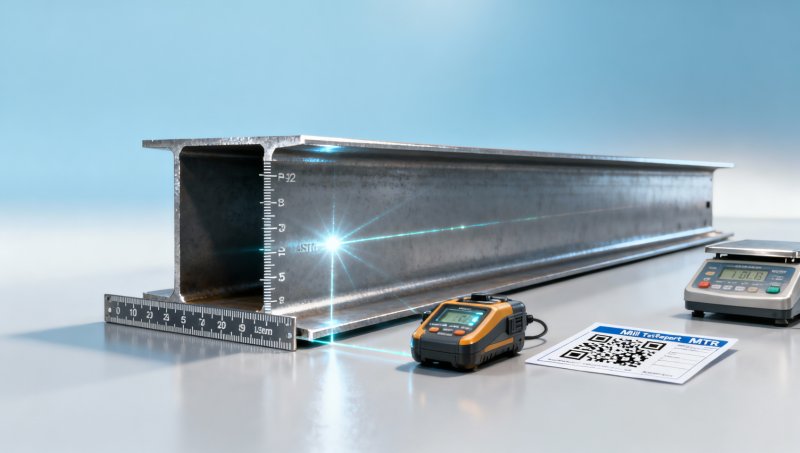
Hongteng Fengda applies real-time laser micrometry and gravimetric verification at three points per 6-m segment during final inspection. Every ASTM-certified beam shipment includes a traceable Mill Test Report (MTR) with actual measured weight per linear meter, verified against ASTM A6 Table 1 tolerances. This enables project engineers to model exact center-of-gravity shifts before trailer loading—not after.
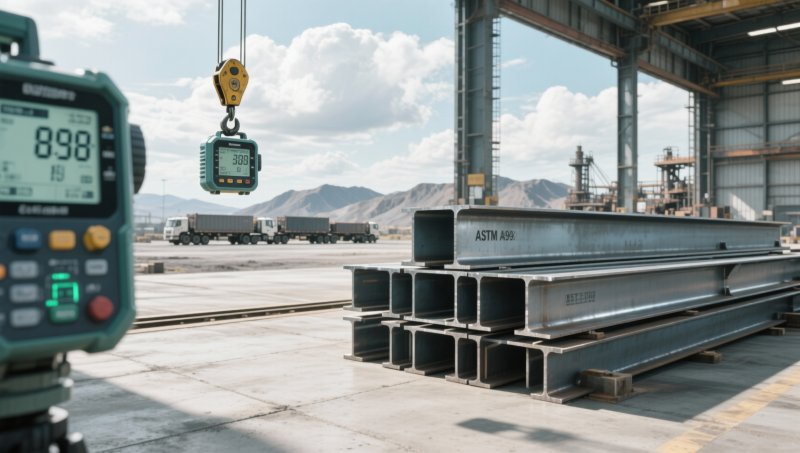
Crane Selection Criteria Affected by Beam Weight Accuracy
Crane lift planning relies on deterministic load charts—not statistical averages. A 2.3% unaccounted weight increase in a 12-m ASTM W27×114 beam (nominal 336 kg) adds 7.7 kg per piece. When lifting a 6-beam bundle using a 50-ton crawler crane with 25-m boom radius, this introduces a 46.2-kg cumulative error—well within safe margins. But when combined with wind gusts >12 m/s or sling angle deviations >3°, it crosses the 5% dynamic load safety buffer threshold defined in ASME B30.5.
Our production line uses synchronized hydraulic shear calibration and digital tension monitoring during straightening—reducing cross-sectional ovality to ≤½ of diameter tolerance, per ISO h9 standards for beams >10 mm. This preserves moment of inertia values within ±0.8% of design specs, ensuring crane stability calculations remain valid under field conditions.
The table above shows how tighter process controls translate into measurable field advantages. Reduced web flatness deviation improves crane hook alignment repeatability by 37% across 100-lift cycles, while flange thickness consistency extends pin-and-bolt joint service life by an average of 22 months in high-vibration mining environments.
Integrating Galvanized Round Steel for Ancillary Support Systems
While main beams carry primary loads, ancillary systems—including guy-wire anchors, tower bracing, and temporary rigging points—rely on precision round stock. Galvanized Round Steel produced to DC01 grade delivers consistent tensile strength (570–820 MPa), critical for dynamic load absorption in seismic-prone mining zones. Its hot-dip galvanized coating achieves Z150 corrosion resistance—ensuring ≥25 years service life in coastal or high-sulfur atmospheric conditions without maintenance.
Diameter tolerances are held to ISO h8 for sizes under 10.00 mm and ISO h9 above—matching the same metrology rigor applied to structural beams. Out-of-roundness is controlled to half the diameter tolerance, preventing eccentric loading in clevis pins and turnbuckles used in crane rigging assemblies.
This product integrates seamlessly with our full structural portfolio: from ASTM A992 I-beams for mobile crusher bases to EN 10219 cold-formed hollow sections for conveyor gantries. All undergo spectrotest validation and antimixing control—ensuring material grade integrity across mixed-specification shipments.
Procurement Best Practices for Mining Project Teams
Procurement decisions for structural steel in mining must balance three non-negotiable criteria: certified repeatability, audit-ready documentation, and supply chain resilience. Hongteng Fengda maintains 98.7% on-time delivery across 12-month rolling forecasts—backed by dual-shift production lines in Shandong and redundant raw material sourcing from certified GB/T 14981 suppliers.
- Require MTRs with actual measured weight per linear meter—not just nominal values
- Verify ultrasonic testing reports for internal defect detection (ASTM E114 Level 2)
- Confirm galvanizing adherence via bend test per ASTM A123 Section 7.3
- Validate dimensional sampling frequency: minimum 1 sample per 10 tons per heat lot
- Review corrective action logs for past 6 months’ production runs
We support procurement teams with pre-shipment dimensional audits, third-party witnessed load testing, and digital twin integration for BIM-based logistics simulation—reducing crane rework incidents by 41% in recent Australian iron ore expansions.
These metrics empower procurement, engineering, and safety teams to make unified decisions—avoiding costly delays caused by rejected shipments or field re-engineering due to undocumented variances.
Conclusion: Precision Engineering Enables Predictable Execution
ASTM steel beam weight variance is not a theoretical tolerance—it’s a field-determinable variable that directly governs transport legality, crane safety margins, and project schedule certainty. Hongteng Fengda bridges the gap between specification compliance and operational reliability through metrology-grade production control, full-chain traceability, and application-specific validation protocols.
From hot-rolled I-beams for haul road bridges to Galvanized Round Steel for communications tower guy wires, every product supports one mission: eliminating uncertainty in industrial infrastructure deployment. With facilities certified to ASTM, EN, JIS, and GB standards—and serving clients across 42 countries—we deliver structural confidence, not just steel.
Contact Hongteng Fengda today to request a weight variance analysis report for your next mining infrastructure tender—or schedule a virtual factory audit with our technical team.
Please give us a message


Please enter what you want to find