Choosing between ASTM A653 (zinc-coated) and A792 (zinc-aluminum alloy-coated) steel coil is critical for outdoor structural durability — especially when sourcing ASTM Steel Coil from a trusted steel sheet supplier like Hongteng Fengda. As a leading China-based structural steel manufacturer and exporter, we supply high-performance SGCC, DX51D, and HRC (Hot Rolled Coil) compliant with ASTM, EN, and GB standards. Whether you're a procurement specialist evaluating cost vs. corrosion resistance, an engineer assessing coating longevity, or a project manager specifying materials for harsh environments, understanding these ASTM standard differences ensures optimal performance, compliance, and lifecycle value.
Understanding the Core Differences: Coating Composition & Corrosion Mechanism
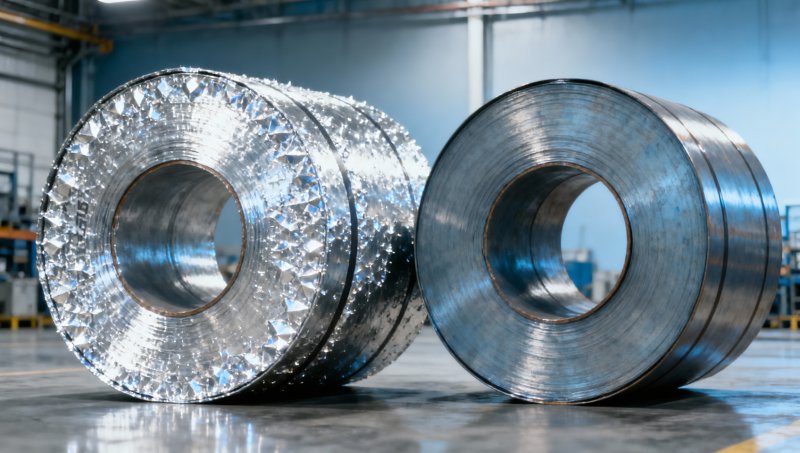
ASTM A653 specifies hot-dip galvanized steel sheet with a pure zinc coating, typically ranging from 40–180 g/m² (Z40 to Z180). The zinc layer acts sacrificially—corroding preferentially to protect the underlying steel substrate. In contrast, ASTM A792 defines steel sheet coated with a 55% aluminum–45% zinc alloy (commonly referred to as “Galvalume®” in commercial contexts), applied at minimum weights of 70–150 g/m² (AZ70 to AZ150). The aluminum content forms a dense, self-healing aluminum oxide barrier, significantly slowing atmospheric oxidation and enhancing resistance to cut-edge corrosion.
This fundamental difference dictates long-term behavior: A653 excels in high-humidity, chloride-rich coastal zones where rapid zinc consumption is acceptable for initial protection; A792 delivers superior performance in industrial atmospheres, rooftop applications, and rural settings where uniform barrier integrity matters more than short-term sacrificial response. Field studies show A792-coated panels retain >90% coating mass after 15 years in moderate industrial exposure, while equivalent A653 coatings may drop below 60% in the same period.
Performance Comparison Across Key Environmental Conditions
Selecting the right coating isn’t about “better” or “worse”—it’s about matching material behavior to site-specific stressors. Temperature cycling, UV intensity, airborne sulfates, and salt deposition rates all interact differently with zinc versus zinc–aluminum layers. For example, in subtropical climates with frequent wet–dry cycles (e.g., Southeast Asia), A792’s stable oxide layer reduces white rust formation by up to 70% compared to A653 under identical humidity conditions.
The table confirms that A792 consistently outperforms A653 in longevity-critical applications—but only when environmental data justifies the 12–18% average price premium. For short-duration temporary structures or interior secondary framing, A653 remains the most cost-effective solution.
Manufacturing & Quality Control Implications for Global Sourcing
At Hongteng Fengda, both A653 and A792 coils undergo identical rigorous quality gates: tensile testing per ASTM E8, coating weight verification via gravimetric analysis (ASTM A90/A90M), and bend testing per ASTM A653 Section 9. However, A792 requires tighter process control during annealing and coating bath chemistry management—aluminum oxidizes rapidly above 600°C, demanding precise furnace atmosphere regulation. Our production line maintains ±1.5°C temperature tolerance across 120m of continuous annealing zone, ensuring consistent alloy phase distribution.
All coils are certified to ASTM A653/A792, EN 10346, and GB/T 2518, with mill test reports (MTRs) traceable to batch-level heat numbers. Lead time for standard A653 orders is 7–10 working days; A792 requires 12–15 days due to specialized bath replenishment cycles. We maintain dedicated A792 inventory for North American and EU clients to reduce delivery latency.
For structural components requiring welding, A653 offers marginally better arc stability and lower fume toxicity—critical for on-site fabrication teams. Meanwhile, A792’s superior formability supports complex cold-formed profiles like tapered purlins and curved cladding systems without edge cracking.
Strategic Procurement Guidance: When to Specify Which Standard
Procurement decisions should be anchored in lifecycle cost—not upfront unit price. Consider this framework:
- Choose A653 if: Project duration is ≤10 years; budget constraints are absolute; structure is sheltered or interior; local regulations accept zinc-only certification (e.g., many municipal building codes).
- Choose A792 if: Design life exceeds 20 years; location falls within ISO 9223 Corrosivity Category C4 or higher; aesthetic consistency matters (no white rust staining); or OEM specifications mandate alloy-coated substrates (e.g., solar mounting rails, HVAC ductwork).
- Hybrid approach: Use A792 for exposed roof/decking elements and A653 for concealed structural members—reducing total system cost by 9–13% while preserving core durability.
Our technical sales team provides free corrosion mapping support using ISO 9223 environmental data layers for your exact GPS coordinates—helping quantify expected coating loss rates before order placement.
Complementary Structural Solutions from Hongteng Fengda
Beyond coated coil, Hongteng Fengda supplies fully integrated structural solutions. For foundations and reinforcing frameworks, our Wire Rod meets ASTM A615 Grade 60 and GB1499.2 HRB400E standards, with carbon content tightly controlled between 0.06–0.22% to ensure optimal weldability and ductility in seismic zones. These rods are routinely used in petrochemical plant foundations and wind-tower anchor cages—applications demanding yield strength consistency within ±0.25% tolerance.
We also offer precision-cut angle steel, channel sections, and custom cold-formed profiles—each laser-verified for dimensional accuracy within ±0.5 mm over 6-meter lengths. All products ship with full EN 10204 3.1 certification and optional third-party inspection (SGS/BV/TÜV).
Final Recommendation & Next Steps
There is no universal “best” coating—only the best match for your project’s specific environmental exposure, design life, maintenance access, and total cost of ownership. For projects in Middle Eastern deserts or European industrial belts, A792 delivers measurable ROI through reduced recoating cycles and extended warranty periods. For fast-track infrastructure in Southeast Asia with 15-year design life, A653 remains technically sound and economically rational.
Hongteng Fengda supports your decision with real-world data—not brochures. Request our complimentary ASTM A653 vs. A792 Technical Dossier, including 12-month accelerated corrosion test results, coating cross-section SEM imagery, and regional case studies from Dubai, Rotterdam, and Ho Chi Minh City.
Contact our engineering sales team today to discuss your next structural steel order—or request a sample coil with full MTR package for lab evaluation.
Please give us a message


Please enter what you want to find