ASTM steel pipe pricing can shift significantly between quotations, even when products look similar at first glance.
Grade, size, wall thickness, coating, testing, and delivery terms all influence the final number.
For steel sourcing decisions, understanding these specification-based cost drivers helps control budgets and reduce supply risk.
In structural and industrial projects, a precise ASTM steel pipe quote depends on more than base material price alone.
Core Meaning of ASTM Steel Pipe Pricing
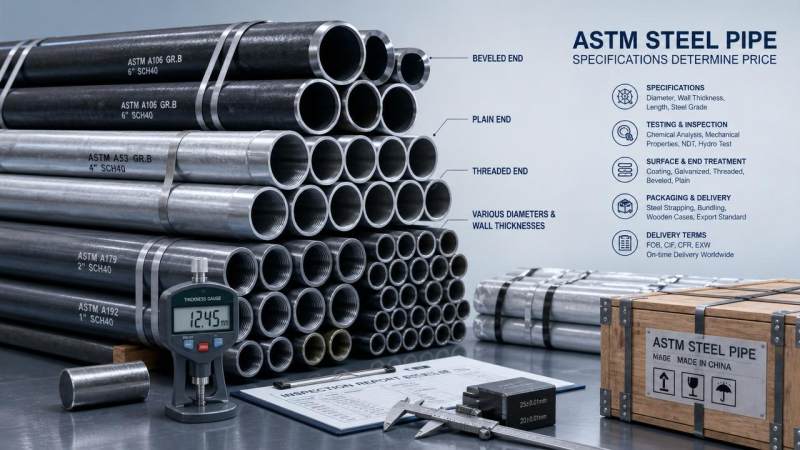
ASTM steel pipe refers to pipe produced according to ASTM material and performance standards.
These standards define chemistry, mechanical properties, dimensions, tolerances, and testing requirements.
Because specifications differ, ASTM steel pipe pricing also changes from one application to another.
A quote for ASTM A53 pipe may differ greatly from ASTM A106 or ASTM A500 products.
The difference is not only about steel cost.
It also includes forming method, heat treatment, inspection scope, and end-use compliance needs.
In practice, ASTM steel pipe price analysis should always start with the exact standard and service condition.
Main Specifications That Change the Final Quote
Several technical factors explain why ASTM steel pipe quotations vary across suppliers and projects.
Material Grade and Standard
Different ASTM grades carry different chemistry limits and performance expectations.
Higher strength, pressure resistance, or temperature resistance usually means higher processing and testing costs.
This is one of the first drivers behind ASTM steel pipe pricing.
Diameter, Wall Thickness, and Length
Outer diameter and wall thickness directly affect steel weight per meter.
Heavier pipes consume more raw material and often increase freight costs.
Special cut lengths can also raise production complexity and scrap ratio.
Manufacturing Method
Seamless, ERW, LSAW, and SSAW pipes do not share the same production route.
Seamless products typically cost more because of process intensity and tighter performance requirements.
Welded options may offer better economy for many structural uses.
Surface Treatment and End Finish
Black pipe, galvanized pipe, painted pipe, beveled ends, threaded ends, and capped ends each add value and cost.
Corrosion protection is especially important for outdoor and marine exposure.
Testing and Certification
Hydrostatic testing, ultrasonic inspection, impact testing, and third-party certification all affect the quote.
Documentation quality matters in global construction and industrial supply chains.
Current Market Factors Affecting ASTM Steel Pipe Pricing
Beyond technical specifications, external market conditions also shape ASTM steel pipe pricing.
When comparing suppliers, it is important to separate market fluctuation from specification-based pricing differences.
That comparison improves visibility into the true ASTM steel pipe cost structure.
Business Value of Understanding Quote Structure
Clear quote analysis creates practical value for project planning, technical alignment, and commercial risk control.
- Prevents overbuying unnecessary specifications
- Reduces hidden cost from incomplete testing assumptions
- Improves comparison between seamless and welded alternatives
- Helps balance corrosion protection and budget targets
- Supports better planning for export packing and freight
This approach is especially useful in construction, machinery, infrastructure, and industrial fabrication.
For broader steel projects, related flat products can also matter.
For example, Carbon Sheet Steel is widely used in construction, shipbuilding, petroleum, chemical equipment, boilers, and machinery fabrication.
Available in grades such as Q245R, Q345R, 16MnDR, and 15CrMoR, it supports thickness from 1mm to 100mm.
Typical ASTM Steel Pipe Use Cases and Price Priorities
Different applications prioritize different specifications, which changes the final ASTM steel pipe quote.
This table shows why one ASTM steel pipe specification cannot represent all project needs.
Accurate application matching is a direct path to a more reliable quotation.
Practical Points When Comparing ASTM Steel Pipe Suppliers
A low headline price does not always mean lower total procurement cost.
The following checkpoints improve quote transparency.
- Confirm ASTM standard, grade, and manufacturing route.
- Check outer diameter, wall thickness, and length tolerances.
- Review included testing methods and certificate scope.
- Clarify coating type, zinc thickness, or paint system.
- Compare packing, marking, and export loading details.
- Ask whether freight, duties, or third-party inspection are excluded.
Reliable steel suppliers should also explain where a quote may change after technical review.
That explanation matters for both schedule stability and cost control.
How Structural Steel Supply Experience Supports Better Cost Decisions
For global projects, pipe sourcing often connects with beams, channels, angles, and fabricated steel components.
A supplier with broad structural steel capability can coordinate specifications more effectively.
Hongteng Fengda, based in China, focuses on structural steel manufacturing and export for international construction and industrial demand.
Its product range includes angle steel, channel steel, steel beams, cold formed profiles, and customized structural steel solutions.
Production follows major standards such as ASTM, EN, JIS, and GB with controlled quality processes.
That type of supply foundation helps improve consistency, lead time reliability, and specification matching.
In some combined fabrication projects, plate materials like Carbon Sheet Steel may also support welded assemblies and equipment structures.
Actionable Steps Before Requesting the Final ASTM Steel Pipe Quote
To get a more accurate ASTM steel pipe quotation, prepare a complete technical inquiry first.
- State the ASTM standard and grade clearly
- List size, thickness, length, and quantity
- Specify seamless or welded preference
- Add coating, end finish, and packing needs
- Define inspection, certificates, and destination port
These details make ASTM steel pipe pricing more transparent and easier to compare.
They also reduce revision cycles and avoid mismatched assumptions.
When quotations are built on exact specifications, the final decision becomes faster, safer, and more cost-effective.
Please give us a message


Please enter what you want to find