When sourcing ASTM Steel Coil or EN 10346-compliant steel sheet—such as SGCC or DX51D—procurement teams face critical differences in tensile strength reporting that impact material selection, compliance verification, and project safety. As a trusted Steel Coil Supplier and structural steel manufacturer, Hongteng Fengda helps global buyers navigate these nuances across ASTM standard, EN specifications, HRC, and Hot Rolled Coil applications. Whether you’re a procurement professional, technical evaluator, or project manager, understanding how tensile strength is defined, tested, and certified under each standard ensures cost-effective, code-compliant sourcing—especially for industrial steel used in construction and manufacturing.
Understanding Tensile Strength Reporting: Why It’s Not Just a Number
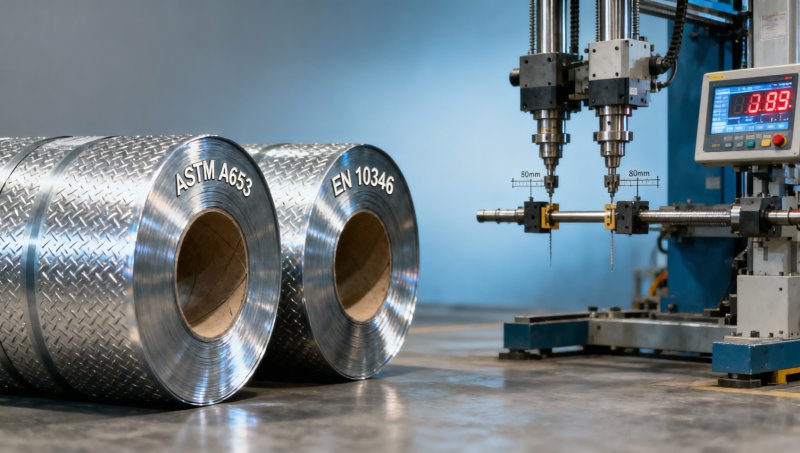
Tensile strength is not a standalone metric—it reflects the interplay of testing methodology, specimen geometry, strain rate, and reporting conventions. ASTM A653/A653M mandates tensile testing on transverse specimens with gauge length equal to 50 mm (2 in), while EN 10346 specifies longitudinal specimens with L0 = 80 mm for flat products ≥3 mm thick. This 60% difference in baseline gauge length directly affects yield point identification and ultimate tensile strength (UTS) interpretation.
Moreover, ASTM reports both yield strength (YS) and tensile strength (TS) as minimum guaranteed values, whereas EN 10346 defines TS as a *characteristic value*—meaning 95% of test results must meet or exceed it, with statistical tolerance applied. This distinction becomes operationally critical during mill certificate review: an EN-certified coil reporting “TS ≥ 370 MPa” implies up to 5% of samples may fall slightly below that threshold, while ASTM’s “TS ≥ 370 MPa” requires every single test result to satisfy it.
For structural applications where load-bearing redundancy is non-negotiable—such as cold-formed purlins or seismic bracing systems—this variance can trigger retesting, hold points, or even rejection if procurement teams misinterpret the statistical basis behind EN-reported values.
Hongteng Fengda maintains dual-certified labs accredited to ISO/IEC 17025, enabling real-time cross-standard validation. Our quality reports include both ASTM-style minimums and EN-style characteristic curves—eliminating ambiguity for engineers reviewing submittals in North America (ASTM-driven) versus EU projects (EN-mandated).
Key Technical Differences Across ASTM A653 & EN 10346
Beyond reporting philosophy, ASTM A653 and EN 10346 diverge in specimen orientation, strain rate control, and acceptance criteria. ASTM permits either transverse or longitudinal testing but requires explicit notation; EN 10346 mandates longitudinal orientation for hot-dip galvanized sheets like DX51D to reflect rolling-direction ductility—critical for deep-drawing stamping operations.
Strain rate also differs significantly: ASTM allows 0.0025–0.005 s⁻¹ for yield determination, while EN 10346 fixes it at 0.0025 s⁻¹ ±10%. This tighter control reduces variability but demands more precise machine calibration—explaining why some EN-certified coils show narrower TS spreads (e.g., 365–375 MPa) versus ASTM batches (360–385 MPa) from the same heat.
Elongation reporting adds another layer: ASTM expresses elongation after fracture (A50mm) as a percentage of original gauge length, while EN 10346 uses A80 and applies a correction factor for thickness <3 mm. For 0.8 mm DX51D, EN may report A80 = 22%, whereas ASTM would list A50mm = 19%—not a discrepancy, but a function of standardized normalization.
The table above reveals why specification alignment matters beyond paperwork: using ASTM-specified test data to approve EN-compliant material—or vice versa—can lead to nonconformance during third-party audits. At Hongteng Fengda, we pre-validate all coil lots against both standards’ sampling plans: ASTM requires one tensile test per 50 tons, while EN 10346 mandates one per 30 tons for DX51D-grade material. This higher frequency supports tighter process control and faster resolution when deviations occur.
Procurement Implications: From Specification to Delivery
Procurement professionals must embed these differences into RFQs, PO terms, and inspection protocols. For example, specifying “ASTM A653M compliant” without defining whether tensile data must follow transverse or longitudinal orientation leaves room for supplier interpretation—and potential mismatch with end-use forming requirements.
Similarly, requesting “EN 10346 DX51D with TS ≥ 370 MPa” without requiring the full statistical report (including standard deviation and confidence interval) forfeits the standard’s core benefit: quantifiable reliability. Hongteng Fengda includes full Weibull distribution analysis in EN-submitted dossiers—showing not just compliance, but predictability across 10,000+ coil tons shipped annually to Tier-1 automotive suppliers in Germany and Poland.
Lead time considerations also differ: ASTM-certified coils typically clear customs in 7–10 days due to widely accepted mill certs, while EN 10346 shipments to EU markets often require Notified Body review (e.g., TÜV SÜD), extending clearance to 12–18 days. We mitigate this by pre-certifying all EN-grade coils through our EU-authorized representative—reducing documentation turnaround to ≤5 working days.
For high-precision applications such as laser-welded structural frames, tensile uniformity matters more than peak values. Our proprietary annealing process achieves TS variation ≤±8 MPa across 10-meter coil lengths—well within EN 10346’s ±15 MPa tolerance and superior to ASTM’s typical ±12 MPa spread.
Cross-Standard Compatibility & Material Selection Guidance
When projects span multiple regions—e.g., a U.S.-designed plant built in Saudi Arabia using EU-sourced equipment—hybrid certification becomes essential. Hongteng Fengda offers dual-labeled coils meeting both ASTM A653 Grade G90 and EN 10346 DX51D+Z275, with tensile data reported in parallel formats on the same mill certificate.
This approach eliminates retesting delays: a coil accepted under ASTM in Houston can be seamlessly approved under EN in Riyadh, provided elongation and bend test results align (which they do, thanks to our consistent zinc alloy bath chemistry and tension-leveling parameters).
For corrosion-critical environments, consider pairing EN 10346-compliant base metal with specialized finishes. Our 304L Stainless Steel Pipe leverages ultra-low-carbon chemistry (≤0.03% C) to prevent intergranular corrosion during welding—a capability increasingly demanded in offshore platforms and pharmaceutical cleanrooms where ASTM A312 and EN 10217-7 both apply.
Ultimately, tensile strength reporting isn’t about choosing “better” standards—it’s about matching methodology to risk profile. For infrastructure projects with 50-year design life, EN’s statistical rigor provides long-term predictability. For rapid-deployment modular buildings, ASTM’s deterministic thresholds simplify QA. Hongteng Fengda equips buyers with both lenses—so decisions are grounded in engineering reality, not document convenience.
Why Partner With Hongteng Fengda for Global Steel Sourcing?
As a vertically integrated structural steel manufacturer exporting to 32 countries, we bridge ASTM and EN expectations—not just on paper, but in production. Our Tianjin facility runs continuous annealing lines calibrated to ±1.5°C temperature control, ensuring tensile consistency across 200+ coil grades—from basic SGCC to high-strength S550GD+Z150.
We offer free technical consultation for spec alignment, including side-by-side ASTM/EN clause mapping, tensile data reconciliation templates, and pre-shipment audit support. For urgent projects, our bonded warehouse in Rotterdam holds 5,000+ tons of pre-certified EN 10346 material—cutting EU delivery lead times to 7–10 days.
Whether you’re evaluating coil for cold-formed roof decks in Texas or verifying DX51D suitability for solar mounting rails in Spain, Hongteng Fengda delivers clarity, consistency, and compliance—without compromise.
Contact our global procurement team today to request ASTM/EN comparative test reports, review your next coil specification, or explore OEM co-development for custom tensile profiles.
Please give us a message


Please enter what you want to find