Before approving a purchase order, financial decision-makers should look beyond price and verify ASTM steel certification risks that could impact project cost, compliance, and delivery. In global sourcing, incomplete documents, mismatched grades, or unreliable testing can lead to costly delays and disputes. Understanding these risks helps buyers protect budgets while choosing qualified structural steel suppliers.
Why ASTM steel certification matters before financial approval
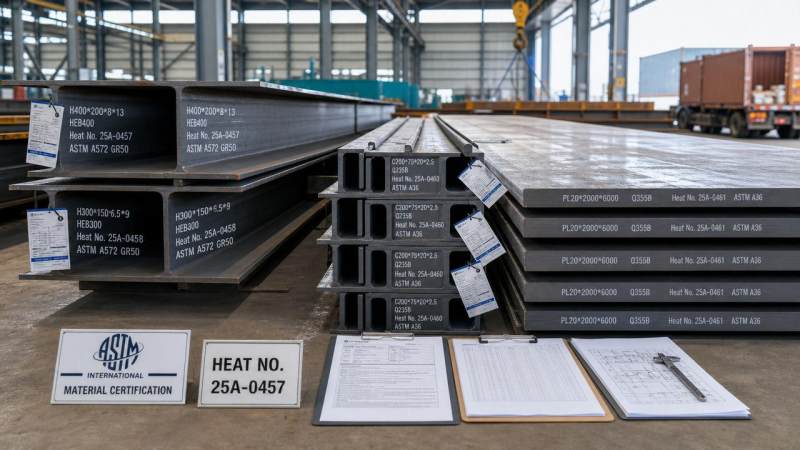
For finance teams, ASTM steel is not only a material line item. It is a compliance risk, a schedule risk, and a warranty risk. If certification does not match the ordered specification, the real cost often appears later through rework, rejected inspections, port claims, or project delays.
In structural steel procurement, a low unit price can quickly become expensive when mills, traders, and fabricators provide inconsistent documents. ASTM steel certification should therefore be reviewed as part of total landed cost control, not as a paperwork formality.
What financial approvers should verify first
- Whether the material grade on the mill test certificate matches the purchase order, drawing, and contract specification.
- Whether chemical composition and mechanical properties fall within the stated ASTM standard limits.
- Whether the test report can be traced to heat number, bundle marking, and shipment batch.
- Whether the supplier has stable production control instead of outsourcing critical items without clear disclosure.
What are the most common ASTM steel certification risks?
The biggest mistakes usually happen in routine transactions. Buyers assume a certificate exists, but do not examine whether it is complete, current, or connected to the actual shipment. For ASTM steel, that gap can create significant financial exposure.
Key risk points to check before placing the order
- Grade substitution risk. A supplier may quote one grade and ship another with similar appearance but different strength, ductility, or weldability.
- Incomplete test reports. Some documents omit impact values, elongation, yield strength, or heat number traceability required by the application.
- Certificate-template risk. Generic forms without shipment linkage can make claims difficult if quality disputes arise after arrival.
- Third-party inspection misunderstanding. Buyers may assume independent verification is included when the contract only covers mill self-inspection.
- Mixed-source supply. In large projects, combining material from different mills without consistent documentation can create audit issues.
These issues matter because financial approval usually locks in payment terms, delivery milestones, and claim boundaries. If ASTM steel documents are weak at the front end, cost recovery becomes harder later.
A practical ASTM steel document review checklist for finance teams
The table below helps financial approvers review ASTM steel certification with procurement and quality teams. It focuses on contract risk rather than only technical detail.
This review process does not require finance staff to act as metallurgists. It requires them to ensure that the supplier’s ASTM steel paperwork supports payment approval, contract compliance, and downstream accountability.
How to compare suppliers beyond the ASTM steel certificate
Certification is only one layer of risk control. A credible structural steel supplier should also demonstrate production stability, specification flexibility, and clear communication on delivery milestones. This is especially important when steel sections, beams, channels, or customized profiles are sourced for international projects.
Supplier comparison factors that affect total cost
The comparison table below can help separate a low-price quote from a lower-risk quote when purchasing ASTM steel products from overseas suppliers.
For buyers managing project cash flow, a controlled manufacturer often reduces hidden cost even when the initial quote is not the lowest. Fewer surprises in ASTM steel documentation and delivery can protect working capital.
Where procurement teams often confuse standards, grades, and application fit
One frequent issue is treating all steel standards as interchangeable. ASTM steel, EN grades, JIS specifications, and GB standards may be comparable in some applications, but they should never be assumed equivalent without technical confirmation. Financial approvers should ask whether substitution has been formally reviewed.
Questions worth asking before payment approval
- Is the quoted ASTM steel standard exactly the one required by the customer drawing or contract appendix?
- If an equivalent grade is proposed, who approves the substitution and what evidence supports it?
- Will welding, galvanizing, forming, or machining performance change due to the selected chemistry?
- Does the project require supplementary testing, dimensional inspection, or third-party witness?
This discipline is useful across structural sections and also in adjacent industrial materials. For example, buyers sourcing filtration or industrial components may evaluate corrosion resistance and mesh precision differently, as with Stainless Steel Welded Mesh in grades such as SS 201, 304, 304L, 316, 316L, and 430, where diameter, mesh count, open area, and chemical resistance directly affect application fit.
That comparison highlights an important procurement principle: standards and certificates are meaningful only when tied to the intended service condition. Whether buying ASTM steel beams or corrosion-resistant wire mesh for filters, architecture, residences, or chemical industry use, the document set must support the actual performance requirement.
How Hongteng Fengda helps reduce ASTM steel sourcing risk
For global buyers, risk reduction starts with supplier capability. Hongteng Fengda operates as a structural steel manufacturer and exporter from China, supplying angle steel, channel steel, steel beams, cold formed steel profiles, and customized structural steel components for construction, industrial, and manufacturing projects.
The practical value for financial approvers lies in process control. A supplier with modern manufacturing facilities, strict quality control, and familiarity with ASTM, EN, JIS, and GB standards can better support document consistency, specification alignment, and stable delivery planning.
Risk-control strengths buyers should look for
- Ability to supply both standard specifications and OEM solutions for project-specific steel components.
- Export experience across North America, Europe, the Middle East, and Southeast Asia, where documentation expectations vary.
- Support for stable production capacity and dependable lead times, which helps budget planning and milestone billing.
- Focus on reducing sourcing risks and controlling cost, rather than competing only on headline price.
What should be written into the purchase order for ASTM steel?
Many disputes happen because the order is too general. A stronger purchase order makes ASTM steel verification easier before shipment and easier to enforce after arrival. It also gives finance teams clearer grounds for staged payment approval.
Recommended order details
- State the exact ASTM standard, grade, size range, tolerances, and surface condition required.
- Require mill test certificates with heat number traceability for each shipment batch.
- Clarify whether third-party inspection is mandatory, optional, or triggered by specific applications.
- Define document submission timing, such as pre-shipment review before balance payment.
- Include claim handling terms for nonconforming ASTM steel, including replacement, credit, or re-inspection responsibility.
This simple discipline can materially lower the chance of payment being released for steel that does not fully support the project requirement.
FAQ: ASTM steel questions financial approvers often ask
Is a mill test certificate enough for ASTM steel approval?
Not always. The certificate must match the exact product, heat number, and shipment batch. In higher-risk applications, buyers may also require dimensional inspection, third-party review, or supplementary test evidence depending on contract needs.
Can equivalent international grades replace ASTM steel?
Sometimes, but only after technical confirmation. Similar naming or approximate mechanical values do not automatically mean interchangeability. Approval should come from the responsible engineering or project authority, not from commercial assumption alone.
What is the biggest budget risk in ASTM steel sourcing?
The largest hidden risk is not usually the purchase price. It is the cost of late discovery: rejected material, schedule disruption, emergency replacement freight, and downstream contractual penalties. Good certification review reduces that exposure early.
When should finance request document review from the supplier?
Ideally before final order approval and again before shipment. Early review prevents specification mismatch, while pre-shipment review helps ensure the delivered ASTM steel aligns with payment release conditions.
Why choose us for ASTM steel supply and project support
If your team is reviewing ASTM steel orders for structural projects, Hongteng Fengda can support both technical confirmation and commercial clarity. We help buyers check specification alignment, evaluate customization needs, and coordinate realistic delivery planning for exported steel products.
You can contact us to discuss grade and parameter confirmation, ASTM steel document requirements, OEM fabrication options, lead time expectations, sample support, packaging details, and quotation comparisons for global procurement. This allows finance, purchasing, and engineering teams to make one coordinated decision instead of solving problems after shipment.
Please give us a message


Please enter what you want to find